The most revered animals in the forests of Dacia. Magical rituals that reconciled the wilds


Romania harbors a rich fauna in the forests of the Carpathian Mountains, but in the past the number of wild animals was impressive. For the ancients, animals were sources of food, but also deities of forests, historians show.
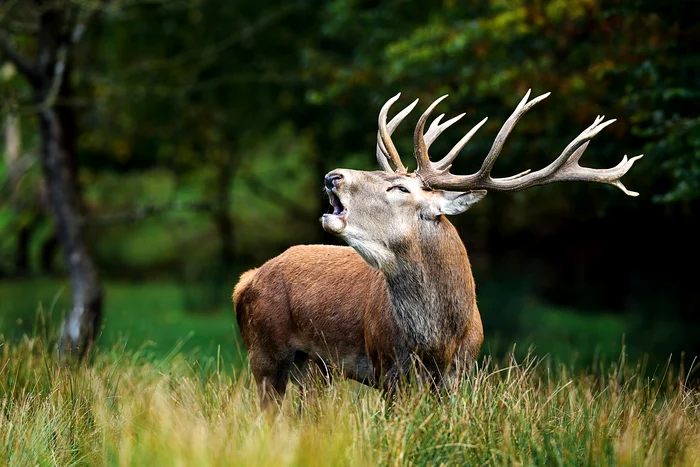
the stag was considered the personification of a deity. Photo: Freepik.com
Thousands of deer, wolves, bears and lynx roam the forests of the Carpathian Mountains, making Romania one of the European countries that excels in terms of wildlife.
The present lands of Romania, covered with dark forests
Two millennia ago, the Carpathian Mountains were a huge sanctuary for animals, which the ancients considered true divinities. Folk traditions and Romanian mythology give special roles to wolves, bears and deer, and archaeological discoveries show how our ancestors viewed them.
In Antiquity, more than two-thirds of the current territory of Romania was covered by forests almost untouched by humans. According to historians, until the Roman conquest at the beginning of the second century, the tribes that lived in the lands of Dacia did not industrially exploit the forests. But these did not only cover the Carpathian Mountains.
From the northwestern borders of Dacia to the valley of the Rhine, a legendary forest was considered in the ancient chronicles as an impassable natural border for the Romans.
“The Hercinian Forest begins in the land of the Helvetii, the Germans and the Rauraci and, running parallel to the Danube, reaches the borders of the Dacians and the Anarti”, iinforms the Roman general Julius Caesar (100 BC – 44 BC) in his work “De Bello Gallico”, one of the first known writings in which the “Dacians” are mentioned as a people.
A century later, the ancient scholar Pliny the Elder completed what was written by Julius Caesar, noting that the Hercynian Forest began at the borders of the Helvetii and the Rauraci, stretched along Germany for an innumerable number of days' march and did not stop except at great distances, remaining on the right of those heading north.
“The Hercynian forest, which is boundless and encompasses a chain of mountains, stretches so far that, although many peoples inhabit it, none can tell where it begins or where it ends. It is of a truly mythical age, untouched for centuries by the ax of man.” stated the Latin scholar in the first century AD. in the work “Naturalis Historia”.
Strange animals in the Hercynian Forest
Some of the animals that roamed the forest were quite unusual. Julius Caesar mentioned a deer-like animal, “with a single straight horn, very long, which opens at the tip into branches like open hands.” Another animal mentioned was the moose, which he depicted in a way that caused controversy.
“Their form and spotted skin resemble those of goats, but they are somewhat larger in stature, and have blunt horns. They have legs without knots or joints, and they do not lie down to sleep, and if a blow causes them to fall, they cannot rise or rise again. Trees serve them as bedding: they lean against them, and thus, stooping a little, take their rest.”Caesar wrote.
The ancients set traps for them, loosening the trees on which they leaned to sleep, because once they fell, they could not get up.
The bulls of the Hercynian Forest were of impressive size and resembled bulls, Caesar stated in “De Bello Gallico”.
“Very great is their strength and very great speed, and they spare neither man nor beast once they have seen them. The Germans hunt them with great zeal, by taking them into pits; by such work the young men are strengthened, and by this kind of hunting they train themselves, and those who have killed the most bring their horns to a public place as a testimony, and gain great fame. But, even if they are caught very young, these animals do not they can be tamed or used to humans. Their horns are very different from our oxen's horns. The locals gather them with great care, dress their edges in silver, and then use them as glasses at the most sumptuous feasts.”noted Julius Caesar.
Animals revered by the ancients
The ancient forests sheltered wolves, wild boars and large bears, deer, deer, but also many species of birds.
For the tribes that lived in Antiquity on the current territory of Romania, animals were sources of food, but also personifications of deities. Bears, wolves, and deer were frequently depicted in Dacian art, and archeological findings show the esteem the ancients placed on animals.
The gold spiral bracelets from Sarmizegetusa Regia were decorated with snake heads, the iron discs from the Dacian fortress Piatra Roșie had in the center representations of griffins, stags, oxen, waterfowl and felines, and the mold from Sarmizegetusa Regia was decorated with battle scenes between animals, real and fabulous, such as griffins and winged wolves, but also exotic, such as rhinoceroses and hippos.
Deer among the most hunted animals
Deer, present in large numbers in the Carpathian Mountains, were considered a substitute for the paternal god of the Carpathian inhabitants and a symbol of virility. They were depicted on some iron shields discovered in the Dacian fortress Piatra Roșie.
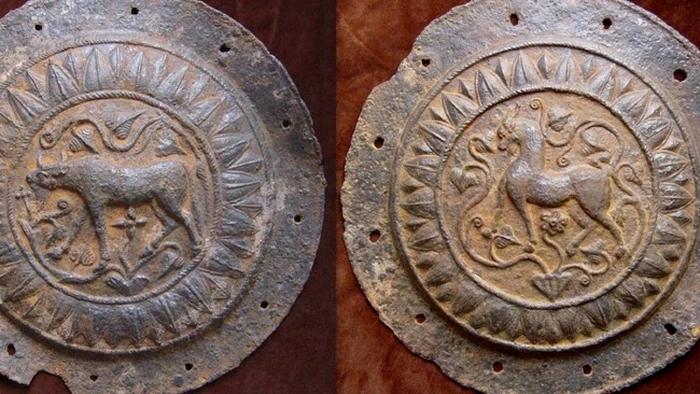
Stag depicted on a shield discovered at Red Stone. Source: Romanian Police
“The deer is associated both with the Neolithic civilization of wood (trees drop their branches to eat their buds; the Mum of the Forest travels in a carriage drawn by deer), clay and agrarian cultures (prehistoric people used the horns of the deer to make plowshares), and with the Indo-European civilization of animal breeders. The features that established him as a deity are the beauty and elegance of the body, the adornment of the head (horns), the strength (the only wild animal that can face and defeat the bear), the speed of movement”, showed the ethnologist Ion Ghinoiu in “Dictionary of Romanian Mythology” (2013).
From his bones and hooves, the ancients made objects of worship, work tools (needles, knives, plow shares, glasses), and the horns were revered by people as Christian icons. Deer were intensively hunted by the Dacians, the large number of bones discovered in archaeological sites show, and they did not allow themselves to be domesticated. Some ancient authors, such as Ovid, recounted the joy with which the Getae hunted deer, when blizzards and heavy snows made it almost impossible for them to move.
“The ritual sacrifice of the stag, narrated in the cert pre-Christian carols, can be interpreted as the initiation of the son before marriage or as a divine sacrifice made at the symbolic death and rebirth of the year or season”, added the scientist.
The boar, another animal depicted on the Dacian shields from Piatra Roșie, was widespread in the forests of Dacia (and Thrace) and also enjoyed religious attention among the Daco-Getae, the specialists pointed out.
“Bourul represents a local convention in the long line of mythological representations found south and north of the Danube”, informed archaeologists Gelu Florea and Liliana Suciu, authors of the study “Observations regarding the shield from Piatra Roșie” (1995).
The bear was feared and revered
Bears are present in many archaic traditions and superstitions of the Romanians. They were looked upon with fear and respect and seen as personifications of deities.
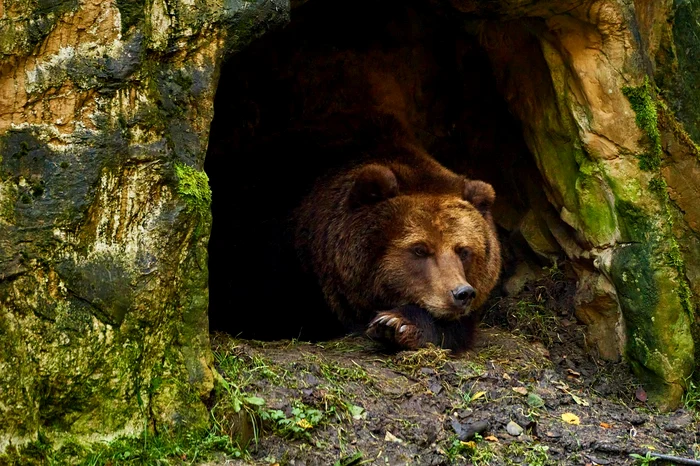
Bears were looked upon with fear by the ancients. Source: Pixabay.com
Some ancient historians say that the name of the Dacian deity Zamolxis was given this way because, according to legend, at birth he was wrapped in a bear fur, called by the Thracians zalmos.
Other scholars have inferred, based on the etymology of the word Zamolxis, that he was a bear-god or a geth god seated among sleeping bears. Mircea Eliade claimed, however, that the name of the Dacian god came from the Phrygian zalmos, which meant “wolf”, and the historian Nicolae Densușianu claimed that the name meant “old man god”.
“The features that established him among the gods are related to his behavior, the strange resemblance to man, the ability to move on two legs and the unexpected disappearance, during the winter, from the countryside”, looked Ion Ghinoiu.
The wolf-like Dacian warriors
Like bears, wolves frequently appear in Romanian celebrations, and some historians claimed that for the ancients these wild animals were personifications of divinities. The Dacian warriors would have practiced rituals aimed at their transformation into savages. The young people wore wolf skins and practiced a magical-religious ceremony through which they worshiped the sacred animal, said historian Mircea Eliade.
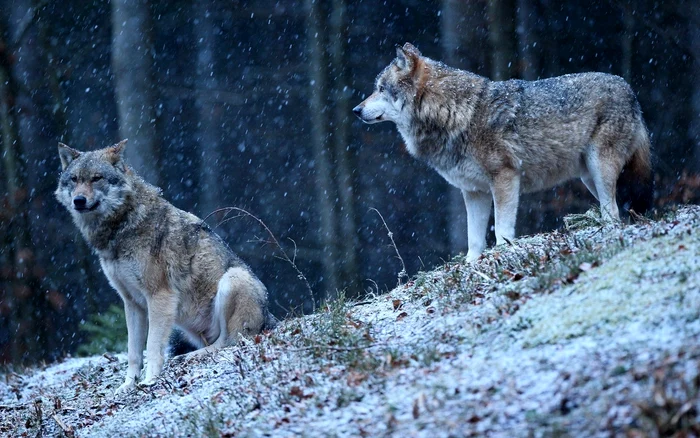
Wolves appear frequently in archaic traditions. Source: Freepik.com
“He had to transmute his humanity through a fit of aggressive and terrifying rage, which assimilated him to the rabid carnassiers. So two facts are worth remembering: to become a redoubtable warrior one magically assimilated the behavior of the beast, especially the wolf, and ritually put on the wolf's skin either to share the way of being of a carnassier, or to signify the transformation into a wolf”. reported Eliade in the work “From Zalmoxis to Ghenghis Han”.
The most active period of the wolf packs was associated with the Dacian New Year, between November 14 and December 7, an interval that included celebrations, customs, ritual acts and magical practices dedicated to the wolf.