Grzegorz Braun's Confederation of the Polish Crown – the third force in the Sejm? Polexit and the elimination of taxes in the program


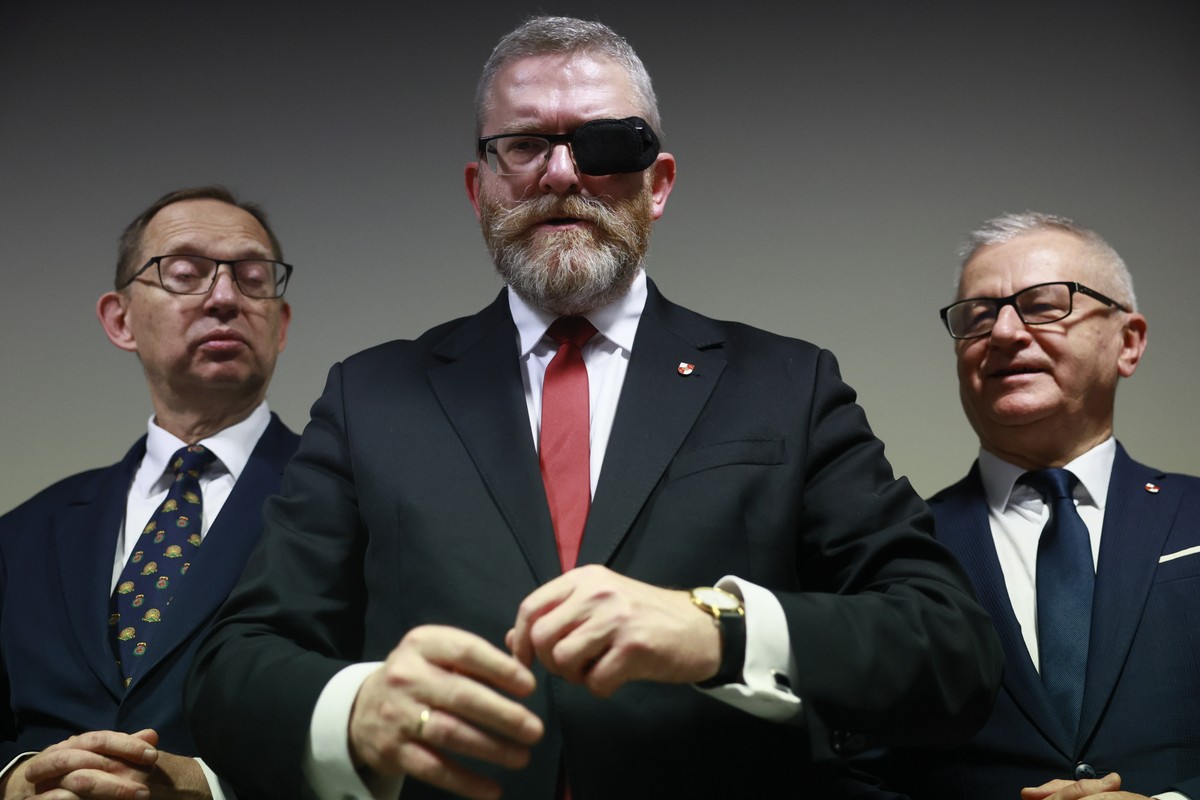
Grzegorz Braun's result in the first round of the presidential elections held in May 2025 was considered “shockingly high”. 6.34% of voters cast their votes for the president of the Confederation of the Crown of Poland group. Poles. That's 1.24 million people. This gave Braun fourth out of 13 candidates.
The rest of the article is below the video:
The results of recent polls are even more shocking. A new study conducted by the All-Poland Research Group shows that Grzegorz Braun's Confederation of the Polish Crown overtook the Confederation for the first time. Braun's party was chosen by 11.18 percent. respondents, which gives it third place – just behind the Civic Coalition and Law and Justice. The Confederation, which was off the podium, could count on support of 10.67 percent.
What would await Poland if Grzegorz Braun's group took the lead and took power in the future? Turning the utility table upside down. “Speaking of security, I am against the plundering of citizens by the state! Looting through taxes, imposing views by the Ministry of Education… We must stand up for freedom, for our independence. Let's get it back, because without it taxes will never be low, life will not be protected, and they will lead us to someone else's war. I want normalization, not escalation!” says Braun.
See also: This is the threshold of wealth in Poland. You don't have to make millions to exceed it [KWOTY]
First, Polexit
One of the main demands of Grzegorz Braun and his group is Polexit. “I will say goodbye to the Green Deal with the climate lie,” Braun promises. “No euro in Poland,” he adds. The growing support for the Confederation of the Polish Crown may be strongly related to this postulate.
The latest Eurobazooka survey shows that as many as 25 percent want Polexit. Poles. This is one of the highest results among the countries surveyed. “In addition to the French Eurobazooka, we also have the British YouGov survey, which also looked at support for the EU in various Community countries. However, the conclusion remains the same – one quarter of Poles support Poland's exit from the EU,” notes Piotr Trudkowski, president of the Jagiellonian Club in the years 2018-2023, civil society expert at the Jagiellonian Club Analysis Center, in a comment on the results. He notes that this is a surprising change, because not long ago we boasted a high level of Euroenthusiasm.
What could this be due to? The expert notes that this could have been caused by the CJEU judgment regarding the need for Poland to register same-sex couples, but also by the uncontrolled spending of funds from the National Reconstruction Plan, which entrepreneurs used to buy, among others, yachts. When the issue of improperly spent funds came to light, Dr. Paweł Musiałek, president of the Jagiellonian Club, wrote that it was a “gift for Grzegorz Braun”.
Read also: Contractors don't pay? There is a way, but watch out for traps
Without PIT and CIT
Braun has more bold demands. He wants to eliminate many taxes: PIT, CIT, pension tax, savings tax, i.e. the so-called Belka tax. He also wants to abolish PCC, i.e. tax on civil law transactions, which is paid when purchasing a second or subsequent apartment on the secondary market. People who purchase their first apartment on the secondary market are already exempt from PCC. The President of the Confederation of the Polish Crown also calls for the abolition of inheritance and donation tax and the reduction and ultimately abolition of VAT. The demands also included the abandonment of mandatory ZUS and health insurance contributions.
Braun writes about ZUS in the program that it is a “financial pyramid”. “I am a supporter of voluntary ZUS for everyone and the gradual replacement of the financial pyramid that is ZUS with a decreasing pension tax,” one can read in the election program.
He also adds that if he becomes president, he will “use the legislative initiative to eliminate punishing entrepreneurs with health insurance premiums for their activity.”
Additionally, Braun is against the forced payment of VAT on unpaid invoices by the contractor, and does not want the centralization of the economy and “manual control of entrepreneurship by politicians and officials.” He also calls for a return to coal.
“Extremely dangerous”
What would the introduction of all the demands mean for Poland? — The pragmatists of the world of politics and the world of business are very different. It is often difficult for business practitioners to comment on the demands made by politicians. Firstly, because it is not entirely certain whether a given demand is what the politician actually wants to achieve, or whether it is only a very strict stance before further negotiations – says Piotr Soroczyński, chief economist of the National Chamber of Commerce.
This may be the case, as he notes, even with the Polexit demand. — If it were to be implemented unconditionally as the main goal, fully and quickly, it would be an extremely dangerous scenario for our economy in many aspects. However, if this were an argument for future tougher negotiations of our interests in the EU, it could be considered interesting, although still highly risky, says Piotr Soroczyński.
It is also difficult to evaluate the ideas presented in summary terms without knowing the broader vision. In the case of the demand to return to coal, the question arises as to how well our mining industry would be able to supply potential customers with coal in the right quantity and at an attractive price in the long term. Let's remember that there are decades behind us in which there was no investment in mining as in many other countries – so we have completely different efficiency. So that it doesn't turn out later that investing in coal means making us dependent on imports of this raw material – says the president of KIG.
In the case of the proposals to abolish CIT and PIT taxes and reduce VAT, the expert claims that it is difficult to comment on the effects on the economy without knowing whether the losses in income are to be compensated by other levies or whether they are to be reflected in a significant reduction in state expenditure – and if so, which ones.
— It is worth emphasizing here that it is one thing for politicians who are not currently in power to put forward demands that are interesting for certain groups of voters, and another thing for the subsequent implementation of far-reaching systemic changes once they are in power. Usually, the transition from one economic reality to another, even a very interesting one, requires time and a lot of money to survive the transition period – notes Piotr Soroczyński.