The most contested cozonac recipe and the testimony of someone who put it into practice. “It's one of my great culinary challenges”


50 eggs for every kilogram of flour. This is the basic principle of a cozonac recipe, which caused many protests, but made history.
The writer and gastronome Păstorel Teodoreanu published in 1933, in “Adevărul literar si artistic”, a cozonac recipe inherited from his maternal grandmother, which scandalized the readers of the publication. According to Păstorel, no less than 150 eggs had to be used for 3-4 kilograms of flour, a proportion considered implausible by many.
“The shepherd at the cozonaci/ He proposed fifty eggs./ Hence the protests, the calls/ To be held accountable/ But didn't you see that it was an error?/ It was about… jumări”, ironically retorted a reader who signed “A housewife”. And the Shepherd didn't stoop any lower and answered her: “So, madam, I don't give up an egg/ No matter how alarmed you are/ And it seems like a new thing to you:/ My recipe is true.
“The result confirmed all my work”
Ciprian Muntele, radio producer and author of a culinary blog, is one of the brave ones who dared to try Păstorel's recipe. His verdict? “It's definitely one of my biggest culinary challenges that I've had in this life. And I'm one of those people who feed on such challenges,” Muntele told HotNews.
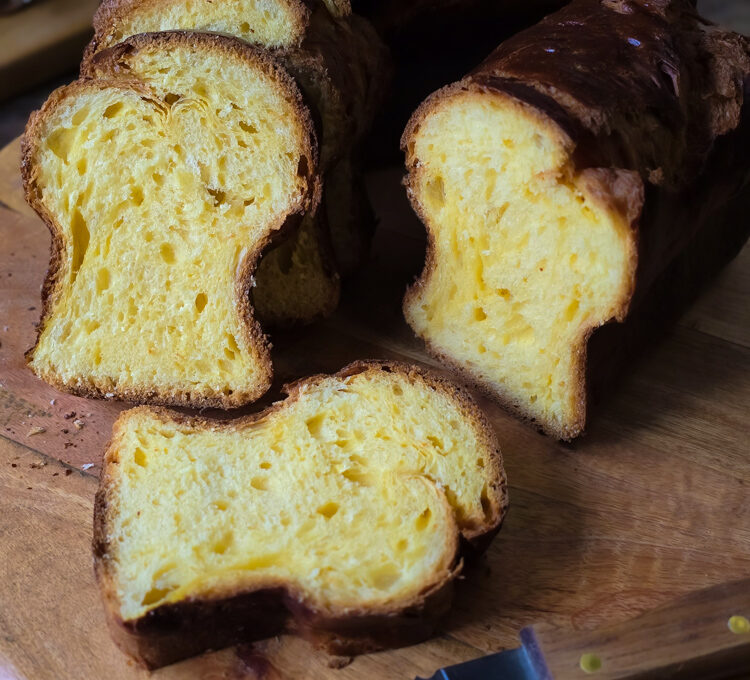
Cozonac made according to the recipe of Păstorel Teodoreanu. Photo: ciprianmuntele.ro
“But I did it because, beyond the preparation itself, I wanted to better understand the rigor and philosophy behind this cozonac. In a world where most people look for short cuts, where the winners are the simplified versions of homemade preparations, this cozonac comes to overturn some paradigms. And not only by the level of physical involvement in the preparation process. It's a recipe that still intrigues mainly by this ratio, only apparently disproportionate, between the liquid part, the melted butter and the flour. It's really more complex than the usual recipes. It's not an easy recipe, but that's why it's not for everyone. I like it described as somewhere between a croissant, panettone and a classic cozonac. And I mean strictly the simple version, without filling, which I made the first time. I'm still working on the version with filling, so we'll talk about it in a year or so,” said the radio personality.
We reproduce below the recipe in its entirety, as it was published in the edition of “Adevărului literar i artistica”, digitized by Arcanum, preserving the writing peculiarities of the era.
The recipe for muffins
MATERIAL:
150 eggs.
3-4 (maximum) kgr. extra flour (I recommend Herdan).
1 large glass (of water), with white rum.
1 vanilla stick.
1 liter of milk
Half a package of yeast (I recommend Bragadiru).
3-4 teaspoons grated with salt.
3-4 glasses of wine with warm melted butter.
1 cup fine butter (I recommend Black).
Cast sugar about 1,200 kgr.
EXPLANATION.
When you apply this recipe, you can't say: I'm going to make three or five kg of muffins, but: I'm going to use that many eggs. Eggs are not all the same and flour is not all equally dry. The drier it is, the more liquid it swallows (read: eggs and rum).
OBSERVATION:
12 (twelve) hours should be considered for the manufacture of the cozonacs. That's why it's good to have everything prepared the night before and get to work with the night in mind.
TECHNIQUE:
The eggs are spoiled the night before, putting the yolks aside. You put the egg whites where you want. because either you put too little (like a tablespoon), or not at all – it's pretty much the same thing.
You put salt in the yolks, chew, refrigerate and go to bed.
The next day.
In a very clean bowl, put two handfuls of flour (about 500 gr.), which you scald with boiling milk.
It is chewed with a special wooden shovel (or a spoon) and beaten vigorously until it becomes like a pomade, without any lumps.
When it has cooled, (so you can suffer the little finger), add the yeast, prepared as follows: crumbled in a deep plate and rubbed with 2-3 spoons of sugar, until it becomes like a coffee with milk. Chew the yeast well with po. the food, cover with a napkin and put it in a warm place (not hot) to rise.
While the custard is rising (that's what the above mixture is called), strain the yolks through a sieve into the trough (wooden bed, very clean, dry and warm), rinse the bowl they were in with 2-3 tablespoons of warm water and pour everything into the bed.
If you want, add a cup of foamy egg white, if not, don't. Beat the egg yolks well, add the rum and beat and beat, keep beating and be happy that it smells good, then add the finely chopped vanilla and continue beating until the cream has risen nicely. When the custard is ready, turn it over in the bed and chew until it becomes one with the yolks. Then, you start adding the flour, a little at a time, and keep chewing and beating with the shovel, until you can't take it anymore. Then, knead with closed fists, until you get a suitable soft dough.
When you think there is no more flour, weigh how much is left, so you know how much you have used, and add the sugar and butter according to the proportion: 300 gr. sugar per kg of flour and a glass of butter, plus one like that, on top. After the flour has entered, knead forward, putting the sugar, little by little, until you put it all. After you have finished the sugar, put the butter (a glass each) and the butter, always turning the dough to the same side (so that the slices come out).
The kneading takes two hours.
Put the chicken in a warm place, not hot, covered well, so that it does not get cold, and leave it for 2-3 hours, until it has grown nicely. Once here, put in the perfectly greased molds with melted butter (a third of the mold) and cover again, in a warm place, for about an hour. While they grow in the molds, prepare the oven (very important detail). When the oven is ready, brush the muffins with beaten egg and press them with chopped almonds or granulated sugar and God help, put them in the oven, where they stay for an hour, an hour and a quarter at the most. In the oven, you need a skilled person, to check that, with dollop (corn) flour, not to make the buns too thick, to cover them if necessary so that they don't turn pale, to make them “gritty”, etc.
When taken out of the oven, another meremet. You take out the cozona, shake it a little with your ear bent, to hear if it plays. He then lays down with all his form on his side, supported by a tree. After two or three minutes, shake him and roll him slowly, with the little one, on something soft and rock him gently and with great care, so that he doesn't get upset and hard!
About an hour after taking them out of the oven, you take them home and after 2-3, when they are well cooled, you transport them to the pantry. To keep them well and fresh for a long time, you wrap them (each one separately, of course) in waterproof paper and a thick napkin. The cake made according to this recipe must not dry out for three or even four weeks.
AL. O. TEODOREANU
P.S. I did not take the above recipe from books, nor did I invent it. I am sending it exactly as it was communicated to me from my parental home, where it has been applied for as long as I can remember. It's an old Russian recipe, known from my maternal grandmother, who in turn got it from the elders. It has been maintained until now, only through oral tradition and especially through practice.
AL. OT