Georgia is five minutes from dictatorship – said prof. in an interview with PAP. Sergi Kapanadze, director of the GRASS think tank. According to him, the Georgian Dream party ruling the country has already taken complete control over the executive, judiciary and legislative power, and the only resistance comes from civil society.
– There will soon be no opposition parties in Georgia because they will be banned, Kapanadze said, noting that it will be one of the few countries in Europe where there will be no opposition in parliament. – As a result, we will have a one-party state – he noted and added that there will be groups that are supposed to resemble oppositions, but in reality they will be completely dependent on the government.
He explained that In October, Georgian Dream submitted a request to the Constitutional Tribunal to ban the three main opposition parties. According to PAP's interlocutor, the Tribunal is completely subordinate to the authorities and will approve everything required of it.
The application for delegalization includes: Coalition for Change, United National Movement former president, currently in prison, Mikheil Saakashvili and Strong Georgia block. According to the applicants, all groups pose a “real threat to the constitutional order.”
– It is one thing to ban a party, but it is another thing to throw an oppositionist to prison. In recent years, numerous opposition leaders have been sent to prison, said the director of GRASS.
He added that as they serve their sentences, more charges are brought against them, which almost always turn into sentences. He noted that so far, no oppositionist has managed to win justice in court.
Kapanadze drew attention to the case of Nik Melia, who leads the Coalition for Change and has been in prison since May this year. He was sentenced to eight months in prison when he refused to appear at a parliamentary hearing on alleged crimes committed during the government of now-imprisoned former president Mikheil Saakashvili (2004-2012). Melia, 45, was found guilty of contempt of court in November. The case concerns an incident from May, when a politician threw water from a plastic bottle at a judge.
– Over the last year, the parliament has adopted 25 laws and each of them is anti-democratic – emphasized Kapanadze. He emphasized that none of them fit into the “European system of values”.
As emphasized by the authors of the report on Georgia “Not the same country”, which was prepared for and published by the Mieroszewski Center, the two most important regulations adopted are the Act on the Transparency of Foreign Influences (the so-called Russian Act) and the Act on the Registration of Foreign Agents (the so-called FARA – Foreign Agent Registration Act). The first of them resembles the law in force in Russia, which, in the case of Georgia, requires entities whose financing is 20 percent from abroad, registrations and annual submission of detailed financial reports to the National Public Registry Agency.
The authors of the report point out that FARA, adopted by Georgian parliamentarians in April this year, extends this regime to individuals and organizations. In the case of this legislation, what matters is the nature of the activity. If the authorities consider it to be pursuing the interests of a foreign principal and the entity is not registered, it may face criminal liability. In the case of the Russian law, an administrative penalty is provided for.
– Due to the introduction of these regulations, a significant number of organizations had to suspend their work. In addition, there are numerous lawsuits that are ongoing, and we know that they never end in favor of the defendants, Kapanadze concluded.
Kapanadze emphasized that Georgia committed to cooperation with civil society when it signed the Association Agreement with the European Union in 2013. This legal act is still in force, despite the suspension of talks with the EU on membership in this organization on November 28, 2024, by the government of Prime Minister Irakli Kobakhidze.
The PAP interlocutor emphasized that Georgia had for a very long time a thriving media characterized by pluralism and a critical dimension. – The legal framework created at the beginning of the 21st century provided a very liberal approach to freedom of expression and assembly – he noted. He explained that since 2016, Georgian Dream began to gradually destroy independent media.
The director of the GRASS think tank pointed out that changes in the Broadcasting Act, as well as the so-called Russian law, made the functioning of free media even more difficult. – For example, if a journalist calls the Georgian Dream government a regime, he or she may be accused of miscommunicating information – he explained. He added that one of the three independent television stations has been closed and two are in a very difficult financial situation.
He emphasized that the authorities very often use violence against journalists. He referred to journalist Mzia Amaglobela, a Sakharov Prize winner who was sentenced to two years in prison for slapping a policeman when he insulted her.
There are portals that had support from Western donors and were connected to think tanks, but due to the introduced laws, their activities are very difficult.
When asked about Russia's influence on the propaganda media, he replied that the narratives about the West and Ukraine are identical to those used by the Kremlin. – There is no doubt that propaganda with a “Russian signature” and Russian narratives are used – he said.
– You cannot build a dictatorship without violence – he said and emphasized that it is a key element of the policy of Georgian Dream, whose members order beatings of opposition members. One of the evidence of open state violence against society was – according to the BBC's findings – the services' use of camite gas (a chemical warfare agent used during World War I – PAP) to disperse anti-government demonstrations last year.
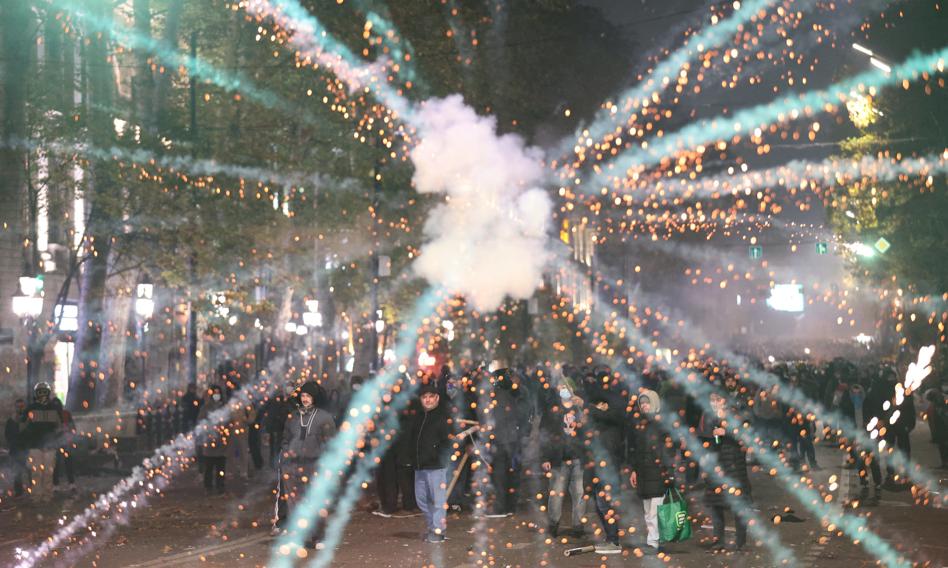
At the same time, despite the oppression, protests in Georgia have not stopped. On the occasion of the anniversary of Georgian Dream's suspension of talks with the EU on membership in this organization until 2028, thousands of protesters gathered on Rustaveli Avenue – the main artery of the capital Tbilisi. – Protests have been going on non-stop since November last year, when the parliamentary elections were held, Kapanadze said, noting that they are not always numerous.
Referring to the brutality of the services when suppressing the protests, Kapanadze said that the Georgian Dream thought at the very beginning of this mass mobilization that it would be able to suppress it, but it failed. – The Georgian Dream is unable to finalize its vision of dictatorship because the “islands of opposition” are still able to maintain resistance, Kapanadze said. He stressed that the perseverance of Georgian society is crucial.
– I don't think Georgian Dream wanted this dictatorship two years ago – he said. – They always wanted power, but for some time, when they ruled as a coalition, some of its members did not want to strive for dictatorship – he added. According to Kapanadze, the first signs of Georgian Dream's pursuit of absolute power appeared in 2016, when Georgian Dream obtained a constitutional majority. – When I was in parliament, I saw it with my own eyes when they started working on the new constitution. Their goal was to remove institutions that have independence, he said.
– I think that in 2022, when Russia invaded Ukraine and the door to the European Union opened, it put double pressure on the Georgian Dream – he said. Kapanadze explained that politicians currently in power say Russia is unstoppable, “that's why they're on the wrong side.”
Kapanadze recalled that during the term of office of the President of the European Commission, Jean-Claude Junker, the accession route to the EU was blocked. The change was to come later. – In 2022, the time has come for reforms and this has put pressure (on Georgian Dream – PAP). Then they realized that they could not do it without giving up power and the benefits that come from it, Kapandadze noted.
– I strongly disagree with those who say that we should wait for some kind of international move, no, this is a purely Georgian matter – emphasized Kapanadze. In his opinion, “European partners should continue to support Georgians, but this is not their fight.” – Activists often put a lot of emphasis on what the West should do, but in the end I don't think that's the most important thing – he added.
– I don't think we have any more time. Besides, regardless of how much time is left before (dictatorship – PAP) becomes a fait accompli (fact), due to Russia's invasion of Ukraine, the attention of European leaders is on something else, he said. Kapanadze noted that he understands this state of affairs because from the point of view of European security, the Russian invasion is a much more important issue than the Georgia issue. – Don't get me wrong, I'm Georgian and I want the best for my country, but I know how it is, he concluded.
Kapanadze admitted that it is interesting whether politicians in power are acting on Russia's orders, but at the same time he emphasized that it is not important. – These people have done everything Russia would want in recent years – he said. He added that despite this, in his opinion, the majority of Georgian society does not support the current government's policy and wants to take a Western path.
Antoni Wiśniewski-Mischal (PAP)
awm/sp/