The average population density in Poland is currently 120 people per square kilometer, but cities are significantly increasing this indicator. In rural areas, the average is only 53 people per square kilometer. Interestingly, there are villages where the population density is as high as that of smaller towns – from 400 to 550 people per square kilometer – we read in an analysis prepared especially for Business Insider.
The largest concentrations of rural population are located in southern Poland – from the Silesian Voivodeship, through the Lesser Poland Voivodeship, to the Podkarpackie Voivodeship. In turn, in the north-west and north-east of the country, the population density in villages often does not exceed 30-40 people per square kilometer. Such differences have a significant impact on the development of local real estate markets.
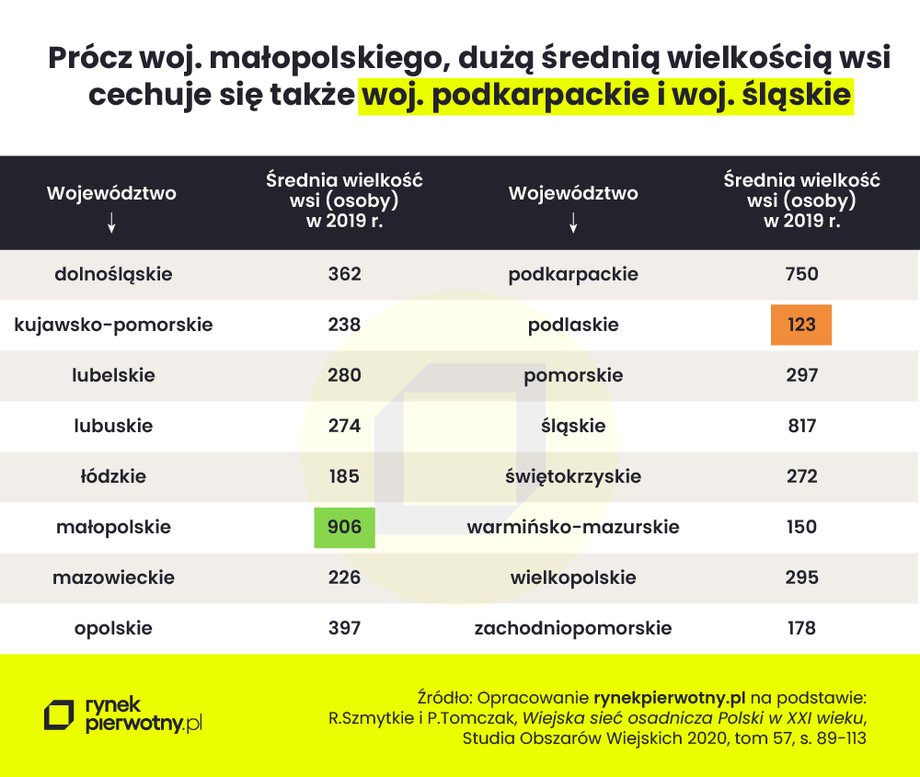
Differences in the size of Polish villages
|
Primary Market
Read also: Conflict over gas in the Polish energy mix. The government and PSE respond to Greenpeace's allegations
Size of the village – from Małopolska to Podlasie
The differences in the size of villages in Poland are surprising. For example, an average village in Małopolska has approximately 906 inhabitants, which makes it seven times larger than an average village in Podlasie, where an average of 123 people live. Similarly large villages are located in the Podkarpackie and Silesian voivodeships, which is confirmed by the higher population in the southern part of the country. Meanwhile, in voivodeships such as Warmian-Masurian, West Pomeranian and Łódź, the average number of rural inhabitants does not exceed 200 people.
The disappearance of the countryside – a process that has been going on for decades
Small and peripheral villages are the first to feel the effects of demographic changes. However, the disappearance of villages is not new – this process has been going on for decades. Scientists' analysis covering the years 1950-2011 indicates seven areas of concentration of disappearing villages, mainly in the areas of the former Russian partition. In these regions, such as Podlasie, Lublin region or Masovia, the disappearance of villages is particularly visible. In total, 2,307 disappearing villages were identified in Poland, which constitutes 78%. all such towns.
Impact on the real estate market
Vanishing villages are not only a demographic challenge, but also an economic one. The decreasing number of inhabitants means falling real estate prices and a significantly longer sales time. In such places, transactions are mainly limited for agricultural and forest land. We can also expect processes of land consolidation and liquidation of unnecessary roads and margins.
At the same time, rural depopulation brings other problems, such as difficulties with access to public services, health care or even basic shops. For local seniors, this may mean the need to change their place of residence.
What's next for the Polish countryside?
Experts emphasize that demographic changes will be a catalyst for processes that have already started in the Polish countryside. Although real estate trade in such places will not completely disappear, its nature will change. The future of the Polish countryside depends on how effectively the challenges related to depopulation and economic degradation of these areas can be addressed. In the face of these changes, it will be crucial to support the development of infrastructure and adapt regional policy to local needs.