
Narrator: To make Sari Patan Patol, all silk beams are meticulously dyed in a specific color.
Only when the threads are intertwined and the pattern will be visible, will craftsmen know if working with mathematical precision worked.
Most other sari are embroidered during weaving, but the complicated Sari Patan Sari Patola designs are dyed directly on silk.
Therefore, every craftsmen error is irreversible, resulting in the wasting of months of work.
After completing, which can take over a year, Sari Patan Patola can cost over $ 8,000.
So why does Sari Patan Patola take so long?
And what makes it so expensive?
In the Indian state of Gujarat, the company belonging to the Salvi family, Patol House, is one of the few producers of authentic Sari Patan Patol.
Due to the time -consuming process, Patol House produces only 15 sari Patola per month on average.
Even among expensive fabrics, Sari Patan Patola is unique.
Most textiles are intricately embroidered on Krosno, but the so -called double -sized pattern is used at Sari Patan.
Thread (horizontal threads) and warp (vertical threads) are separately colored.
Only when the thread and warp are intertwined together will the final pattern can be seen.
The monthly process begins with the purchase of high -quality raw silk at a price of up to $ 110. per kilo.
You need less than a kilo of silk to make a single sari.
These threads are as thin as the hair, so craftsmen must join them to get a stronger thread that they can use for weaving.
They clean silk and whiten it to make it light white and absorb the dye best.
In the meantime, designers, such as Mehul Salvi, create detailed sketches on millimeter on which dye and weavers are modeled.
Measurements can be as small as 0.25 mm.
Completing the pattern takes Mehul for up to 10 days.
Mehul Salvi, co -owner, Patola House: A single error may initiate an avalanche of errors.
The thread and warp may not fit together.
It's a loss for us.
Narrator: The sketch is transmitted to craftsmen such as Limbachiya Priya Ashwin Kumar, which translate the specifications into the warp and thread threads.
Priya does this by marking various sections on silk with a single string immersed in coal.
She says that this is the most difficult part of her work.
Limbachiya Priya Ashwin Kumar, craftsman, Patola House: If the measurement is bad, even if I do everything well, the whole work will be wasted.
Narrator: After finishing, Priya prepares threads for resistance dyeing.
The cotton string is wrapped in a tight one around some parts of the silk thread according to the markings.
Priya covers parts that should not be dyed, leaving only those that will be dyed.
Many layers of tightly wound cotton thread guarantee that the liquid does not get through.
Priya: When I grab this beam, it should not rotate.
It should remain simple.
When I do this, this sound should appear.
If it is not there, it means that the knot is too loose.
Narrator: Dyeing thread is the most time -consuming part of the process, lasting from several months to over a year.
It depends on the complexity of the project.
The background color, usually red, is dyed first.
The thread must dry completely before adding another color.
Patola House claims that their sari usually have at least five colors.
More complex designs can have even more of them.
Ujjaval Salvi, co -owner, Patola House: During the dyeing process, the beams are sometimes close to each other, and it depends on the design.
One beam contains almost 300 threads.
Each thread must be evenly colored.
It's a challenge.
Narrator: The colored parts are wrapped, and the parts that must be colored in the next way are stretched.
The cycle repeats.
Ujjaval: You need to check everything many times, using millimeter paper to make sure that only selected fragments are not wrapped.
We can't do anything if the wrong fragment is colored.
Colors cannot be removed from silk.
Narrator: After dying all colors, the intermitting of the nodes and preparing silk for weaving can take up five people for two days.
The looms used to make Sari Patan Patola are unique.
Most of the looms stand vertically and can be served by one person using a foot pedal, but to make Sari Patan Patol you need oblique hanging loom and two employees to operate it.
Hanging looms pass more light, thanks to which weavers can carefully observe the project.
To bury only 15 cm, they must work for 2.5 hours.
If the thread stress is too strong, they will move up, and if it is too loose, they will move down.
This threatens the exact implementation of the project.
Therefore, every 15 cm, weavers interrupt their work to adjust the thread stress with needles with a ball, which takes another 2.5 hours.
Before continuing their work, they spend the same time, making sure that the warp and thread fit together perfectly.
Making only 15 cm takes a total of eight hours.
Sari Patan Patol is usually 5.5 m long and just over a meter wide.
During the process, threads can break.
Mehul: So we take another thread and connect it to the broken ones.
After weaving and completing the pattern, we remove this additional thread.
However, if too many threads are broken, Sari will be rejected.
Narrator: The weaving process lasts about a month.
The pattern, which has repetitive fragments, is easier to make and can be completed in just four months.
Such projects usually cost just over $ 1,500.
Making more complex projects without repeated fragments can take a year and a half and can cost over $ 8,500.
Mehul claims, however, that production costs have increased over the years.
Mehul: The wages of employees doubled, so everything became more expensive.
Narrator: Before the pandemic of Coronavirus, Patol House bought silk for $ 73. per kilo, but now he pays $ 110.
The dyes he uses are also not cheap.
Some cost $ 24 per kilo and other over $ 120
Imported dyes such as indigo can cost a company over $ 300. per kilo.
Patola House produces Sari Patan Patol in the same way that was done centuries ago – manually, without mechanization.
Although there is conflicting information about the history of this fabric, it is believed that it has gained importance in India between the 11th and 13th century.
Built in the 11th century in Patana, the Step Stair well in Rani Ki Vav presents traditional Patol Patol designs.
These Sari were a symbol of status and were worn by aristocrats and members of the royal family.
Even today, the high price means that only those who can afford it wear it.
Patola House observed that the demand for company sari is still growing because the fabric is gaining more and more fame.
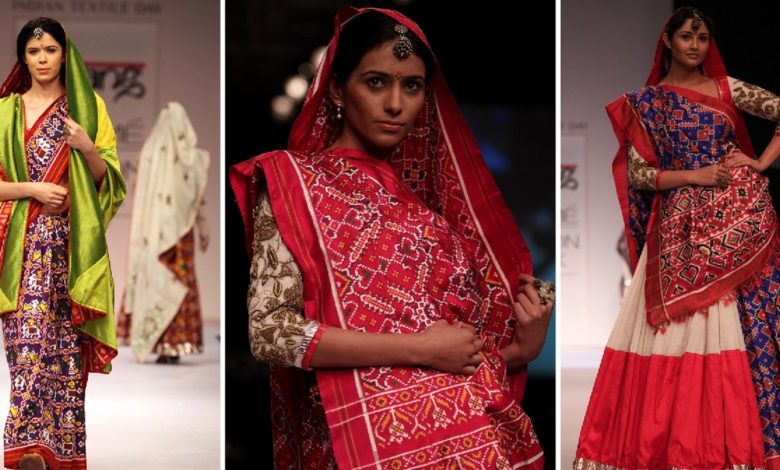
This craft was almost extinct, but now Sari Patan Patola has been presented on the Lakmé Fashion Week.
To satisfy the demand, Patol House employs over 250 people.
Ujjaval: We will produce them as long as the demand is.
There will always be people who pay this high price.
They know that it is an organic, clean and authentic product, so they pay it.
Crowd: Piotr Nazek