More than 70% of budget workers complain about low salaries. What income do they have and what do they want from the system


Very few budget workers have salaries lower than 3,000 lei net, most of them having incomes that far exceed the minimum wage in the economy, according to a specialized study.
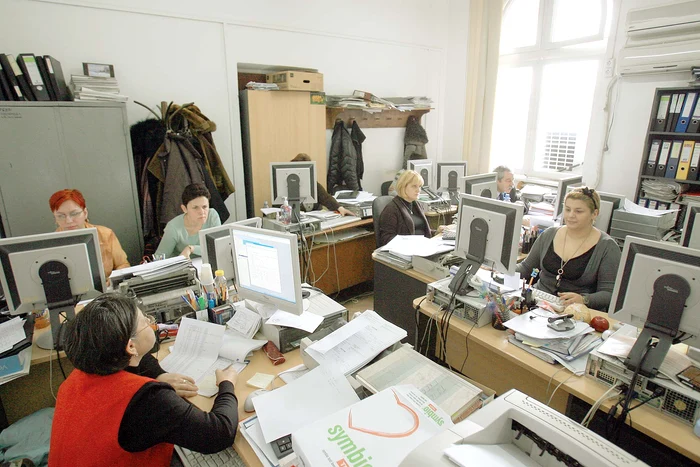
Most budget workers say they deserve a higher salary
Monthly income in the public administration
The distribution of monthly incomes shows a moderate polarization, with the highest concentration in the range of 5,000–7,000 lei net.
• Under 3,000 lei – 1.4%
• 3,001–5,000 lei – 26.7%
• 5,001–7,000 lei – 36%
• 7,001–9,000 lei – 23%
• 9,001–10,000 lei – 5%
• 10,001–12,000 lei – 4.7%
• 12,001–14,000 lei – 1.7%
• 14,001–16,000 lei – 0.7%
• Over 16,001 lei – 0.9%
How long have they been working for the state and what education do they have
More than 33% have been working for more than 15 years in the same institution, 8.2% for 11-15 years, 17.6% for 7-10 years, 18.4% for 1-3 years, 15% for 4-6 years, 7.5% for less than a year
“Public administration in Romania remains a stable environment, with a consistent core of long-serving employees. More than a third of the respondents have been working for more than 15 years in the same institution, which shows loyalty and accumulated experience, but also an increased need for modernization and motivation for the new generations entering the system”said Bogdan-Costin Fârșirotu, president of the APSAP Training Center.
The respondents stand out for their high level of academic training: almost half of the state employees, 49% to be exact, have graduated from a master's program, which confirms the trend of professionalization of human resources in the public sector.
At the same time, 41% hold a bachelor's degree, while 6.7% have only completed secondary education, and 3.7% have pursued doctoral studies, which indicates a significant proportion of specialists with advanced training in public institutions.
They work in several types of public institutions, as follows:
- 32.1% – Authority of the central public administration (Government, ministries, other specialized central bodies subordinate to the Government or ministries)
- 32.4% – Local public administration authority (local councils, mayors and county councils)
- 18.8% – State company/ autonomous public institution
They want higher wages
More than 70% of employees in the public sector believe that their current income does not fully reflect the volume and complexity of the work performed, and say they want a higher salary – either “slightly higher” or “significantly higher”.
A recent survey shows that over 50% of respondents say their current salary “should be slightly higher” and 20% think it should be “significantly higher”. However, 29% consider it correct in relation to the work done.
At the same time, the survey shows that 85% of the respondents hold executive positions and 15% management positions.
The government has not yet decided whether it will freeze wages in 2026
The minimum wage per economy in Romania for 2026 has not yet been officially established, but the unions have proposed an increase to 4,350 lei gross, from the current 4,050 lei.
On the other hand, the employers (IMM Romania and Patronatul Tinerilor Intreprinzători din România – PTIR) officially announced that they do not agree with the increase of the minimum wage in the economy from January 1, 2026, arguing that many entrepreneurs, over two thirds, cannot face a new wage increase, otherwise they will have to close their businesses.
What risks is he taking if he doesn't raise the minimum wage
One of the biggest risks that Romania would take if it freezes the minimum wage next year is the initiation of an infringement procedure.
Infringement is an important mechanism for correcting the position taken by a member state in the event of its non-compliance with European legislation, as is the case of non-transposition of a directive within the prescribed period, lack of harmonization or incorrect application. Infringement may ultimately mean financial repercussions for the state in question, but only after several stages of this procedure have been completed.
From the information published in the central press, it appears that the assumption of this risk of financial repercussions is taken into account, which, in balance with the assumed cost of increasing the minimum wage the following year, would mean a smaller pecuniary effort and which the state would not honor anyway in 2026 (such a procedure would take more than a year).
In other words, the state assumes the “fine”, because it is lower than what it would have to pay if it kept its commitment.
On the other hand, if it increases the minimum wage for the economy from 2026, even if it freezes the salaries of dignitaries and mayors and vice-mayors at the current level, honoring the austerity measures assumed through package 2, the Government risks increasing the budget deficit again, violating the obligations assumed before the European Commission.