Valve is introducing a rival for PlayStation and Xbox. It's a “PC” console for the living room and playing on the couch


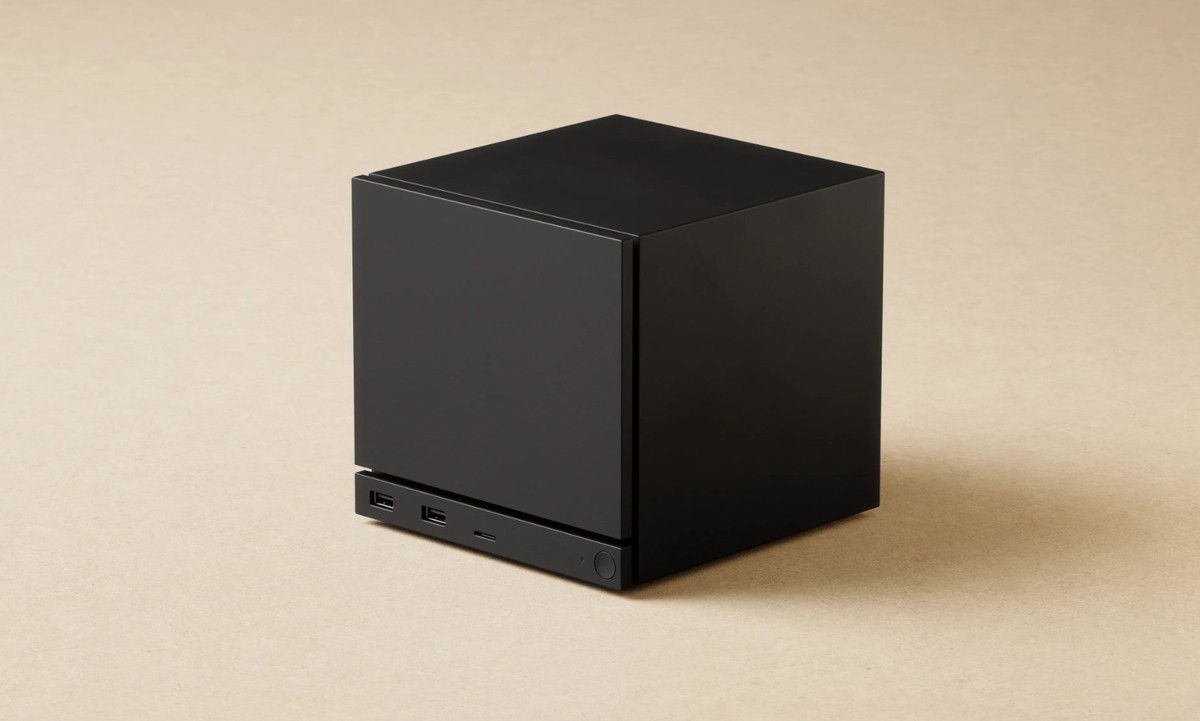
Valve's “PC” living room console announces a compact, cubic device with over six times the performance of a portable console Steam Deck. Steam Machine will run on SteamOS, a Linux distribution developed alongside Steam Deck. It will comfortably support games in 4K resolution at 60 frames per second, which will be supported by FSR upscaling technology and ray tracing support. FSR boosts image resolution to make games run smoother, and ray tracing realistically simulates light, reflections and shadows to make graphics look more like real life.
Inside you will also find a 6-core AMD Zen 4 processor with 12 threads and a RDNA 3 graphics system adapted to Valve's needs with 28 computing units, 16 GB of RAM and 8 GB of VRAM. There are two capacitive versions: 512 GB and 2 TB on a fast SSD drive. These parameters place Steam Machine somewhere between the base PS5 and Xbox Series X and PlayStation 5 Pro.
The console will be available alone or in a set with the new Steam gamepad. The controller has magnetic knobs (to minimize the problem of drift) and two large trackpads that allow you to simulate the precision of a mouse in games that are traditionally associated with a keyboard, e.g. strategy games or shooters. At the same time, Valve announced the Steam Frame virtual reality gogglesalso based on SteamOS, designed as the next step after Valve Index and a direct rival to PS VR2 or Meta Quest.
Check also: PlayStation 5 Pro will provide what the basic version could not cope with. This could be a hit
Valve focuses on a family of devices
It all adds up to a much broader picture than any single piece of equipment. Valve is building an entire family of devices – Steam Deck, Steam Machine, Steam Frame and a new controller – connected by one system and one store platform.
The next part below the video:
It is worth remembering that the name Steam Machine has already appeared in the industry once. In 2015, Valve tried to enter living rooms by working with third-party mini PC manufacturers. However, the hardware was expensive, the offer was fragmented, the system was immature, and the library of Linux games was modest. After a few years and sales estimated at less than half a million units, the project virtually disappeared from Steam.
That the fiasco led Valve to make two strategic decisions. Firstly, the company decided to make devices “in-house” instead of giving everything to OEM partners. And secondly, it began investing aggressively in Proton, a compatibility layer that allows Windows games to run on Linux.
The result of this change in thinking was Steam Deck, a portable game console that has dominated the segment of this type of devices since 2022. Valve sold approximately 3.7–4 million units and surpassed the total sales of most competing Windows devices.
At the same time, SteamOS has matured. There are already over 19,000-20,000 devices running on Deck and other Linux devices. games marked as “Verified” or “Playable”, and in May 2025, among the thousand most popular titles on Steam, over 70 percent had the status of a game running on SteamOS. Valve also introduced the “Powered by SteamOS” program for hardware partners and a new SteamOS compatibility marking system, which immediately covered over 18,000 games. titles.
New Steam Machine it is therefore created in completely different conditions than its predecessors. It's a mature system, a huge library of games and a company that has already proven that it can deliver successful hardware.
See also: Customs are not a problem. Nintendo was smart about the launch of the Switch 2 console
Steam Machine. Why is this important news for the market
Today, Steam has over 130 million monthly active users and approximately 70 million daily active users. PlayStation and Xbox have to build player bases for new generations of their consoles for years, while Valve may simply offer a new way to play what we already have.
The next part below the video:
Anyone who has been purchasing games on Steam for years will get access to their library on Steam Machine at no additional cost. This is a strong contrast to the situation in which some games from previous console generations have to be purchased again or wait for “remastered” versions.
The Valve console is actually a PC enclosed in an appropriate housing. On the one hand, it works like a typical console: you turn it on, log in, see the SteamOS interface adapted to the TV, games update automatically, and the user does not have to think about drivers and configuration. On the other hand, you can still switch to desktop mode and install Windows – something PlayStation and Xbox will never agree to because they live off their own closed ecosystems.
Valve's novelty is also another blow to Windows' dominance as a gaming system. SteamOS is already taking over the portable console segment, because Windows 11 on such devices can be sluggish and poorly adapted.
If Steam Machine appeals to gamers, Valve will have an attractive alternative to both Microsoft's console and Windows itself – and this may hurt Xbox twice in the long run.
Read also: Xbox goes beyond the living room. Microsoft introduced portable versions of the console
Steam Machine will be a formidable rival to PlayStation and Xbox
If you look only at raw numbers, Steam Machine starts in a strong position. Its GPU in the RDNA 3 architecture with 28 CU is more modern than the RDNA 2 in Xbox Series X and the base PS5, and The declared range of 4K/60 fps with FSR puts it in a similar segment to the current generation of premium consoles.
Of course, computing power is only part of the puzzle. Sony still has the advantage of very strong exclusive brands, from God of War to Spider-Man, while Microsoft responds with Game Pass and a rich library of on-demand games.
Valve doesn't have a comparable subscription program or such an aggressive strategy for exclusive titles today. But it has something else – the attachment of PC players to Steam, a gigantic library and a culture of promotion. For a user who has several hundred titles in their Steam library, purchasing a Steam Machine may be a natural way to bring the entire hobby to the living room, without abandoning the PC.
Valve's console doesn't start with a few dozen starter games, but with a catalog built over two decades – from old classics to the latest AAA hits.
For years, the console market was divided between Sony, Nintendo and Microsoft, and attempts by new players to enter ended in failure. This time, a company enters the arena that does not have to start from scratch and that has a brand among PC gamers associated with gaming.
On the other hand – big question marks
So as not to be too rosy, Steam Machine also has a lot of potential weaknesses. The biggest one is the price, which Valve has not yet announced, but analysts and media are speculating around $800, which is clearly more expensive than the base PS5, PS5 Pro or Nintendo Switch 2. In such a scenario, Steam Machine will target the premium rather than the mass segment.
The second issue is that compatibility is still far from perfect. Proton has solved a huge part of the problems of playing on Linux, but there are still titles with anti-piracy protection or anti-cheat (to prevent players from cheating in the game) that do not work or work worse on SteamOS.
For now, it certainly doesn't seem that Steam Machine will displace Sony and Microsoft consoles from the market – especially in the mass and family segment. PS5 Pro with its suite of exclusive games and Nintendo Switch 2 with its hybrid design will still be natural choices for a huge part of the market. But At the intersection of the PC and console worlds, things get really interesting. For many gamers who today have both a powerful PC and a console, Steam Machine may be a way to simplify their lives. It will be one game library, one list of friends with whom you can play, one store and at the same time a “couch” experience straight from consoles.
If Valve gets the price right, improves communication (which was missing in the first Steam Machines) and consistently develops SteamOS, PlayStation and Xbox will have a dangerous competitor.
Author: Grzegorz Kubera, journalist of Business Insider Polska