
A powerful blow to Putin's army. Ukraine returned the blow from two years ago. “Big, uncontrolled hole”


The first Ukrainian strikes on the dam of the Belgorod reservoir began at the end of October. Initially, the damage was minor, but after the impact on October 25, significant amounts of water began to flow from the reservoir.
The water flowed down the Siewierski Donets River. It flooded the area and raised the level of nearby water bodies.
— A large, uncontrolled hole appeared because the Ukrainian Armed Forces apparently destroyed the lock, says Yevgeny Simonov, an expert of the working group on the study of the ecological effects of the war in Ukraine (UWEC), commenting on the results of the Ukrainian attack. The painful consequences are felt not only by Putin's army, but also by the entire region.
As a result of the Ukrainian attacks, the thermal power plant in Belgorod, which supplies heat to the city and the surrounding area and is cooled by water from the Seversky Donets River, was also at risk. To stop the outflow of water near the thermal power plant, the authorities quickly built a new, small dam.
In the town of Shebekino, located downstream from the reservoir and close to the Ukrainian border, the water level in the Nezhegol River rose noticeably – it flooded deckchairs placed in the riverside recreation area, and residents began to discuss the situation.
Governor Gladkov proposed an evacuation, but most of the inhabitants of Shebekino did not react to this proposal. Some have stated that the rise in water levels may not be related to water entering the dam at all, but may be due to heavy rains that hit the area around the same time.
No one in Russia prepared for possible flooding – and no one knows how to prepare for it.
— Now the river is normal, Anton, a resident of Shebekin, told the “Nowa Europa” website and added sadly: “it will probably be a difficult winter.”
How Toplinka was flooded
The construction of the water reservoir in Belgorod began in 1977. It was built “for the future”, taking into account planned enterprises. However, due to the collapse of the USSR, the enterprises were never established and the water body became a recreational zone. “Belgorod Sea” – that's what the locals called this area.
You can read in local newspapers that in the vicinity of the future reservoir there was the village of Toplinka and several other small villages, of which only the foundations remained, still visible at the bottom of the reservoir. There is even a story about how a new school was built in Toplinka from the stones of a church destroyed by the Bolsheviks, and then demolished.
When construction of the dam began, the inhabitants of these villages were displaced. Houses were demolished or burned.
In 1985, when the construction of the dam was completed, most of Toplinka was still above the expected level of the future water reservoir, and there was even one resident left in this part of the village – Valentina Petrovna Kovalova. She refused to leave because she thought the water would not reach her house. And so it happened. The last time the media wrote about her was shortly before the start of the current military campaign, when she was still living peacefully in this village.
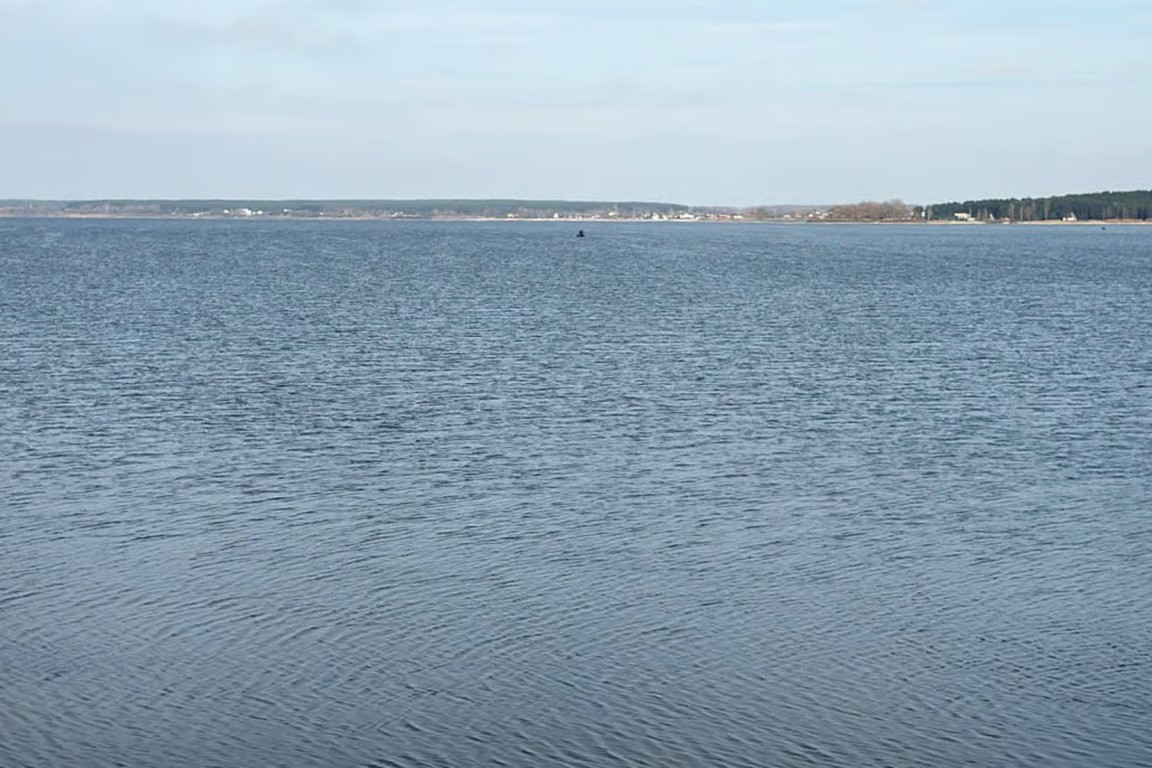
Belgorod reservoirPress service of the governor of the Belgorod region / Novaya Gazeta
In 2018, the reservoir level was artificially lowered in order to carry out a major renovation. At the same time, local media wrote that if the renovation were delayed, the dam would be destroyed, which would result in flooding of adjacent areas and possible fatalities.
After draining the water, activists found artifacts from another war, World War II, at the bottom of the reservoir – in August 1943, the Battle of Kursk also reached these places. The water was hiding old, rusty bullets. And now, after the latest series of Ukrainian attacks, new missile fragments appear in these places.
“There remains a risk that the breach will be blurred and the dam will fail.”
— [Ukraińscy żołnierze] They aimed, judging from media reports, at two locks [chociaż zniszczyli najprawdopodobniej jedną]. Well, actually, the Ukrainian army has already practiced this in the case of other hydrotechnical facilities – for example, you can recall the impact of the HIMARS missile on the locks in Novaya Kakhovka in November 2022, long before the dam was destroyed – comments Evgeny Simonov, an expert of the working group on the study of the ecological effects of the war in Ukraine (UWEC), on the results of the latest attack by the Ukrainian Armed Forces.
In the case of the Belgorod dam, as a result of the damage, a lot of water flows out of the reservoir. However, Simonov believes that the volume of this flow is limited by the width of the damage – for this reason, a flood similar to that which occurred, for example, in Kachovka should not be expected.
There remains a risk that the breach will be widened and the dam will failbut even in this case, according to the expert, there will not be equally serious consequences. The volume of the water reservoir in Belgorod is not so large compared to the reservoir in Kakhovka, especially since some of the water has already spilled out. For comparison, the nominal capacity of the Belgorod reservoir is 0.076 cubic kilometers. — while the water reservoir in Kachovka had a capacity of 18.18 cubic kilometers.
Simonov, however, believes that problems related to blowing up the dam in Belgorod may arise among the inhabitants of the Kharkiv Oblast. In the lower reaches of the Seversky Donets River there is the Ukrainian Volchansk, which is also likely to be flooded.
On October 27, the Governor of the Belgorod Oblast, Vyacheslav Gladkov, stated that due to the drainage of the Belgorod reservoir, the city would not be deprived of water, because it primarily uses water not from the river, but from wells. Expert Simonov thinks similarly.
— Belgorod is located on artesian springs. This means that the city is supplied with water from underground. Perhaps the reservoir is intended as a backup source of water for Belgorod, he says.
However, the self-proclaimed Donetsk People's Republic (“DNR”), located further downstream and which has been struggling with serious water supply problems in recent months, draws its water from the same river (Seversky Donets). Some experts even talk about a possible humanitarian catastrophe caused by the pollution and drainage of the Seversky Donets. However, according to Simonov, the destruction of the Belgorod dam will not in any way affect Donetsk's water supply.
At the same time, the specialist warns of other serious and likely consequences – water may now seep into the flood plain, where, for example, ordinary floods occur. Houses close to the shore may be flooded. Ecological consequences are also possible.
“What happened will have a negative impact on fish that hibernated in winter holes: now they will be washed out and will have to go somewhere again,” explains Simonov.
When asked about the expected speed of the dam's reconstruction, the expert answers briefly: “the dam is a very expensive structure.”
Its reconstruction depends primarily on the availability of financial resources, which the Belgorod region already has problems with. According to Simonov, the regional authorities should now seriously consider whether it is worth rebuilding the reservoir at all, since it serves primarily as a place for recreation, but does not fulfill the task declared during construction, i.e. supplying enterprises with water.


