Parish cemeteries have their own rules. How not to lose your grave and when do you have to pay?

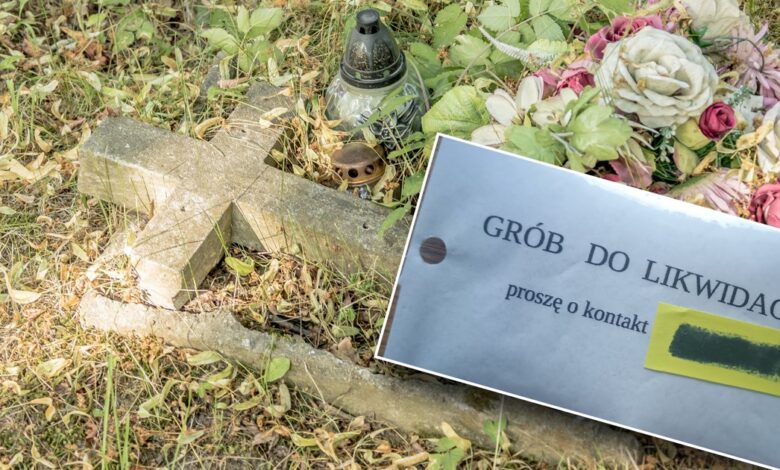
When we visit graves on November 1 and 2, we sometimes find a note: “grave to be liquidated, please contact us.” What to do then? First of all, it is worth knowing the rules for paying cemetery fees. They are defined in the Act on Cemeteries and Burial of the Dead of 1959. According to it, the amount paid at burial is valid for 20 years. During this time, you do not have to incur any additional costs related to reserving a place at the cemetery. After 20 years of using the site, both in municipal and church cemeteries, a fee must be paid to extend the inviolability of the grave. However, according to the act, not such a fee is paid for every grave. Here's everything you need to know to be able to have a substantive discussion with the cemetery manager.
Read also in BUSINESS INSIDER
What does the Cemeteries Act say about grave fees?
Pursuant to Art. 7 of the Act, After 20 years, the grave cannot be used again if any person raises an objection and pays the fee for burying the body. This reservation has effect for a further 20 years and may be renewed. This provision, however, does not apply to brick graves intended to accommodate more than one person, or to contain urns (Article 7(3) of the Act).
In a word, the extension fee applies to earth graves. Pursuant to the regulation of the Minister of Infrastructure of March 7, 2028 on the requirements that must be met by cemeteries, graves and other places for burial of bodies and remains, an earth grave is a pit into which a coffin with a body or an urn is placed and covered with earth. The survey conducted as part of the “Digitization of memorial sites” project shows that there are in Poland 3.3 million earthen graves and 2.2 million brick graves. Information about the type of grave, the people buried in it, and the fees paid should be included in the cemetery books, which each administrator must keep.
If the fee is not paid 20 years after the last burial in an earthen grave, the grave may fall to someone else. This results directly from Art. 7 section 1 of the Act. It states that an earthen grave cannot be used for re-burial before the expiry of 20 years. This means that after 20 years without paying an extension fee, the place may be made available to another person.
For example, if a family member or other close relative of the person taking care of a given earth grave was last buried before 2005, if the fee is not paid, the cemetery management may make the place available to someone else. In such a situation, it is common to talk about liquidating the grave, but the idea is to allocate it to other people. It is a good custom to place information (a plaque) on such a grave with the details of people buried there 20 years ago.
It is also worth remembering that the Supreme Court indicated that the right to an earth grave does not expire automatically after 20 years. After this date, the holder of the right to the grave may effectively raise an objection to the extension and pay the fee. The right to an earth grave, in the absence of any reservations, expires after the expiry of the 20-year period only when the cemetery management used it for another burial, i.e. gave the place to someone else,
Dispute over fees for a brick grave after 20 years
The provisions of the Act state that if the guardian of a single-person brick grave wants to maintain exclusivity, he or she should pay an extension fee 20 years after the burial. A brick grave is one in which the sides are bricked to the ground level. However, the Act states that the extension fee does not cover multi-person brick graves.
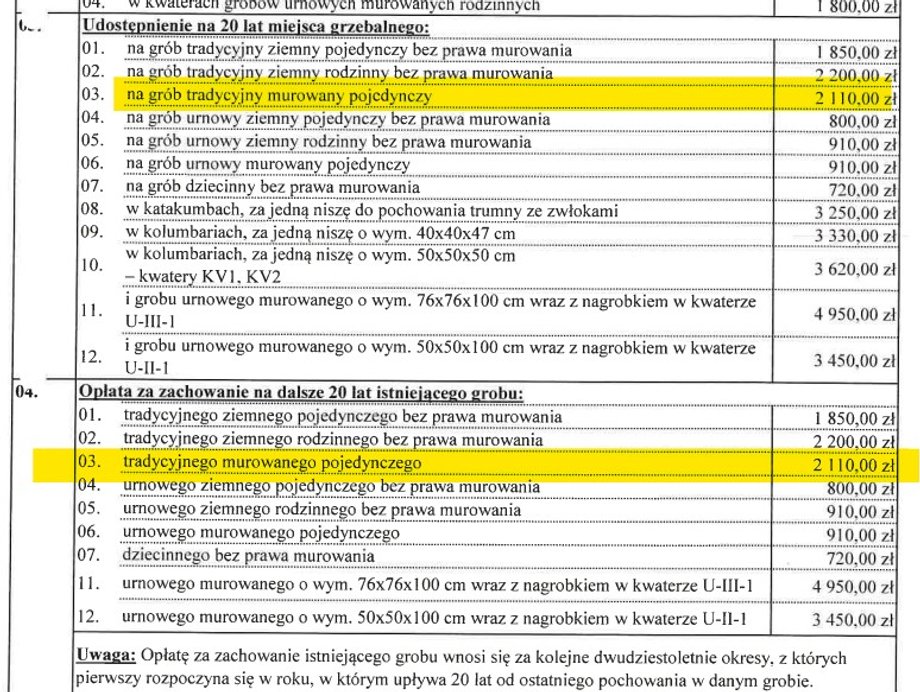
Fragment of the ordinance regarding the price list for the Northern Cemetery in Warsaw
|
cemeterekomunalne.com.pl
Local government practicewhich municipal cemeteries are often subject to sometimes it's different. Maintaining a cemetery costs money in the case of brick graves, managers often charge fees for the use of the land under the graveas shown by a fragment of the price list of the Municipal Cemetery in Podgórki Tynieckie in Krakow. Recently, citizens, but also the prosecutor's office, are increasingly questioning price lists established on the basis of councilors' resolutions, and the case goes to court. This is the case with municipal cemeteries owned by the local government.
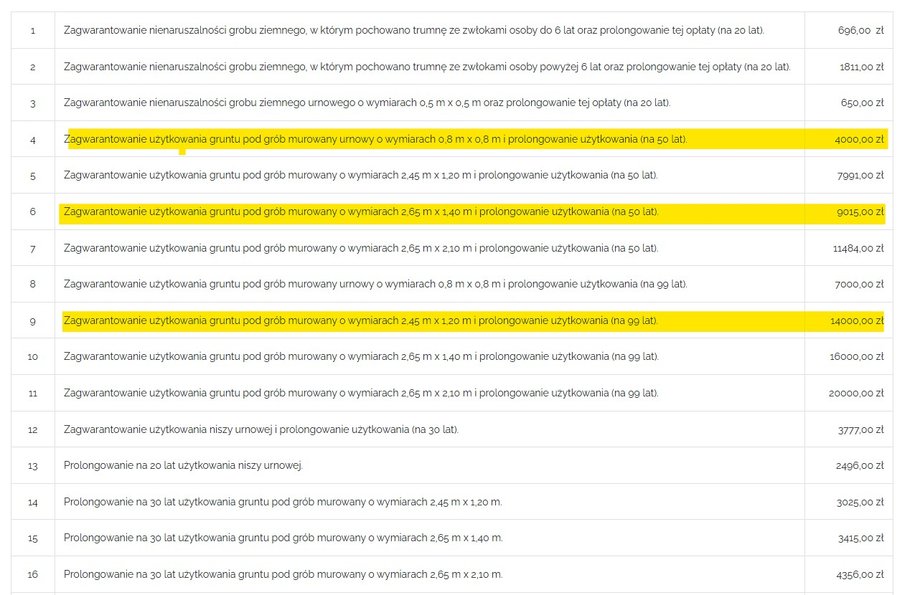
Price list of the Municipal Cemetery in Podgórki Tynieckie in Krakow
|
https://www.cmentarzkrakow.pl/
Citizens argue that the above-mentioned Art. 7 section 3 of the Cemeteries Act excludes brick graves for more than one person from the fee. Local governments do not usually set fees pursuant to Art. 4 section 1 point 2 of the Municipal Economy Act, which allows for the establishment of fees for municipal services of a public utility nature and for the use of public utility facilities and devices. Except court decisions state that in the case of a brick grave, no fees are charged for integrity and burial.
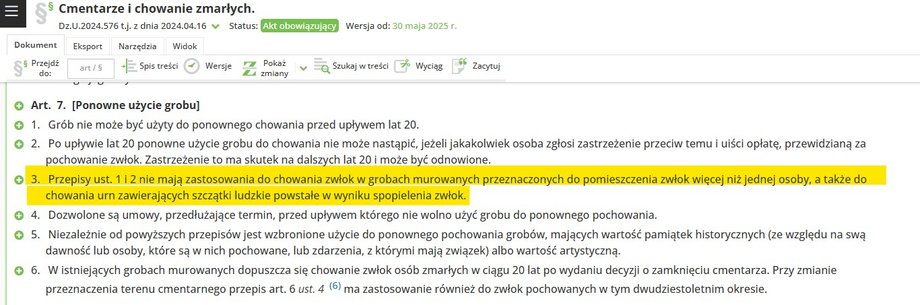
Act on cemeteries and burial of the dead
|
LEX
What do the courts say about fees for brick graves?
Initially, some provincial administrative courts agreed with local governments. Recently though the jurisprudence has changed significantlyand thanks to the Supreme Administrative Court. For example, the Provincial Administrative Court in Olsztyn, in a non-final judgment of October 3, 2024 (reference number II SA/Ol 621/24), indicated that “there is no authority to determine additional fees for the passage of 20 years in relation to a brick grave intended to accommodate the bodies of more than one person, as well as to bury births.” And he referred to the resolution of the Supreme Administrative Court of September 17, 2024 (reference number III OSK 357/24). The Supreme Administrative Court ruled that “the extension fee for extending the right to a grave in relation to a brick grave intended to house the bodies of more than one person has no legal basis.”
It is worth noting that the Supreme Court, in its judgment of December 3, 2010 (reference number I CSK 66/10), stated that restrictions on the re-use of the grave do not apply to brick graves intended for the burial of more than one body (Article 7(3) of the Act), and therefore family members entitled to this grave not only do not have to extend this right after 20 years, but also do not have to pay another fee. The Supreme Court also emphasized that the cemetery management does not have the right to dispose of free places in a family brick grave either before or after twenty years from burial, or to charge another fee.
Now the Supreme Administrative Court has followed this lead, followed by provincial administrative courts, pointing out that the Municipal Management Act does not give local governments the right to impose additional fees for the use of cemeteries, and the Cemeteries Act does not allow charging extension fees for brick graves. As a result, according to the latest case law, cemeteries may charge burial fees and an extension for the right to an earthen grave and a single-person brick grave. If someone has a tomb, they do not have to pay an extension fee. He also does not have to pay for the burial of the deceased in a brick grave. These are permanent graves. As a result, such graves are made available for an indefinite period of time, and contracts concluded with families, e.g. for 99 years in the case of multi-person brick graves, are not legal. Such an agreement may be concluded for earthen graves regardless of the number of burial places and brick graves intended for one coffin, because these graves are subject to fees every 20 years. Therefore, when the cemetery manager demands a fee, it is worth asking about its legal basis and starting a dispute.
For local governments, this means the challenge of maintaining cemeteries without funds from fees considered unlawful, which is why they are calling for the adoption of a new act on cemeteries.
See also: These cemetery fees are illegal. Poles can get their money back
Does a church cemetery have the same rules as a municipal cemetery?
Religious cemeteries predominate in Poland, although precise data are lacking. According to data provided on the gov.pl website, There are approximately 12,269 cemeteries in our country, and according to the Central Statistical Office, 13,742. However, only about 1,900 of these are municipal cemeteries, which are found mainly in cities. The rest are usually religious cemeteries, mostly owned by the Roman Catholic Church, which are run by parishes (hence the name parish cemetery). According to the Central Statistical Office, the Catholic Church is responsible for approximately 8,000. cemeteries.
Regardless of its owner, a cemetery is subject to the law in force in Poland. A parish cemetery, like any other, is subject to the Act on Cemeteries and Burial of the Dead, although it is governed by its own laws. Pursuant to Art. 2 of the Act of May 17, 1989 “The Church is governed by its own law, freely exercises spiritual and jurisdictional authority and manages its affairs.” It is true that in accordance with Art. 8 of the Concordat, organizing worship is the responsibility of the church authorities in compliance with the relevant provisions of Polish law, but their enforcement may be difficult.
In parishes, it is usually the parish council that establishes the cemetery regulations and determines the fees, although the parish priest may also, e.g. in consultation with the council. For example, the regulations of the Parish Cemetery of the Archdiocese of Warmia were established by Archbishop Józef Górzyński. Many regulations, as well as municipal resolutions, mention fees or sacrifices that are not provided for in the law. In this case, there may be a problem with appealing such regulations to an administrative court. “Church” regulations, unlike a resolution of the commune council, are not an act of local law.
If the manager of a church cemetery demands an illegal fee for a multi-person brick grave, it is also worth asking him for a legal basis. The letter may refer to the above-mentioned court judgments. If the parish priest does not accept the complaint – he is usually the one who manages the parish cemetery – the next step may be to direct the complaint to the appropriate church administrator (e.g. bishop or diocesan curia). If this path does not work, you can take the next step and file a complaint to the church court or a lawsuit to the common court for the right to a grave.
In practice, rarely anyone discusses the amount of the offering with a priest, especially when it is not strictly defined. In many regulations, it is the cemetery manager, mainly the parish priest, who decides on the amount. However, as we read on the website elektrocmentarny.pl, you do not have to pay illegal fees, regardless of the cemetery, municipal or parish. It is therefore worth considering legal action, especially since the required fees are no longer low.
How much are the fees?
The amount of the fee varies, both in municipal and parish cemeteries. Sometimes it is one extension fee for everyone, e.g. PLN 2,000. zloty. However, it sometimes happens that its amount depends on the type of cemetery, the width of the grave, and the type of grave. A detailed price list for each cemetery should be publicly available. Recently, cemetery managers often place them on the Internet.