Corvin Castle reveals its secrets. The enigma of the rulers in the diet hall, almost unraveling

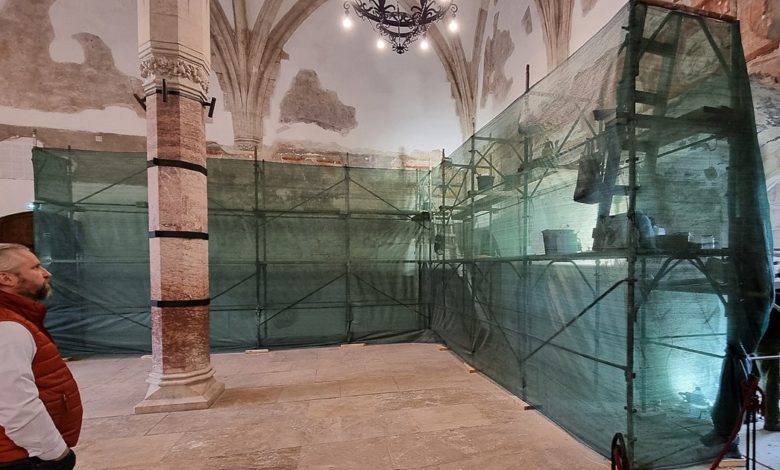
The restoration of the mural paintings in the diet hall of the Corvin Castle could unravel one of the controversial enigmas of the historical monument, the appearance, among the frescoes of the seventeenth century, of faces that could be of the rulers Matei Basarab and Vasile Lupu.
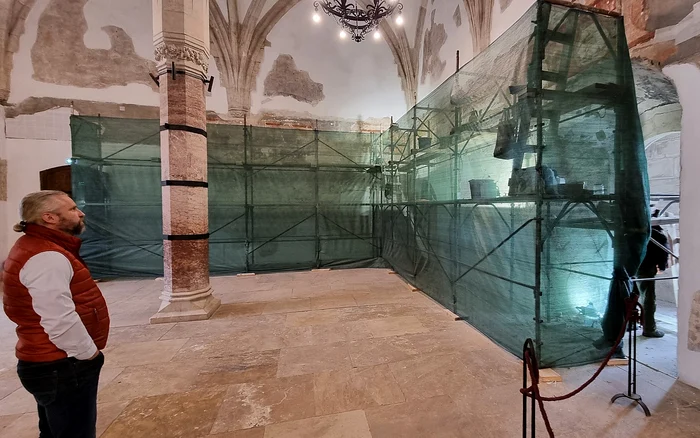
Sorin Tincu, director of the Castle Castle Museum, in the Diet Hall. Photo: Hunedoara City Hall
A mystery of the Corvin Castle of Hunedoara could be unraveled after several centuries, with the restoration work of the paintings in the Diet Hall.
“For several days, a team of specialists in the field (attested restorers) has started the restoration of the existing frescoes on the arches on the western side of the diet hall. The restorers have to do an extremely migraine work, because the original frescoes (from the 17th century) are under several layers of plaster applied successively until the 19th century,” informed Hunedoara City Hall.
Among the paintings that depict the castles and characters of the era in which the Corvin Castle was under the control of the Transylvanian Prince Gabor Bethlen (1580–1629) there are two portraits that, according to tradition, would depict Matei Basarab (1580–1654) and Vasile Lupu (1595-161) XVII-rivals, but appreciated for the cultural and religious contributions to the development of Romanian countries.
Rival voivodes, put on the same wall
Vasile Lupu, ruler of Moldova from 1634-1653, is mentioned by historians for Vasile Lupu's pravila, a code of harsh laws of medieval Moldova. It has also noticed by the luxury of the palace life, but it is much more known as one of the great church founders in Moldova. According to historians, in the nearly two decades, he raised 15 churches from the ground up and restored 14 other religious buildings. The most famous of them is the Church of the “Holy Three Hierarchs” in Iași, which he endowed with the relics of Saint Parascheva.
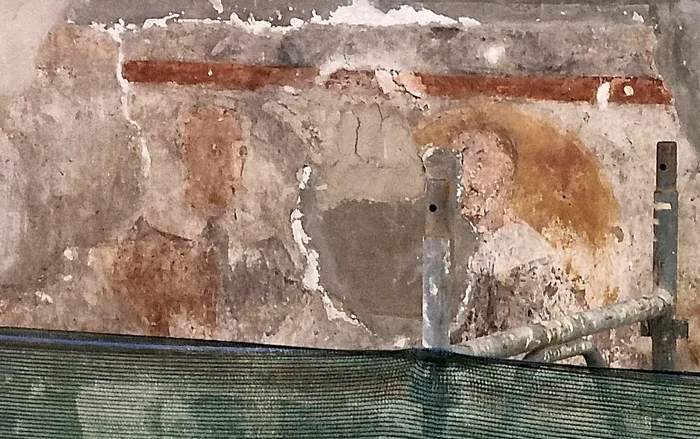
Portete from the Diet Hall. Photo: Hunedoara City Hall
Matei Basarab reigned in the Romanian Country between 1632 and 1654 and is noted by historians as a great supporter of culture and print. He founded the typographers, encouraged the appearance of religious books and laws and founded over 40 churches and monasteries. He was a rival of Vasile Lupu, which he defeated in the battle of Finta, from May 27, 1653, ending his ambitions to control Moldova and the Romanian Country.
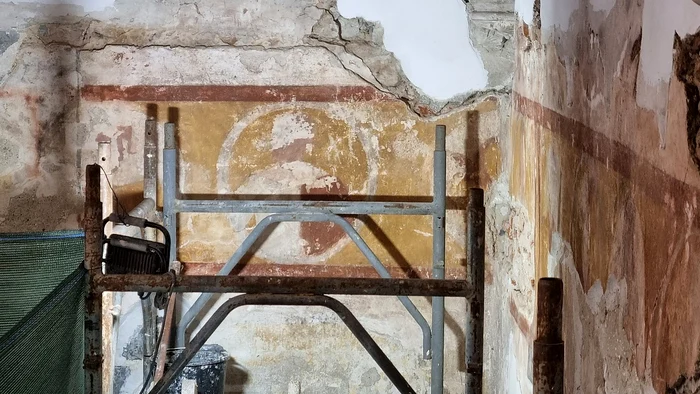
Paintings in the diet room. Photo: Hunedoara City Hall
Considered by some historians as opponents, the two rulers would have been depicted next to the portraits in the Diet Hall. The frescoes were investigated by historians in the mid -1950s, when the Diet Hall was restored. Then they were in an advanced state of degradation, after, a century ago, in 1854, the Corvin Castle was devastated by a fire.
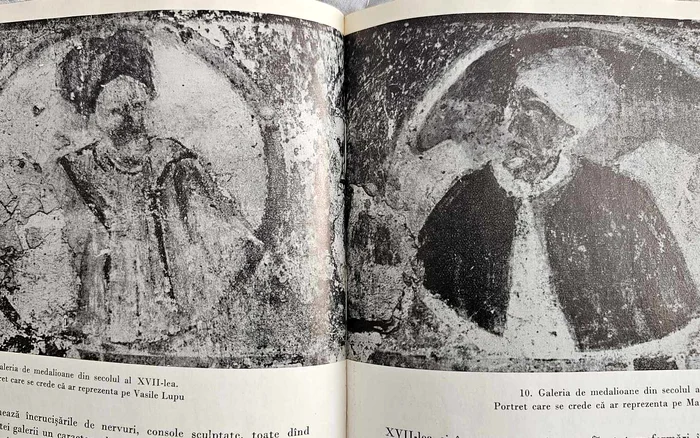
The frescoes that some historians identified the voivodes. Source: O. Velescu, 1961
The art historian Oliver Velescu then showed that the legend that the portraits could represent the two rulers give birth to doubts.
“A newer tradition attributed, without the basis, two of the portraits of Matei Basarab and Vasile Lupu. From the beginning it must be said that the reign of Gabriel Bethlen was not contemporary with the two gentlemen. Bethlen dies on November 15, 1629, and Matei Basarab occupies the royal chair after October 25, 1632, A certain historical basis.“Informs Oliver Velescu, in 1968.
Who could be Gabor Bethlen's allies
In support of this hypothesis, adds the art history, it seems rather to appear here the image of Radu Mihnea, the Lord of the Romanian Country, and of Stefan Tomșa, Mr. Moldovei, “Who supported with their troops Gabriel Bethlen in the fight for occupying the throne”, or of Gavril Movilă, the next gentleman – from 1616 – of the Romanian Country, with which an alliance treaty had also ended.
“This gallery could confirm, in a way, one of Bethlen's political conceptions, which fought with the Habsburgs-also having the support of the Romanian gentlemen-to strengthen the autonomous principality of Transylvania, following the union of the three Romanian countries under its scepter, in a kingdom of Dacia. Which of the respective figures would not be said. They keep, being destroyed during the big fire, and the costume details visible in medallions are not conclusive ”, says Ovidiu Velescu.
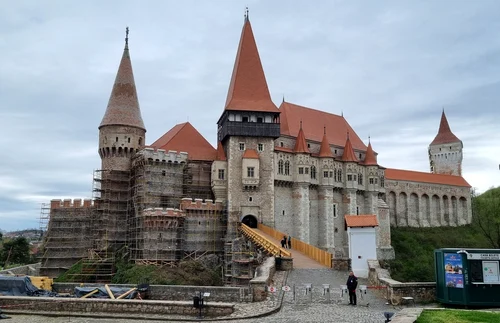
Image 1/21:
Corvin Castle Photo Hall Hunedoara City Hall (8) JPG
In the seventeenth century, the royal costume in the Romanian Countries was not particularly of the nobles, and the portraits could also represent the figures of some feudal, contemporaries with Gabriel Bethlen, the historian said. The restorers have not yet reached the seventeenth -century portraits, which are at the upper level of the diet hall.
Restoration also saved the medieval portraits of Huniazi
In recent years, the restoration works carried out at the Corvin Castle have meant the restoration of some of the oldest portraits of Ioan de Hunedoara.
The mural painting in which the voivode is depicted, in the time of his adolescence, dates from the fifteenth century and decorates the loggia Matia, from the floor of the medieval castle. By the end of the 19th century, when it was discovered by the scientist Aranyi Lajos, it stayed for a long time hidden under a few layers of plaster.
The plaster saved her from the five fires that included, over time, the Corvin Castle.
The most powerful of them took place in 1854 and consumed much of the castle. According to the representatives of the Museum of Corvin Castle, the painting of King Matia is the only secular fresco in the fifteenth century, which is kept in such a good state in Transylvania. Ioan de Hunedoara and his mother are the main characters depicted in the scenes that play the story of the Corvin.
Diet Hall, built by Huniazi
Located on the first floor of the Corvin Castle, above the Knight's Hall, the diet hall was built in the second half of the fifteenth century, in the time of Huniazi. The French craftsmen would have raised the west wing, which includes the two great Gothic rooms, known as the Knights Hall and the Diet Hall, and in the sunrise, the chapel of the castle. This hypothesis could not be confirmed by documents, Oliver Velescu said.
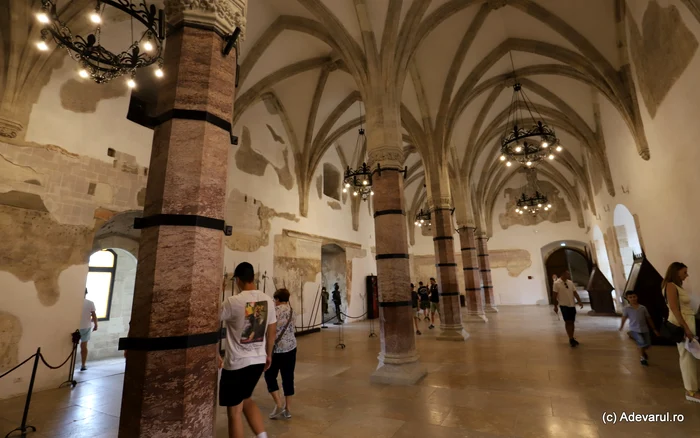
Diet Hall. Photo: Daniel Guță. TRUTH
The room, spacious and high, with Gothic and Renaissance architecture, with ogival ribs, massive columns and high windows, was the place where official meetings, receptions and councils were held. The name “Diet Hall” is improper, historians show, because the Diet of Transylvania, the assembly of nobles that make political and economic decisions, has never met in Hunedoara.
“The diet hall was so baptized in the 19th century by an author who, full of fantasy, wrote that, while men debated the current problems, the skirts were retired to the logs, from where they attended the debates-an inspired image, of course, from the aspect of modern parliaments, but which has no place here. His vassals, appointed in the medieval acts briefcase.says Oliver Velescu.
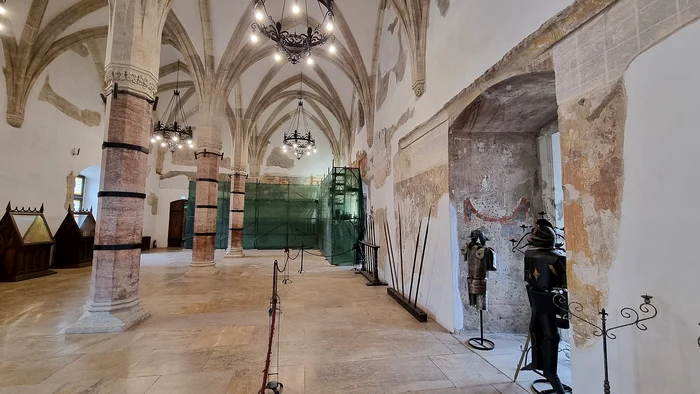
Diet Hall. Photo: Hunedoara City Hall
His walls were decorated with frescoes and painted medallions (some still visible), representing historical characters and castles. On the top of the walls were kept the traces of the ogival arches (broken arcs), which proved that this room also had a gothic appearance, with vaults on stone ribs that leaned on columns, as in the Knights Hall, added the historian Oliver Velescu.
Gabor Bethlen turned it into a bedroom
In the seventeenth century, the Diet Hall was destroyed to be recompartered on two levels, each with three rooms. On the newly formed floor there were simple rooms, of which nothing special is known. In contrast, about the ones on the ground floor, the scholars of the past showed that here were, in succession, the rooms called “lady”, “of the Lord” and “the living room”.
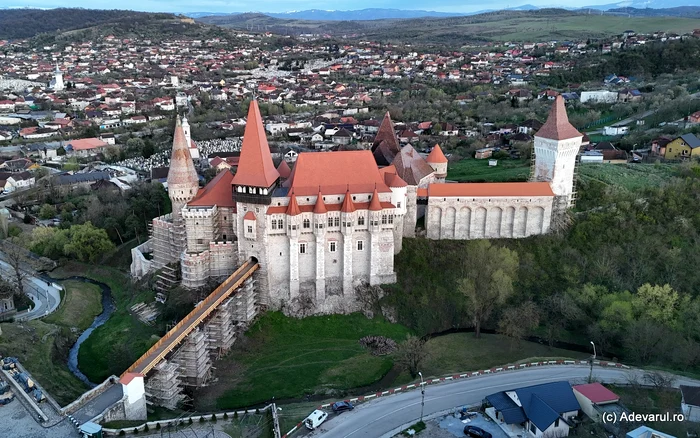
Corvin Castle. Photo: Daniel Guță
“The walls of these rooms were adorned, according to the taste of the era, with stucco elements, from which only too small fragments were kept on the walls to allow an assessment of their artistic value. Being a very resistant material, the stucco was first damaged during the improper use of the castle in the eighteenth century, and in the period, in the period roof ”, said Oliver Velescu.
In the living room, the walls were adorned with a portrait gallery of contemporary rulers with Prince Gabriel Bethlen, but these medallions were lost over time.
Restores at Corvin Castle with European funds
The diet hall was restored between 1956–1957 based on the architectural traces and the original fragments found in the castle, and is currently in a new restoration process, focused on its old paintings.
Started in 2024, with European funds, the second stage of restoration of the Corvin Castle concerns complex works of consolidation and rehabilitation of some monuments that could not be included in the project carried out in 2019 at the castle.
These include the restoration of several interior and exterior frescoes, the most important being those in the diet hall and on the Buzdugan tower.
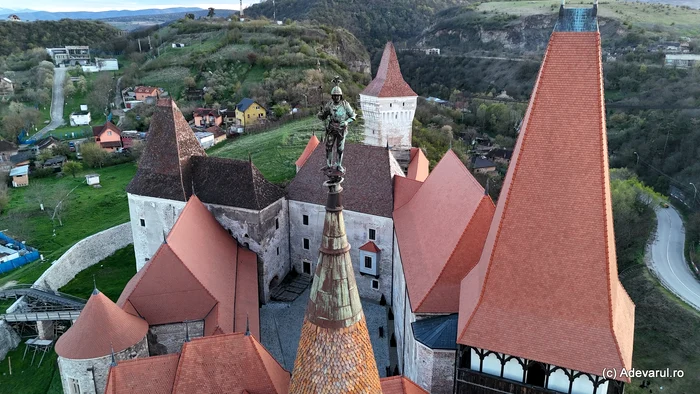
The towers of Corvin Castle. Photo: Daniel Guță. TRUTH
Also, it is aimed at replacing the floor in the Knights Hall, the restoration of the two access bridges, the restoration of the bears pit and putting it in the visiting circuit, making a floor on the artillery terrace, restoring the knight's armor at the top of the Buzdugan Tower, repairing the roof (where the court is needed).