Increasingly intense Russian bombing highlights the escalation of an air war that is gaining prominence as the battle on the ground comes to a stalemate, The Guardian reports.
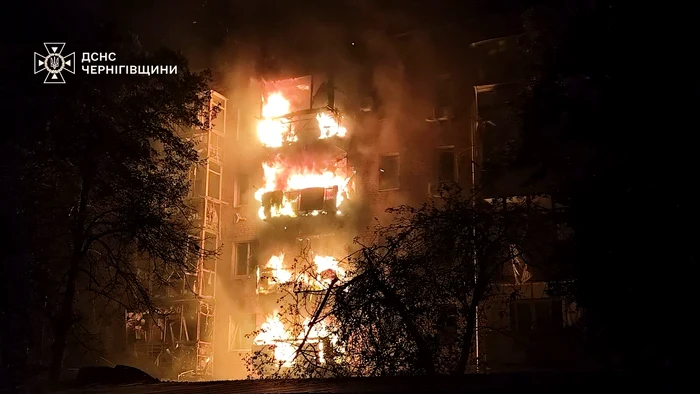
Block in flames after a Russian bombardment PHOTO EPA-EFE
Recently, Russia attacked the Shebelinka gas processing plant in the Kharkiv region. The facility attacked with drones and missiles caught fire, which threatened to ignite the tanks. That same night, Russian bombing sparked air raid alarms across the country.
Moscow has stepped up its air war in recent months, launching more than 3,000 drones, 92 missiles and nearly 1,400 hover bombs over Ukraine between October 5 and 12 alone.
Ukrainian air defense soldiers from the Territorial Brigade, based in northern Ukraine, explain why the air war is becoming increasingly difficult to fight.
They report that the air sirens are going off as many as six times in one day. From the moment they start, the soldiers armed with machine guns have only 10 minutes to get into the vans and reach the firing points.
Only from a distance of about one km is the shooter able to see the target. After which he has less than a minute, sometimes even less, to take it down.
“It's extremely difficult. If it's flying at an altitude of 1,500 meters, it's like trying to strike the end of a match.” explained Iury Dovgan, a soldier in the air defense. “And then the shooter has to hit the drone engine or the explosive charge.”
Successful attempts are not as numerous as the soldiers had hoped, although between 20 and 60 drones fly through their sector every day, coming from the Briansk region and through Belarusian airspace.
But the problem is not the short window of action, but the consequences of failure.
“The key to success and victory is in the sky,” said Iuri Ignat, a spokesman for the Ukrainian Air Force. “But the result will not only manifest itself in the air, but also through innovation.”
Russia widely uses trap drones in mass attacks, he explained.
“Russia is breaking its own records for the number of munitions used in these attacks,” he said. “In August and September we saw massive attacks every week.”
An air war of increasing intensity
After the poor performance of the Russian air force at the beginning of the war, Moscow adapted by resorting to new, more effective and constantly evolving tactics for aerial bombardment. For its part, Ukraine recorded its own successes.
In recent months, large-scale Russian airstrikes have been launched simultaneously on Ukrainian cities and key infrastructure such as power plants. The attacks were carried out by launching hundreds of drones at once in combination with a small number of ballistic missiles.
In the most significant attack this month, Russia launched more than 600 drones and missiles.
In parallel, on the eastern front, Russia has stepped up attacks with glide bombs on Ukrainian positions. Along with stronger capabilities, Russia has also changed its attack tactics.
These developments represent a great challenge for the Ukrainian defenders.
“First of all, drones fly higher. At the beginning of the war we observed them at a height of 500-800 meters, now they often start from 1500 meters”, explains Oleskandr Foucek, commander of the air defense unit within the territorial brigade.
“And their speed has increased, from 150-160 kilometers per hour to over 200 kilometers per hour. It's a game of cat and mouse,” added his comrade Iaroslav Tristan. “The Russians find out where our positions are when we shoot them down. So they'll fly higher to where they estimate we are, and we have to move our positions.”
Attacks on Kiev
After the powerful Russian airstrike that plunged Kiev into darkness on October 10, Zelenskiy expressed concern about protecting Kiev's energy infrastructure, saying he was “dissatisfied” with the effectiveness of air defenses.
For his part, the head of the Ukrainian army, Oleksandr Sîrski, said that the air defense is about 74 percent effective, but still needs improvement.
“I think it's one of the conflict areas where we've seen the most significant change in the last 18 months,” says Justin Bronk, airpower and technology researcher at the Royal United Services Institute.
It's not so much the FPV drones that are dangerous to the Ukrainians' ability to hold their positions as the weekly dropping of hundreds of glide bombs from SU-34s on them until they are completely destroyed.
“They have also improved their in-flight reprogramming. This is a radical change in the impact that Russian tactical aviation has on the front,” notes the quoted analyst.
On the other hand, on the drone front, Bronk anticipates that Russia will “more dynamically use the Shahed drones that it is now mass-producing. They are refining route plans and identifying air defense emplacements.”
Russia is also using missiles more effectively, for example equipping the Iskander ballistic missile with decoys that can be launched in the terminal phase of flight and are capable of maneuvering.
“Not surprisingly, after hundreds of engagements, Russia has learned a lot about what makes interceptions by Patriot anti-missile batteries less likely to succeed,” he explained.
But Ukraine does not let itself down either, refining its offensive tactics, for example by increasing the frequency of attacks deep in Russia.
“We are destroying the facilities [rusești] involved in the production of fuel, lubricants, explosives and other key components of Russia's military-industrial complex”the head of the Ukrainian army said last week.
A hotly debated issue throughout the war is whether air power alone can be conflict-defining.
“I would say that air power is unlikely to win the war in Ukraine, but it could lose it. Ukraine has an inherent limitation and Russia has an enormous air defense capability. The concern must be that Russia will achieve air superiority and ascendancy beyond the present one. We must keep pace to avoid losing” in this area, the analyst pointed out.
Recently, a hospital in Kharkiv was hit by a hovercraft for the second time in seven months, causing extensive damage.
“There were a hundred staff members and patients here at the time of the attack,” said Alex Datsenko, the medical director. “The situation is getting worse. More and more glide bombs and drones are hitting the city. The Russians have not been able to win with tanks. Now they are trying to intimidate the population.”