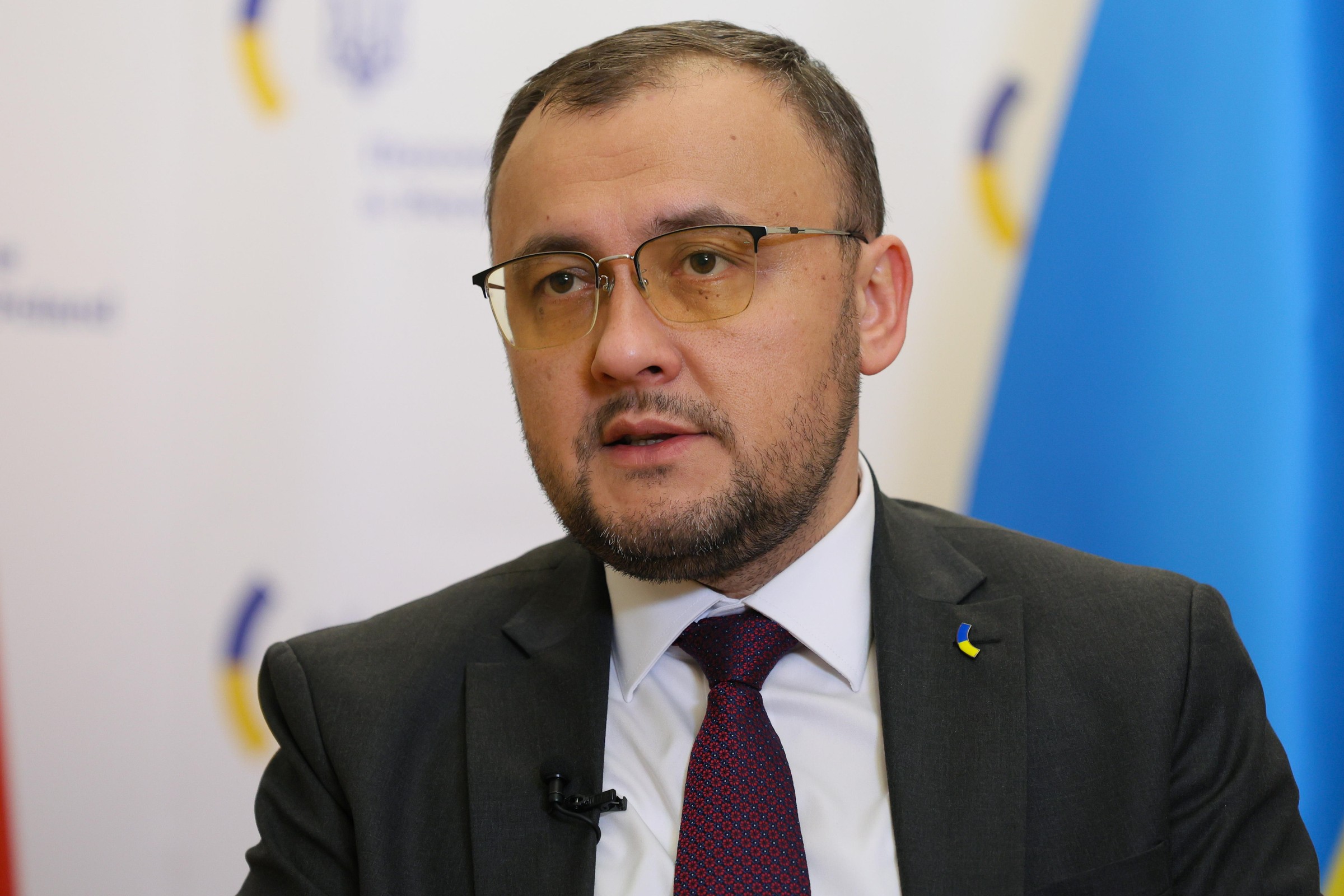
— We are preparing further permits. God grant that everything will work out. But the more provocations and the more negative communication, the more difficult it is to move these matters forward, Bodnar said.
— In this case, everyone is adding their two cents to the public space instead of talking to each other. I would very much like the Institutes of National Remembrance to establish normal cooperation between themselves. How can you work if there is no communication between key ministries? he asked.
The diplomat pointed out that despite previous arrangements, there has not yet been a meeting between the head of the Institute of National Remembrance, Karol Polejowski, and the president of the Ukrainian Institute of National Remembrance, Oleksandr Alferov, who was already in Poland on September 21-25. He then visited Warsaw, Rzeszów and Przemyśl.
The article continues below the video
“Let me be skeptical.”
— We have been waiting for the third month for a response from the Polish side regarding the meeting of the heads of the Institute of National Remembrance and the organization of meetings of historians. I would like to be wrong, but it seems that there is average interest in historical cooperation on the Polish side, said Bodnar.
On Tuesday, the deputy head of the Polish Institute of National Remembrance, Karol Polejowski, said that despite certain signals, there was no breakthrough in the matter of exhumation of the victims of the Volhynian Massacre.
— Sometimes it's presented as a breakthrough. Let me be skeptical. The breakthrough would consist in something else, that is, in the systemic regulation of the search for victims of crimes committed by Ukrainian nationalists, he said.
Polejowski referred to the Ukrainian side's consent to exhumation work in Ugly, in the former Volhynian Voivodeship [dziś obwód rówieński]. He said that this consent was received by the Lviv company Dola. – I have not seen any document that it was for a Polish entity – he said.
Ambassador Bodnar explained that, according to Ukrainian law, the main contractor for such work in his country is to be a company registered there. — The right to perform exploration work is granted to a Ukrainian company. It was like that in Puźniki, it was like that in Lviv-Zboiska, it's like that in Ugly, he emphasized.
Consent application process
The permit to search in Ugly, which the Ukrainian authorities issued in recent days, was the result of the efforts of the Polish-Ukrainian Reconciliation Association.
— The Association's application to the Ukrainian Institute of National Remembrance was approved. We handed over the permit to work in Ugły along with a letter [ukraińskiego] Ministry of Culture, in a note to the Polish Ministry of Foreign Affairs. We asked for these documents to be forwarded to the appropriate institutions in Poland. We also issued an invitation to dialogue on agreeing on the technical details of the organization of exploration in Ugły, emphasized Bodnar.
The diplomat added that, as before in Puźniki, the Polish applicant turns to the Ukrainian company regarding the search for the victims' remains, which then applies for appropriate permits to the Ukrainian regional authorities. They, in turn, deal with such matters at the ministerial level.
— These matters were discussed during the meeting of the Polish-Ukrainian Working Group on Historical Dialogue; this is a mutually agreed position. And those who manipulate want to hinder the entire process, he said.
Bodnar also recalled that in November last year, the Ministers of Foreign Affairs of Poland and Ukraine, Radosław Sikorski and Andriy Sybiha, encouraged Polish state institutions and private entities to conduct search and exhumation work.
“Ukraine confirms that there are no obstacles to Polish state institutions and private entities conducting search and exhumation work on the territory of Ukraine in cooperation with relevant Ukrainian institutions, in accordance with Ukrainian legislation, and declares its readiness to positively consider applications in these matters,” Sikorski quoted the statement at the time. He added that the Polish side will mobilize its own institutions, such as the Institute of National Remembrance, “to be sensitive to Ukrainian demands.”
Dispute over the Volhynia massacre
Poland and Ukraine have been divided for many years by the memory of the role of the Organization of Ukrainian Nationalists and the Ukrainian Insurgent Army, which in 1943-1945 committed the genocidal ethnic cleansing of nearly 100,000 people. Polish men, women and children. Since the spring of 2017, there has been a dispute over the ban on the search and exhumation of the remains of Polish victims of wars and conflicts on the territory of Ukraine, introduced by the Ukrainian Institute of National Remembrance. The ban was issued after the dismantling of the UPA monument in Hruszowice in April 2017.
The decision to lift the moratorium on the search and exhumation of the remains of Polish victims of the Volhynian crime, in force since 2017, was announced at the end of November 2024 during a joint press conference of the foreign ministers of Poland and Ukraine, Sikorski and Sibiha. Ukraine then confirmed that “there are no obstacles to Polish state institutions and private entities, in cooperation with the relevant Ukrainian institutions, carrying out search and exhumation work on the territory of Ukraine, in accordance with Ukrainian legislation” and declared “readiness to positively consider applications in these matters.”
In the spring of this year, the Polish side carried out exhumations in the former village of Puźniki in the current Ternopil Oblast. On the night of February 12-13, 1945, Ukrainian nationalists murdered there – according to various sources – from 50 to 120 Poles. As a result of the work, the remains of at least 42 people were found. They were buried in Puźniki on September 6.
The Ukrainians also issued a permit for the exhumation of the remains of Polish Army soldiers who died in September 1939 in the defense of Lviv and were buried in Lviv-Zboiska. As a result, the remains of at least 31 people were found.