The Nobel Award for Economy was won in 2025 by Joel Mokyr, Philippe Aghion and Peter Howitt to explain the connection between economic growth and innovation

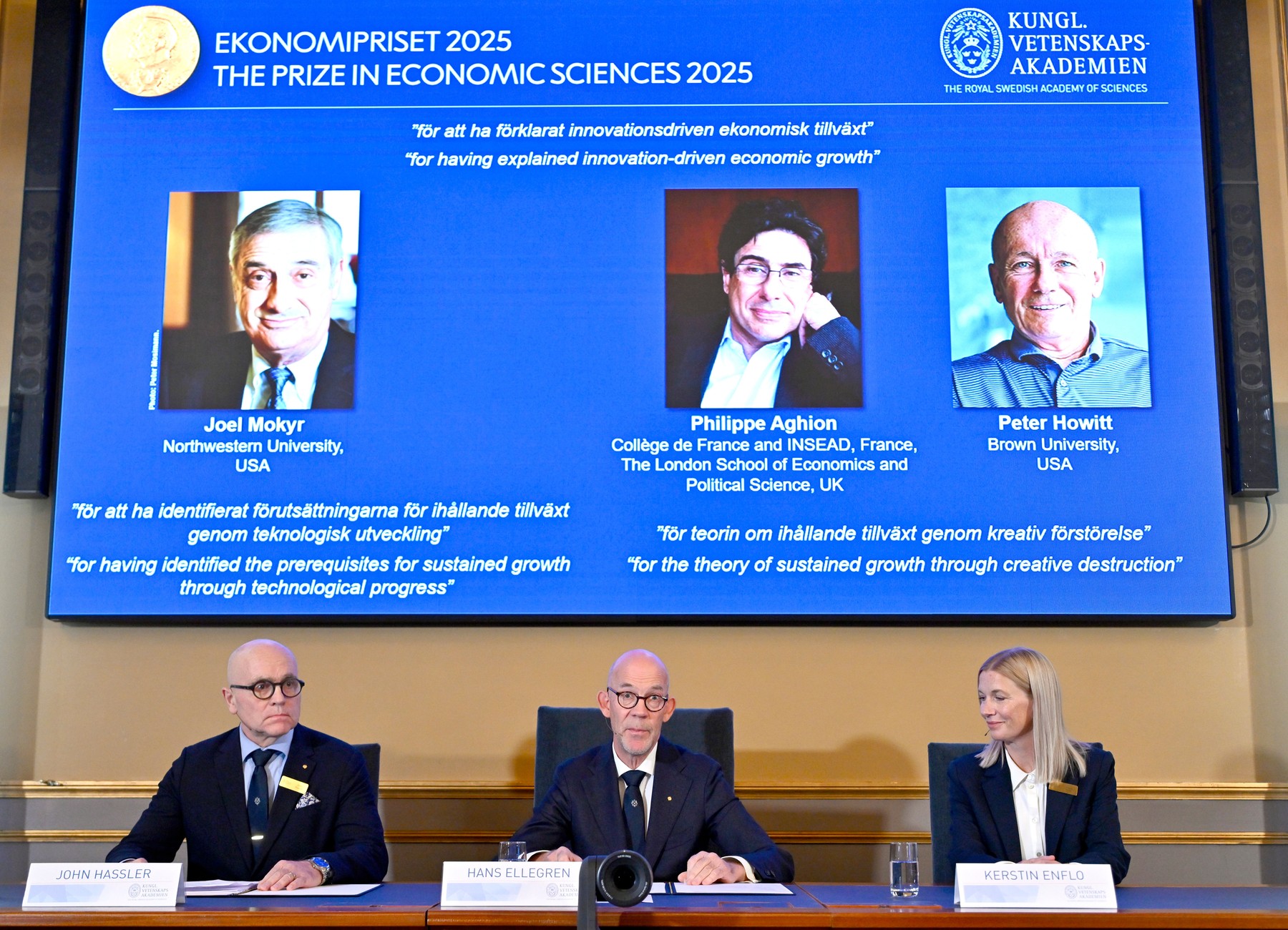
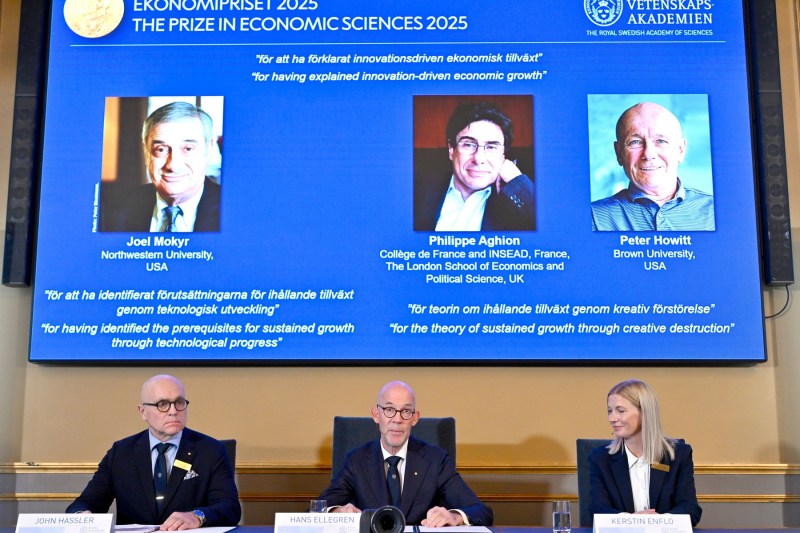
Joel Mokyr, Philippe Aghion and Peter Howitt are the 2025 Nobel Prize laureates, photo: Anders Wiklund-TT / Shutterstock Editorial / Profimedia Images
Joel Mokyr, Philippe Aghion and Peter Howitt won the Nobel Award in Economics in 2025 for “explaining innovation -based economic growth,” the Swedish Royal Academy announced on Monday, Reuters reports.
The prestigious distinction, officially referred to as the Swedish Bank Prize in Economic Sciences in the memory of Alfred Nobel, is the last award awarded this year and has a value of 11 million Swedish crowns (about $ 1.2 million).
“The laureates have taught us that a sustained economic growth cannot be considered by itself,” said the institution that awarded the prize, in a statement. “Economic stagnation, not growth, was the norm for most of the history of mankind. Their works show that we must be aware and counteract threats to continuous economic growth.”
Who are the 2025 Laureates of the Nobel Prize for Economy
Mokyr is a professor at Northwestern University in Evanson, the United States, while Aghion is a professor at Collège de France and Insead, Paris, as well as at the London School of Economics and Political Science.
Howitt is a professor at the University of Brown in Providence, the United States.
Mokyr received half of the prize, and the other half was divided between Aghion and Howitt.
“Joel Mokyr used historical observations to identify the factors needed for a sustained growth based on technological innovations,” said John Hassler, a member of the Nobel Committee.
“Philippe Aghion and Peter Howitt have developed a mathematical model of creative destruction, an endless process through which new and better products replace the old ones.”
All Laureates of the Nobel Prize of 2025
Awards for Medicine, Physics, Chemistry, Peace and Literature were announced last week:
- On Monday, the Nobel Prize for Medicine was given to researchers Mary E. Brunkow, Fred Ramsdell and Shimon Sakaguchi for an important discovery related to T cells, the “safety guards” of the immune system;
- On Tuesday, the Nobel Prize for Physics was given to researchers John Clarke, Michel Devoret and John Martinis for important discoveries in quantum physics;
- On Wednesday, the Nobel Prize for Chemistry was given to the researchers Susumu Kitagawa, Richard Robson and Omar M. Yaghi for the development of metal-organic structures;
- On Thursday, the Nobel Prize for Literature was awarded to the Hungarian writer László Krasznahorkai “for his impressive and visionary work, which, in the middle of the apocalyptic terror, reaffirms the power of art”;
- On Friday, the Nobel Peace Prize was awarded to the leader of the opposition of Maria Corina Machado “for her tireless work to promote the democratic rights of the Venezuelan people and for her struggle to obtain a fair and peaceful transition from dictatorship to democracy.”
These distinctions were instituted by the will of the inventor and the Swedish businessman Alfred Nobel, the inventor of Dynamite, and are granted since 1901, with some interruptions caused mainly by world wars.
Nobel Prize for Economy was created much later
The Award for Economy was established much later, being granted for the first time in 1969, when it was won by the Norwegian Ragnar Frisch and the Dutchman Jan Tinbergen, for their works in the field of dynamic economic modeling. Tinbergen's brother, Nikolas, also won a prize, the one for medicine in 1973.
Although few economists are figures known to the general public, the most famous laureates include the former president of the US Federal Reserve, Ben Bernanke, as well as Paul Krugman and Milton Friedman.
The Award for Economy was awarded last year to researchers Simon Johnson, James Robinson and Daron Acemoglu, for a series of studies that analyzed the relationship between colonization and the establishment of public institutions, explaining why some countries have been blocked in poverty for decades.