A girl disappears before 1989 while she was carrying the garbage, and her younger sister is the last person to see her. Despite the appearances, it is not the script of a police film, nor of a historical painting, writes the film critic Iulia Blaga in a text that starts from the new film “milk teeth” directed by Mihai Mincan and which reaches a discussion with death.
Recently, I wrote on Hotnews about violence from fear of the other. The film Mihai Mincan launched at the Venice Festival, “Milk teeth”, proposes another important theme: the fear of death.
- The film had the first projection in Romania at the opening of the Bucharest International Film Festival (September 19 – 28) and will enter theaters on October 14th.
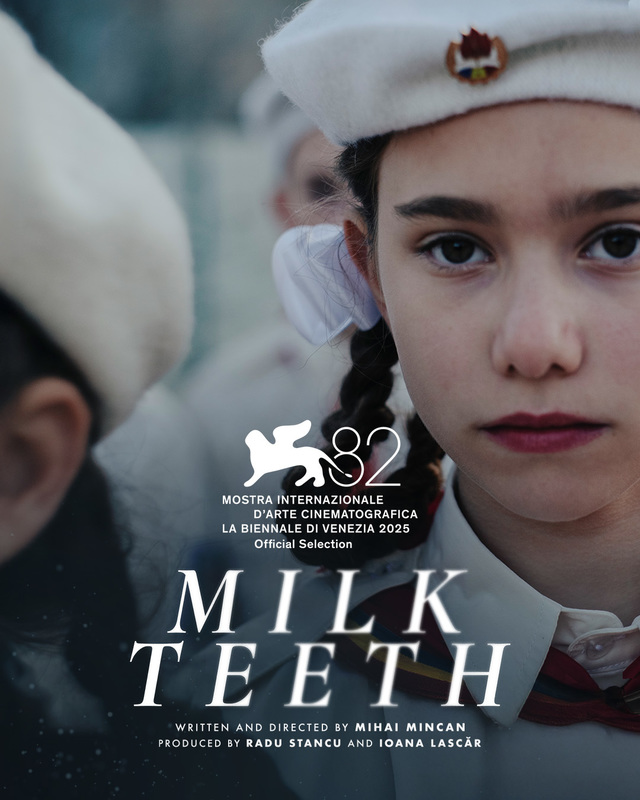
The story written by Mincan took place from April 1989 to March 1990 and follows a little girl whose older sister disappeared when she was taking the garbage to Ghena, being the last person to see her. It is not a police story, no realistic and no historical painting, although it has disparate elements.
The film tries to enter the little girl and understand how a child processes trauma, guilt and mourning. A child who does not externalize. The result is almost hypnotic. Among other things, if you are careful, you will have the impression that space does not exist; He forms around the little girl, with her movement or following the direction of his gaze. Or that almost everything that happens on the screen could only be in her imagination. One of the clues is a enchanted nut, the memory of the moment of break, when the sister went to throw the bucket with walnut shells, but also the memory of life intact before the cataclysm.
Preparing for the film's scenario, Mincan read a bulky file about a similar abduction case, before 1989, but says in interviews that it was not desired to dramatize it being his awful details.
https://www.youtube.com/watch?v=pn7Aykgpxye
Instead it gives the impression that it has left its subconscious free
The story is reflected in mirrors that have to deal with the story of each spectator, and with the mechanism of memory, and with transgenerational trauma or with great history. I have not seen many Romanian films whose form in the waters allow such a complex reading.
Mincan also recognizes that the film has autobiographical accents and talks about his childhood memories as more synesthetic than punctual because he mixes smells, colors and daily silence of the period before '89. (The director was 9 years old in 1989, one year less than the heroine.).
At a certain level, perhaps the film has to do with its own fear of death, which they try to heal it through a fictitious story. But the approach is clearly a nostalgic one.
In the director's walnut they fit symbolic objects that it is almost like characters. The pen of plywood with Abac, the sharpener green elephant, the Chinese pencil with the gold metal from the turtle between the teeth, the glossy plastic pen, with the mirror inside, the still fresh savory, the jewelry box dressed in shells, the songs “suburb” (Pet)
The spectator who lived that period can start, assisted by these triggers, a personal process of recovering the past. It happened to me too. The third day after I saw the movie, I woke up with the song “Suburbia” singing in my head, at maximum volume. I had woken up, but the song did not stop, as if it didn't come from me.
Each one has a special relationship with death
Because I lost my father at 8, I thought I didn't fear death. When they died, a little later, a classmate and the father of some children in the neighbors, I stayed at no emotions, close to the corpse. It had to pass years and to die many close friends to understand that the loss of the father had caused a wound to whom, as a child, I could not cope other than dissociate.
I came to the core when, recently, I started a Matrix Re -printing therapy. In relaxation, leaving the subconscious as free, I went with the help of the therapist at the time of my father's death, when the adults took us out of the room, the children, to protect us. I was not near my dad when he died, but I understood in that meeting that I had not processed his death and I had not made his mourning because I had not been given the opportunity to say good.
For the role of the main interpreter Mihai Mincan, he saw many children, but probably in the choice of talented Emma Ioana Mogoș also weighed that she had recently lost her grandfather and dog, and that at their first meeting they told about how to disappear from your life without saying goodbye.
The familiarity of death, however, gave me another perspective on this event that people generally fear. I understood that death is as important as birth and that it is important – that “things to bind”, as Mihai Mincan's film is said, to leave life with things left in order.
Aunt Jenica, our doica, died with me next
I was a student, I had come home for a few days and, as if he had expected me, her condition was worse. I stayed next to her, read her prayers, and after she died I washed it and dressed in the clothes prepared long before. I felt reconciled and the mourning was done by itself. I even dreamed of it shortly afterwards: I was over a tall threshold, it was very easy and a kind of oil was flowing.
Later I also took care of my mother and, again, that allowed me to make my separation. Our connection was strengthened, but I let my mother go.
When I finished, in 2003, the first book at that time about the persecuting filmmaker Mircea Săucan, his health worsened immediately after admiring the sign of the book and died the day before launch. I thought then that we can all build bridges for those who leave, that it is something to do and that this is the biggest help you can give to someone.
For years, volunteering at an asylum of old people showed me that preparation for death does not mean only hot food, carolers and, if possible, nurses that do not speak ugly but, above all, an ear will listen and hands.
Seeing that most of the women there were not able to forgive the infidelity of the spouses who were long and ulcers, we also understood that it is good to forgive our mistakes in time, to leave, in our turn, as easy as possible.
But the asylum showed me something else: that who wants to alleviate those near the great threshold must solve their problems with death beforehand. That is, to close their mourning and accept their own departure.
At the same time I learned that there is a job for the accompanying people on this trampoline.
A midwife for those who die
Is called death midwife or mourning counselor (Death Doula) And not only in us, but also in the West, it is still in the pioneering phase. As there is a twist for women who are born, it can be a twist for those who are preparing to leave. A twist can also deal with administrative or medical stuff, but its role is to be with the one who dies and make her leave easier.
It can only do this by treating death as something natural.
We would have to win if I understand that death is not scary. In Romania there are very few more deaths, and one of them is in Sibiu: a bright being who tries to convince others that death does not have to be taboo.
Those who do the courses of Death doula Find out from the beginning that he has to do his will, to put himself in order with his own death. I started writing to him too. Choosing music is a continuous effort, but I started to get used to the idea. Nothing to be scared, more complicated is to understand that the world will continue to exist without you, as if you were moving to another city.
None of those who passed through clinical death are still afraid of death; These people have understood that death is not the end. But maybe this is the rule of the game: to live as if we had only one life, so that we don't fight it.
Pockets filled with happiness
Actor Richard E. Grant added a unique page to his notoriety when he began to document, in 2021, the mourning after his wife. He began to climb Tiktok videos in which he was talking about what he felt, and then he published the book “A Pocketful of Happiness”, whose title, translated freely by “a pocket full of happiness”, is inspired by the last words that his wife told him before he died: everything will be good if he was able to find something for a day.
Although it seemed too sweet for the caustic intellectuals, Grant tried to follow him, and now he says he has managed to find an area where it doesn't hurt.
His interventions on Tiktok continue and do not only refer to what he feels, but also to the behavior of others. At one point the story of meeting some old friends, and they did not see him because they had not kept in touch and felt stupid to present them. The incident was angry.
You don't have to tell anything special to someone who lost someone dear. Anything is better than nothing, but be there next to him.
And about the days when suffering comes back and restores everything, Grant says he learned to stay with her and that it goes easier if you do not try to stop them.
But society teaches us that negative emotions are not good. That we must overcome our nerves, run away from loneliness and come up with everything we come to us when we feel sad. Negative emotions are needed, they try to tell us something. Only suffering hides the key to healing and gives it sense, as there is a meaning in the loneliness that holds things.
“Milk teeth” is also a movie about loneliness, especially about the loneliness of the child who sometimes finds the bridges with the world, preferring to communicate by beating it from other children.
The title of the film is superimposed at the beginning of the film over a child's drawing representing a butterfly, but resembling a Rorschach test – that psychological test in the form of ink spots, whose patient interpretation gives the psychologist indications about his personality and emotional state.
In fact, this is Mincan's declared message: the one subject to the test is precisely the spectator. The author of the movie did not provide the drawing.