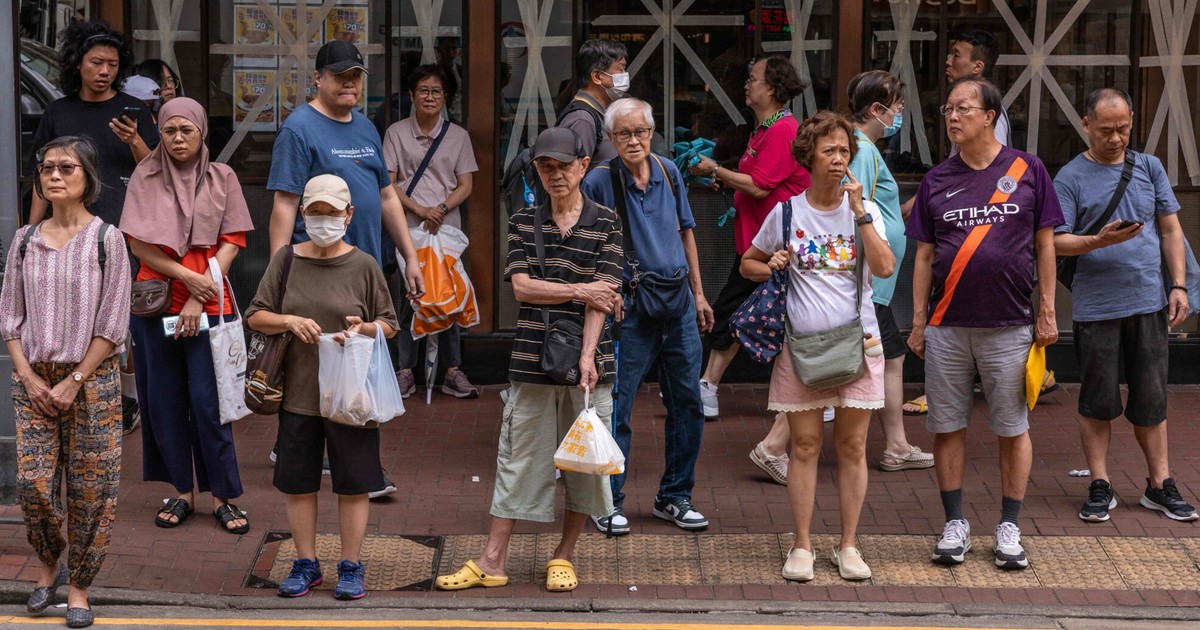
China has shrunk for the third year in a row up to approx. 1.408 billion inhabitants, despite the “dragon year”, which slightly conquered the number of births to 9.54 million. However, there were more deaths, because 10.93 million. Now, as part of the CAC (Central Cyberspace Bureau), the government is starting with an action covering many platforms and online networks, where “excessively strengthening pessimism” will be blocked. It is said that this is to help, among others In the fight against the aging society according to the principle: people who are optimistic, are more likely to start families and decide on children.
The official message of the Chinese government says directly that the control includes “topics, trend lists, recommendations, live subtitles (Danmu) and comments” on social networking sites, in short videos and live-commerce (live shopping). The black list includes Content that strengthens pessimismslogans in the style of “effort is useless” or “science is useless” as well as “selling anxiety” (eg courses feeding on anxiety about jobs) and “malicious distortion of social phenomena”. At the same time, users are encouraged to actively report such content.
This translates into specific tools. The platforms modify the recommendation engines and the list of trends – The regulator directly announced the audits of “recommendations” and “hot topics”. In China, which is worth adding, since 2022 there is a legal regime forcing the recording of recommendation algorithms and enabling them to “straighten” them for prioritizing content in accordance with the “positive energy” line. Thanks to this, the state may require changes to the feed parameters online and suppressing specific topics.
Check also: Colossal jump in China's military technology. The expert does not trust them to the pace of their development
China is technologically mastered
Automatic content moderation is also used: classic lists of words-kicks and more and more often NLP models to detect “bad narratives” and new euphemisms. Studies on searches and Weibo censorship show tens of thousands of locking rules, gray list modes (delayed publishing, silencing range) and automatic “rating” in fractions of a second, as well as cyclical cleaning of the letter “popular in the search engine”. This is the place where various accounts and video disappeared, and today you have to add to, for example, the message “the effort is useless”.
The platforms themselves will also be punished and “straightened”, which prompts them to be overzealous filtration what users publish. In recent days, Weibo, Kuaishou and Xiaohongsh have affected the admonitions just for insufficient moderation of trends and comments. A new wave of control of pessimistic content was also launched.
The network layer of the great firewall works – filtration of DNS addresses (the server blocks or replaces the translation of the page name, so the browser does not know where to connect and the page does not open), IP locks, or snow/dpi filtering (the device looks deeper into packages, recognizes the service/content and can stop it or slow down) – more important for content from abroad, but He closes the ecosystem when “negative narratives” go beyond national platforms.
There are also recipes for synthetic content in the background. There was an obligation to mark and easier to catch video and images generated by AIwhich simplifies the automatic moderation of “anxiety” fakes or “shocking” clips.
Check also: China accuses Nvidia of violation of antitrust provisions
Can this increase optimism – and fertility?
Such actions can insulate the tone in user information feeds, but There is no strong evidence that this will improve real life optimismand even more so tendency to start families.
CAC knows how to change what is visible in trends and comments, while attitudes stabilize mainly through material living conditions and predictability of the future.
The costs of raising a child are in China to the highest in the world relative to GDP per capita, as the government and Think Tanks itself today consider a central barrier – and hence the national payments for care or local encouragement. Research and reviews from recent years show that this A mixture of high housing prices, educational pressure, a shortage of nursery care and women's professional risks after birth. Correction of mood in social media is unlikely to replace it.
There is also a side effect. Users quickly create new metaphors and codes to celebrate filters, which has already been observed many times on the Chinese internet. The campaign, therefore, almost certainly “loads” pessimism in a visible layer, but will not necessarily change their beliefs if the prospects of work, apartment and childcare are not really better.
Although – which is worth noting – there are studies that show that there is such a thing as a clear impact of the narrative about the future on the intentions of having children. The 2022 experiment in the laboratory (Italy and Norway) showed that When people are given a positive vision of the future, their procreation intentions grow. In 2024, a cross -sectional test in many countries “Social pessimism and parenting appeared: the future too gloomy to have children?”, Which shows that contemporary adults often give economic uncertainty, global warming and growing inequalities as reasons why children do not want to have.
As a side note, also a billionaire and the richest man in the world Elon Musk also promotes the “better optimist” attitude and warns against the “fall of the population”. However, this is a motivational philosophy, not a public policy plan. Even if there will be less pessimism on the internet, children's decisions remain strongly economical.
Author: Grzegorz Kubera, Business Insider Polska journalist