The world rushes forward and Europe can barely nozzle. Will the Union finally stop shooting at the foot? Here are three scenarios


In the face of the growing division of the global economy into competing blocks and influence zones, Europe was at the crossroads. On the one hand, he wants to remain a global advocate of multilateral trade. On the other hand – it is becoming more and more based on regulations, which are also an expression of internal values and a tool of geopolitical influence.
This contradiction between openness and control defines the today's economic identity of Europe. Openness requires flexibility, speed and readiness to compete, as well as compromises to conclude trade agreements in a rapidly changing world.
In theory, moderate and transparent regulations can strengthen Europe's soft strength and make it an attractive trade partner. In practice, however, trade companies and partners are increasingly afraid that the European regulatory model is drifting towards stagnation under the guise of caution and control.
It is time for Europe to face an uncomfortable question: Can he remain a reliable, competitive player in the international arena, sticking to the regulatory model that threatens to slow down innovation and economic growth?
Frightened, focused Europe
In recent years, the European Union has focused more and more on internal consolidation: improving regulatory framework, relieving tensions between Member States and achieving strategic goals, such as climate neutrality or digital sovereignty. Although these ambitions are part of the long -term political vision of the community, they have their price – Especially in the area of commercial diplomacy and external economic relations.
Until recently, the EU presented itself, at least on paper, as a global defender of open markets. She was one of the pillars of a multilateral trade system within the World Trade Organization (WTO) and signed a number of free trade agreements (FTA) with Latin American, Asia and Africa. Today, however, many of these contracts have stuck in a deadline or became the subject of sharp political disputes. The agreement prepared for two decades between the EU and the South American economic organization Mercosur was approved, but it was still not ratified. The proposed trade agreement with India is doing very slowly. In the update of the EU trade strategy from 2021, the slogan “open strategic autonomy” appeared – a term that sounds careful rather than ambitious.
Against this background, other powers look much more dynamic. The United States has departed from traditional FTA, but develop bilateral and multilateral frames focused on strategic purposes (e.g. indo-pacific economic framework for prosperity). China concludes further commercial and investment agreements, including regional comprehensive economic partnership (ug), at the same time expanding the initiative of the belt and trail (BRI). The EU, with its slow, consensual decision structure, often reacts too slowly to emerging occasions.
Internal divisions are also part of the problem. Trade policy, although nominally, belongs to the EU competences, remains a politically delicate issue in the Member States. For example, France often opposes concessions in the field of agriculture in trade agreements, while other countries demand more access to industrial markets.
This creates congestion in negotiations and the ratification process. Meanwhile, some powerful regulatory initiatives, such as the mechanism of price adjustment at the borders, including carbon dioxide emissions (CBAM) and the directive on due diligence in the field of sustainable development of enterprises (CSDDD), are perceived by some partners as protectionism in moral robes.
Investors also see this. The complexity of European regulations and legal uncertainty have become discouraging factors, especially for rapidly developing and technology -oriented companies. Although the EU is great at creating regulations, it copes much worse with building innovation ecosystems or quickly concluding trade partnerships. South Korea, Vietnam, and even postbrexit United Kingdom move much more efficiently in this sphere.
Continued article under video material
As a result, the impression arises that The EU is becoming more and more closed and reluctant to take riskssubmitting internal political consensus and regulatory harmonization over speed, flexibility and economic competitiveness. As world trade becomes more and more geopolitical and transactional, such a position can weaken the importance of Europe, unless it is revised.
The wave of adjustment tired and weakened Europe
Europe's dependence on regulations as a strategic tool has long been seen as a source of strength. By constantly expanding the principles and standards of EU promotes its interests around the world, affecting everything, from compliance with environmental protection regulations to digital management. However, as the rate accelerates and the increase in the complexity of regulations both in Europe and beyond it, the fears are growing that this block excessively expands its regulatory range at the expense of economic competitiveness and strategic flexibility.
Recent years have brought a real wave of legislative initiatives to transform the European economy and set global standards. Green order and a set of changes in climate regulations ready for 55 they apply raw environment. CBAM also transfers climate responsibility to trading partners. Meanwhile, broadly extensive digital regulations, act on digital services (DSA), act with digital markets (DMA) and an act on artificial intelligence (AI Act) – which impose rules on technology companies operating on the single market.
Although the goals behind these activities are clear – sustainable development, justice, responsibility – their cumulative burden begins to be a burden. Companies, especially small and medium -sized enterprises, are getting worse with growing reporting requirements and compliance with regulations. Start-ups warn that innovations are stewed in the bud. Even international concerns, who have strong teams of lawyers, are increasingly paying attention to legal uncertainty, administrative delays and lack of predictability.
Signs of “regulatory fatigue” are no longer subtle. Industry groups throughout Europe call for simplification and limitation of regulations. The European Commission itself noticed this problem, and the chairwoman of Ursula von der Leyen undertook to reduce reporting obligations by 25 percent. However, these promises – which have not yet been realized – appear in the context of the growing anxiety that Europe lasts behind in key strategic sectors, not because of the lack of vision or resources, but because it works too slowly to compete with more decisive global powers.
China versus the USA. Europe on the side track
The difference compared to other large economies is striking. The United States, although they left traditional trade agreements, have implemented a proactive industrial strategy, based on investments, speed and transferring production back to the country. China continues state initiatives that submit effectiveness over consensus. Both powers adapt regulations to strategic needs. On the other hand, Europe is still using a uniform approach based on rules, even where geopolitical realities or industrial priorities would require greater pragmatism.
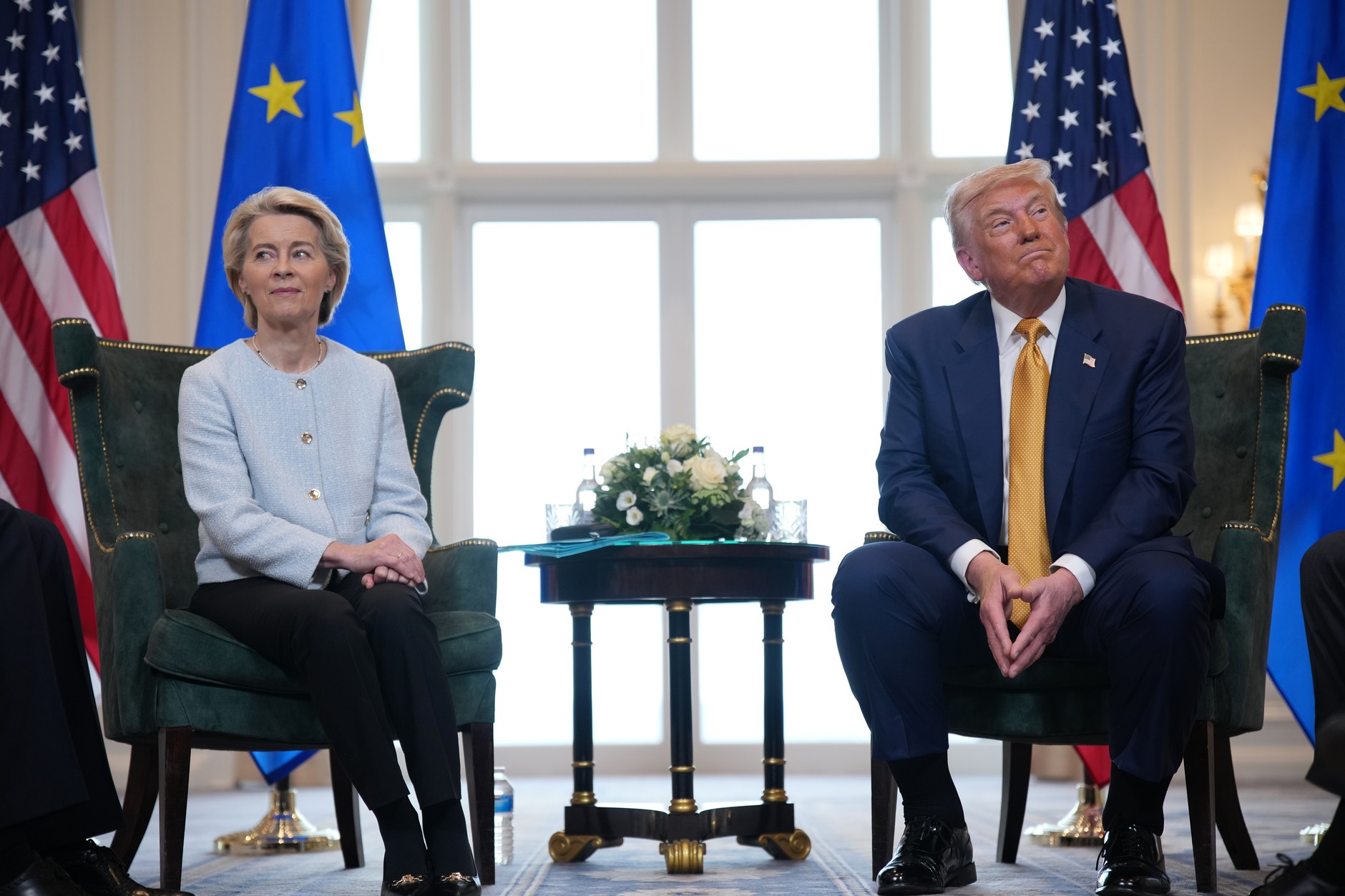
Ursula von der Leyen and Donald Trump, Turnberry, Scotland, 27 July 2025.Andrew Harnik / Getty Images / Getty Images
This discrepancy begins to cost more and more. Europe risks that it will become an entity setting standards without a scale, admired for its ethics, but moved to economic terms. Trade partners can accept EU standards when it is convenient for them, but they are increasingly looking for trade contracts elsewhere – where the negotiations are shorter and the requirements are not so restrictive.
The most likely scenario: Cosmetic changes
In this scenario, the Union continues the current course, improving, but not changing its regulatory approach. The expansion of the rules slightly slows down in the influence of internal pressure, with limited corrections in key sectors – such as artificial intelligence, energy and defense. Attempts are made to simplify the reporting and clarifying legal obligations, but the overall system remains complicated.
On the EU trade front he takes small steps forward. Some of the free trade contracts are refreshed, especially with smaller or “similarly thinking” economies, where internal opposition is limited. The main emphasis, however, remains inwards: to enforce existing regulations, protect consumers and the environment and maintain political cohesion between Member States.
This scenario carries the risk of further weakening of Europe's economic dynamics. Adjusting fatigue will persist. Trade partners will remain careful. Europe will have difficulty reaction in situations of geopolitical interference. The probability of this scenario is 50 percent.
Scenario quite likely: even more adjustment
In this version of Europe events doubles his efforts in the field of regulatory modelby expanding instruments such as CBAM and enforcing harsh trade conditions, data flow and supply chains. What began as normative leadership is transformed into rigid protectionism. Commercial negotiations die, innovation inhibit, and relationships with key partners deteriorate.
Instead of adapting to global realities, the EU inspect its rules, even if it undermines its strategic interests. Start-ups and investors transfer their attention to more flexible markets. The costs of ensuring compliance are rising and competitiveness decreases. The EU retains its standards, but at the expense of influence, economic growth and meaning in the international arena. The probability of this scenario is 30 percent.
Scenario less likely: Strategic trade offensive
Here, growing pressure from industry, changing political moods and increasing global competition forces the EU to correct the course. The new wave of reformers in Brussels and key capitals decides to improve the regulatory system and actively strive to conclude strategic trade agreements. Unnecessary or bothersome regulations are frozen, simplified or delayed.
The European Commission resumes negotiations with Mercosur and India, accelerates contracts with the countries of Southeast Asia and Africa, and is investigating new trade channels with the United States. The regulations cease to be a rigid frame and begin to function as a negotiating tool – used flexibly and selectively.
This scenario would mean a significant change in Europe's economic identity and could revive its global importance. However, it remains unlikely in the near future. Political and institutional inertia, strong interests in the area of regulation and attachment of public opinion to high standards still limit the chance of a radical return to deregulation and active conclusion of contracts.