The US president said that America is ready to impose new sanctions on Moscow – but only on one condition: all NATO countries must stop buying Russian oil. “I am ready to introduce serious sanctions against Russia when all NATO countries agree and begin, and when all NATO countries stop buying oil from Russia,” Trump wrote at the end of last week in social media.
The US Secretary of Energy Chris Wright also spoke in a similar tone. In an interview with the Financial Times, he stated that European Union countries should stop buying Russian oil and gas if they want Washington to tighten economic sanctions against Moscow.
Oil and gas are nothing but a golden alive for the Kremlin, which allows him to pump money into a war machine. Without it, the Russian budget would shrink quickly, and the war with Ukraine would ruin the Russian economy. But as long as oil flows with pipelines, and gas goes to tankers to ports around the world, Putin can sleep peacefully.
The West after the beginning of the war in 2022 significantly reduced the import of these raw materials from Russia, but it was not possible to compensate for this cooperation to zero. Currently, the leaders in the import of Russian oil to the EU are Hungary and Slovakia. The leaders of both countries do not hide their relatives with Vladimir Putin and cool relations with Kiev.
Russia Fossil Tracker, a project carried out by Crea (Center for Research on Energy and Clean Air), informs Russia's natural raw materials it exports on an ongoing basis. And so, despite the sanctions and international pressure to reduce cooperation with Russia, the data show that oil still remains the key export commodity of the Kremlin.
Absolute leader
Since the beginning of the war in 2022, billions of euros sailed from the cash registers of the largest importers in the world directly to Moscow. China is the absolute number one today among Russian oil importers. In the analyzed period, they brought raw material worth about EUR 195 billion.
They came second in Indiawhich since 2022 increased the purchases of Russian raw material rapidly. The value of their imports reached EUR 134 billion.
Türkiye is also high on the list. It is the NATO state that brought oil for EUR 72 billion.
Brussels has introduced numerous restrictions on the import of Russian raw materials over the past three years. EU In total, since 2022, it is the third largest recipient of oil from Russia. The value of purchases is about EUR 105 billion. According to the current plan, the import of oil is to be completely suspended at the EU countries by the end of 2027. A few days ago the chairwoman of the European Commission Ursula von der Leyen announced that this deadline may be shortened.
Among the individual European countries are Germany, which bought Russian oil for around EUR 13.9 billion and Netherlands – for EUR 14.9 billion. Both countries began to limit the import of these raw materials and it is currently virtually zero.
However, there are two countries in the EU that work very fruitfully with Moscow. They are Hungary and Slovakia. Each of these countries from the beginning of the war brought a total of oil with a value – respectively EUR 8.3 billion – EUR 8 billion. The main source of delivery is the southern section of the Przyjaźń pipeline, which is not subject to EU sanctions.
Russia compensates for losses on the European market with trading with countries outside the Old Continent. In addition to the already mentioned countries – China, India – among the recipients were, among others Brazilwith purchases at the level of around EUR 19 billion and Egypt – with imports worth less than EUR 5 billion.
The Kremlin also successfully cooperates with Asian transit hubs. They are Singapore (approx. EUR 12-14 billion) and United Arab Emirates (approx. EUR 9-14 billion), which act as intermediaries. They import oil from Russia and often redirect it – to Asian or African markets.
Two special countries
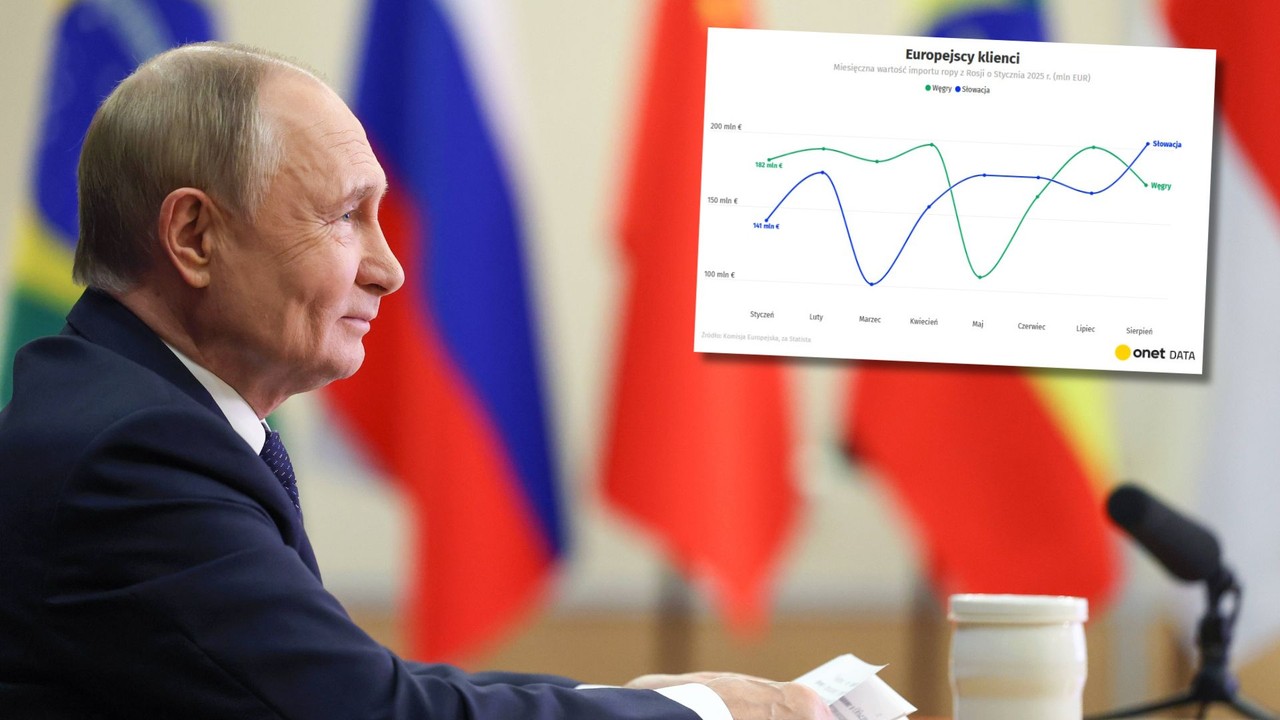
Let's look at Hungary and Slovakia, i.e. two countries that import the most in the EU oil from Russia. Here is the Center for Research on Energy and Clean Air for the period from January to August 2025.
In the analyzed period, Hungary brought Russian raw material with a total value EUR 1.404 billionand Slovakia is not much less – EUR 1.301 billion. On average, this means monthly expenses at the level EUR 175.5 million in the case of Budapest and EUR 162.6 million in Bratislava.
Differences in import dynamics deserve special attention. Hungary maintained a relatively stable level of shopping – from 182 million euros in January, through 191 million in February, to 197 million in April. Slovakia, in turn, recorded significant fluctuations: in February imports amounted to as much as 175 million euros, but in March it fell to just 101 million, and in May it would increase to 178 million again.