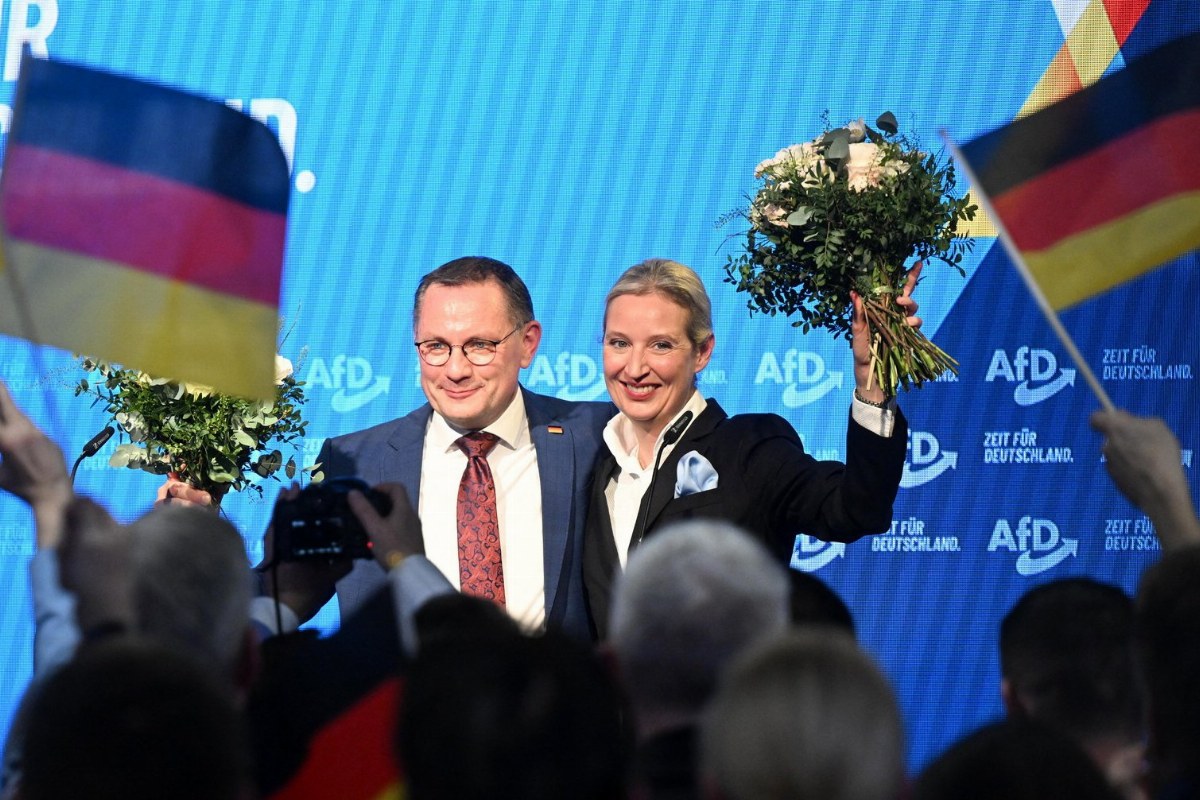
The far-right party Alternative for Germany (AfD) has extended its lead over the center-right coalition supporting Chancellor Friedrich Merz, according to a national poll released Thursday by DPA.
The survey by Infratest Dimap indicates that only 21% of voters would back Merz’s center-right coalition, which includes the Christian Democratic Union (CDU) and the Christian Social Union (CSU). This reflects a decrease from earlier polling conducted in July.
Meanwhile, the AfD, known for its conservative, Eurosceptic, and anti-migration stance, has risen to 28% in this latest poll. The party is currently under investigation by German intelligence agencies for its extremist views.
The Social Democratic Party (SPD), part of the governing coalition led by Merz, garnered 12% of voter intentions, while the Greens received 15%, the Left Party (Die Linke) 11%, and the Free Democratic Party (FDP) 4%, all showing no changes from the last poll.
Poll Ahead of Regional Elections in Three States
Although Germany’s next federal elections are not scheduled until March 2029, regional elections are set for next month in three eastern states: Berlin, Saxony-Anhalt, and Mecklenburg-Vorpommern. Current polling suggests the AfD could see record gains in these elections.
In Saxony-Anhalt, the AfD is projected to achieve an absolute majority, with recent polls showing it at 41% compared to 24% for the CDU, 13% for the Left Party, 7% for the SPD, and 5% for the Greens.
Social Democrats Call for AfD Ban
German Vice Chancellor and Finance Minister Lars Klingbeil has expressed support for potentially initiating a ban on the AfD party. In an article for Die Zeit, Klingbeil, who is also the SPD’s vice president, advocated for maintaining a “cordon sanitaire” to isolate the AfD from progressive, pro-EU center-right and center-left parties.
The discussion around banning the AfD has gained momentum over the past two years, particularly after a report from the NGO “Society for Civil Rights and Liberties (GFF)” claimed last month that the party is unconstitutional.
The German intelligence agency, the Federal Office for the Protection of the Constitution, has already classified the AfD as a party suspected of extremism and obtained legal rulings that allow it to monitor the party’s communications and surveillance through undercover agents.
While actions to ban political parties have been pursued in the past in Germany, they have typically targeted smaller groups and never a party enjoying the level of popularity currently experienced by the AfD. Critics argue that such a process could be lengthy and yield uncertain results at the Constitutional Court.