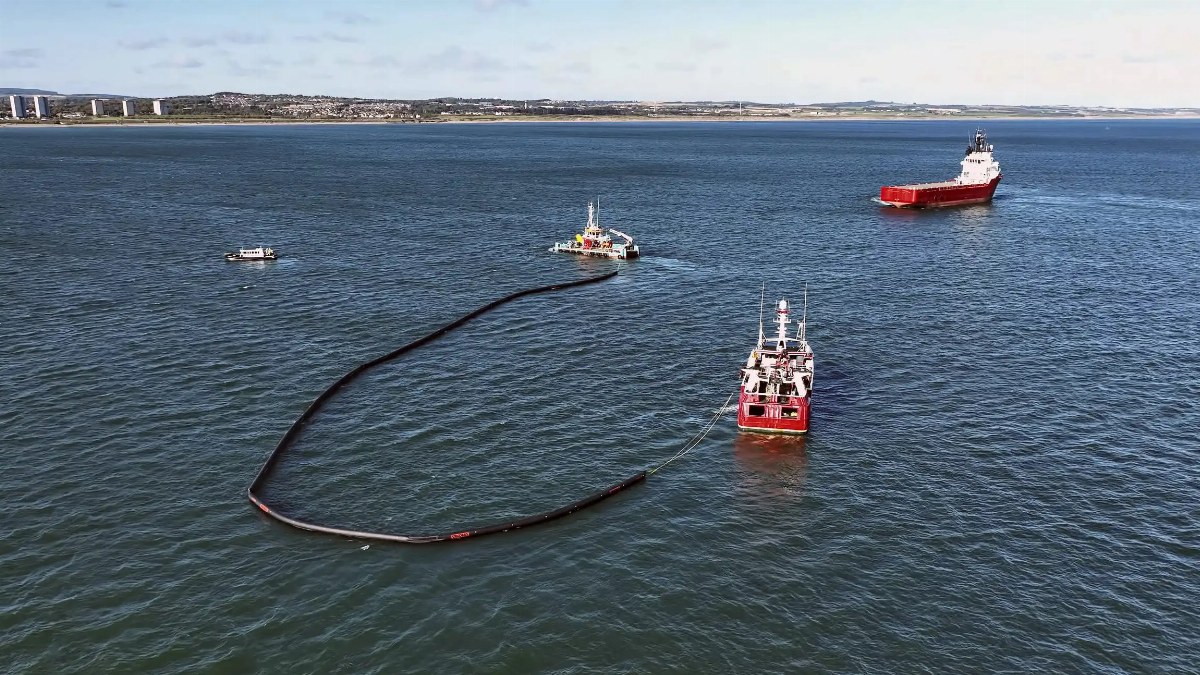
From his lounge chair, Pavlos Beleyiannis watches his grandchildren swim in his favorite bay. This year, however, a floating barrier has been installed for the first time at the bay to guard against the risks posed by toxic rabbitfish, as reported by The Guardian. “Thank God it’s there to protect them,” said Beleyiannis, a recently retired truck driver. “When I was a child, there were no such dangers in these waters,” he emphasized.
Until last summer, it was believed the only hidden dangers in the waters of northern Euboea Bay, separating Evia Island from mainland Greece, were jellyfish. However, an increase in jellyfish stings had overwhelmed the pharmacies in Chalkida, the island’s capital, prompting them to work late hours to accommodate the surge in incidents among swimmers.
The emergence of toxic rabbitfish, equipped with long teeth capable of biting through bone, metal, and even wood, has introduced a new threat. In an unprecedented move, the Hellenic Red Cross issued a public health warning recommending that citizens seek immediate medical attention if bitten, as their “beak-like jaws” can cause severe injuries and bleeding.
The organization also warned against consuming this species due to the presence of the potentially lethal neurotoxin, tetrodotoxin, found in their organs and flesh. There is no known antidote for this poison, and eating rabbitfish can lead to death.
Floating Barriers Installed in a Popular Greek Destination
“Our primary duty and concern must be the safety of citizens,” stated Antonis Spanos, the vice mayor of Chalkida, overseeing the recent installation of the floating barrier, the first of its kind in Greece. “It’s better to be cautious than to regret later,” he stressed.
At 40, Spanos represents a new generation of local politicians determined to take preventive action. He noted that authorities spent months navigating the necessary procedures to secure funding and organize bids to install the most effective protective barrier, which was approved by the national public health laboratory.
“We will install two and a half kilometers of this net in the bays surrounding the gulf so that people can enjoy a worry-free summer,” he stated. “Last year was tough due to jellyfish, but as they say, we’ve killed two birds with one stone. Now, if rabbitfish appear, we will be ready for them too,” he added.
He recounted that the mayor’s office has been inundated with calls, particularly from elderly residents eager to know when the barriers would be installed. “Just this morning, a woman called to say she would feel safe swimming with her grandchildren only after the barrier is in place,” the politician reported.
Other Authorities Follow Chalkida’s Lead
Chalkida is not alone in adopting such measures. This week, Nikos Choulieris, who has operated a diving school for many years, took his team out in a speedboat to anchor additional floating barriers in shallower waters at nearby beaches, as other municipalities begin to embrace the same solution.
“I have been diving for over 40 years and never imagined I would see the day when I would do this,” Choulieris said. “The sea temperature has certainly risen, creating even more favorable conditions for what we are now witnessing,” he added.
In the coming weeks, approximately seven kilometers of floating barriers will be transported by truck from Athens to this region.
“I don’t believe anything could get through this net, not even the teeth of a rabbitfish,” Choulieris asserted. “It has very dense mesh and is extremely sturdy. They would have to bite the same spot repeatedly to break it, and I don’t think they will do that,” he emphasized.
Greece and Cyprus Offer Rewards for Catching Rabbitfish
The proliferation of the Lagocephalus sceleratus species has become so widespread that officials say the entire eastern Mediterranean is falling prey to this aquatic pest. Similar to lionfish, native to the Indo-Pacific region, this torpedo-shaped fish is believed by scientists to have been attracted to the Mediterranean due to rising sea temperatures. They made their way to the Mediterranean from the Red Sea, traversing the Suez Canal.
Cypriot fishermen were the first to report that their catches and nets were being devastated by this inedible intruder. In 2024, Cypriot authorities introduced financial incentives within a government eradication program that has removed over 103 tons of rabbitfish from coastal waters.
Katerina Georgiou, from the island’s fisheries service, attributed the species’ expansion to its “remarkable adaptability,” stating to local publication Sigma that, in the absence of an official census, it is “impossible to draw reliable conclusions about the total population or future trends.” She noted that the presence of rabbitfish is not a temporary phenomenon but a new reality that can no longer be ignored.
Last week, Athens announced a similar capture reward program, offering €5.33 for each kilogram of these toxic fish handed over to authorities.