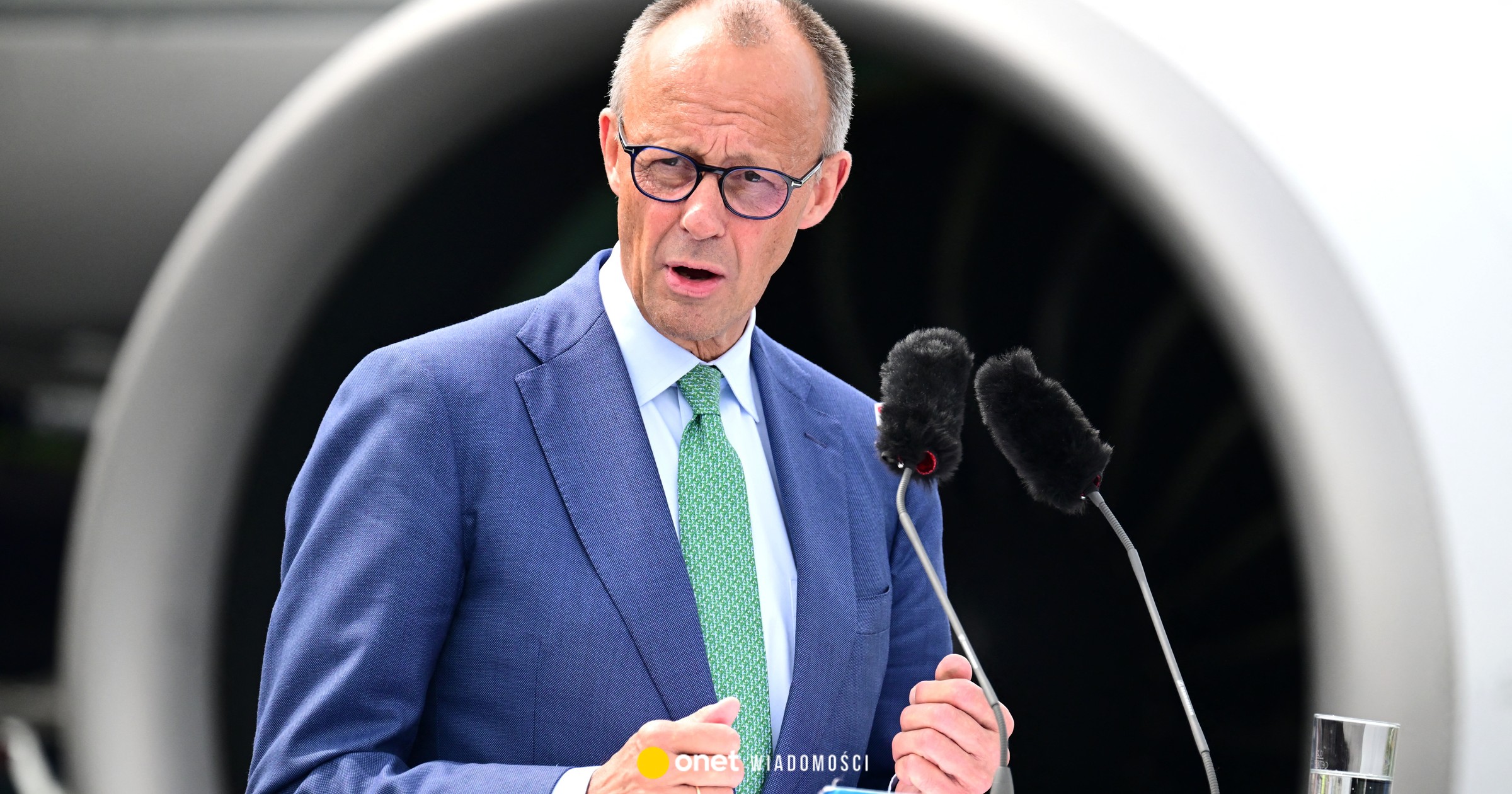
— Germany has always been an aviation pioneer, Chancellor Friedrich Merz said at the opening of Berlin's ILA air show on Wednesday, unveiling a new aviation strategy aimed at combining civil aviation, military aviation, innovation and national security.
This confidence shows that Germany feels liberated after the collapse of the Future Combat Air System (FCAS) fighter aircraft project, which ended due to irreconcilable differences between France's Dassault Aviation and Germany's Airbus Defense and Space.
However, unlike Spain, which spends little on defense and has a less developed military-industrial sector, and technologically advanced but financially struggling France, Germany claims to have the technology, enterprises and financial capacity to undertake the gigantic project of building a state-of-the-art combat aircraft. This belief also prevailed at the Berlin Air Fair.
Merz tried to present the severance of cooperation with France in the field of combat aircraft as an opportunity for German industry. He said that ending the long-term impasse “will open up new opportunities” for building modern combat aircraft using other methods.
This shows that Germany is starting to change their approach and wants their money to translate into a leadership position.
For decades, France — one of Europe's two nuclear powers with historically strong militaries — had a psychological advantage over Germany on defense.
The article continues below the video
France had Dassault and its Rafale combat aircraft, nuclear weapons, aircraft carriers, and a state tradition that treated aviation as an expression of national power. Germany, on the other hand, was more comfortable with international agendas – powerful, wealthy and technologically advanced, but rarely willing to be the main driver of change.
This dynamic is changing.
Germany takes the place of France
According to NATO classification, Germany overtook France in terms of defense spending in 2019, when Berlin spent 46.9 billion euros (199 billion PLN 466 million) compared to 44.2 billion euros (187 billion PLN 983 million) in France.
It is expected that by 2029, Germany will spend EUR 153 billion (PLN 650 billion 709 million) annually on defense. This amounts to approximately 3.5%. GDP, which is consistent with NATO's 2035 target and constitutes the country's most ambitious military expansion since unification. For comparison, France plans to reach the level of EUR 72.8 billion (PLN 309,680 million) in 2029 thanks to the updated military planning law, which the French parliament is currently working on.
France is struggling with much greater fiscal constraints, and budget watchdogs warn that additional defense spending could mean politically controversial cuts in social spending. Germany's public debt is 63.5 percent. GDP, while France – 115.6 percent.
Although Paris is struggling financially, it has expertise in technology. The Rafale aircraft was developed by Dassault, which helped finance the project through strong export sales; the United Arab Emirates' 2021 order for 80 Rafale F4 aircraft was a huge cash injection.
But if France wants to develop its own sixth-generation fighter, which Dassault CEO Eric Trappier has repeatedly said his company is capable of, it will have to ensure its future exports. The total value of the FCAS program was estimated at approximately EUR 100 billion (PLN 425 billion), which is a scale that would be a difficult challenge for France to finance on its own.
RALF HIRSCHBERGER / AFP / AFP
German Chancellor Friedrich Merz together with representatives of the German Air Force during the opening ceremony of the International Aviation Fair (ILA) in Schonefeld near Berlin, June 10, 2026.
However, exporting also involves risks. Paris hoped that Abu Dhabi would help finance the modernization of the Rafale F5 aircraft, but the talks ended in failure after the Emirates demanded a greater share in development work and access to advanced technologies, according to La Tribune.
This confirms the original logic behind FCAS – France has more advanced technology for building combat aircraft, while Germany has greater financial resources.
Nowadays, however, German industry is rapidly taking over the space left by France.
A group of defense companies led by Airbus, called Team Gen 6, this week presented a document to the German government regarding the design of a sixth-generation fighter. The group includes: Airbus, Diehl Defense, Hensoldt, Liebherr, MBDA, MTU Aero Engines and Rohde & Schwarz.
Michael Schoellhorn, head of Airbus Defense and Space, said German industry has “knowledge, technologies, capabilities and clear determinationto develop and build FCAS and a sixth-generation fighter – for and with Europe.
Schoellhorn's statement shows that Germany is not just offering a contribution to the next European combat aircraft. They position themselves as an industrial center.
— We are not in favor of Germany acting alone. We think European. However, we want German industry to play a central role, he said.
But it will take more than just money to build a cutting-edge stealth fighter and the drones, surveillance and computer systems needed to survive on the future battlefield. Germany will need partners, an export strategy, engineering authority and military solutions that will survive subsequent political cycles.
However, the mood at the ILA fair was not pessimistic. During a morning speech alongside Schoellhorn, the head of the German Air Force, Lt. Gen. Holger Neumann, emphasized the urgency of the matter, saying that The Bundeswehr needs an answer “today – not in a year or three years.”
Merz summed up Germany's new confidence. — Germany presents itself as a country that lives and invests in the future of aviation, said the Chancellor. – We are an attractive location for the entire aviation industry, which is among the world's leaders thanks to innovations in civil and military aviation – he assured.
I’m Ashley Davis as an editor, I’m committed to upholding the highest standards of integrity and accuracy in every piece we publish. My work is driven by curiosity, a passion for truth, and a belief that journalism plays a crucial role in shaping public discourse. I strive to tell stories that not only inform but also inspire action and conversation.