CSM directly attacks PNL, USR and Bolojan. The judges put PSD on the list of victims. On behalf of 3,580 judges, they asked the Gendarmerie to tell them how many people demonstrated against them

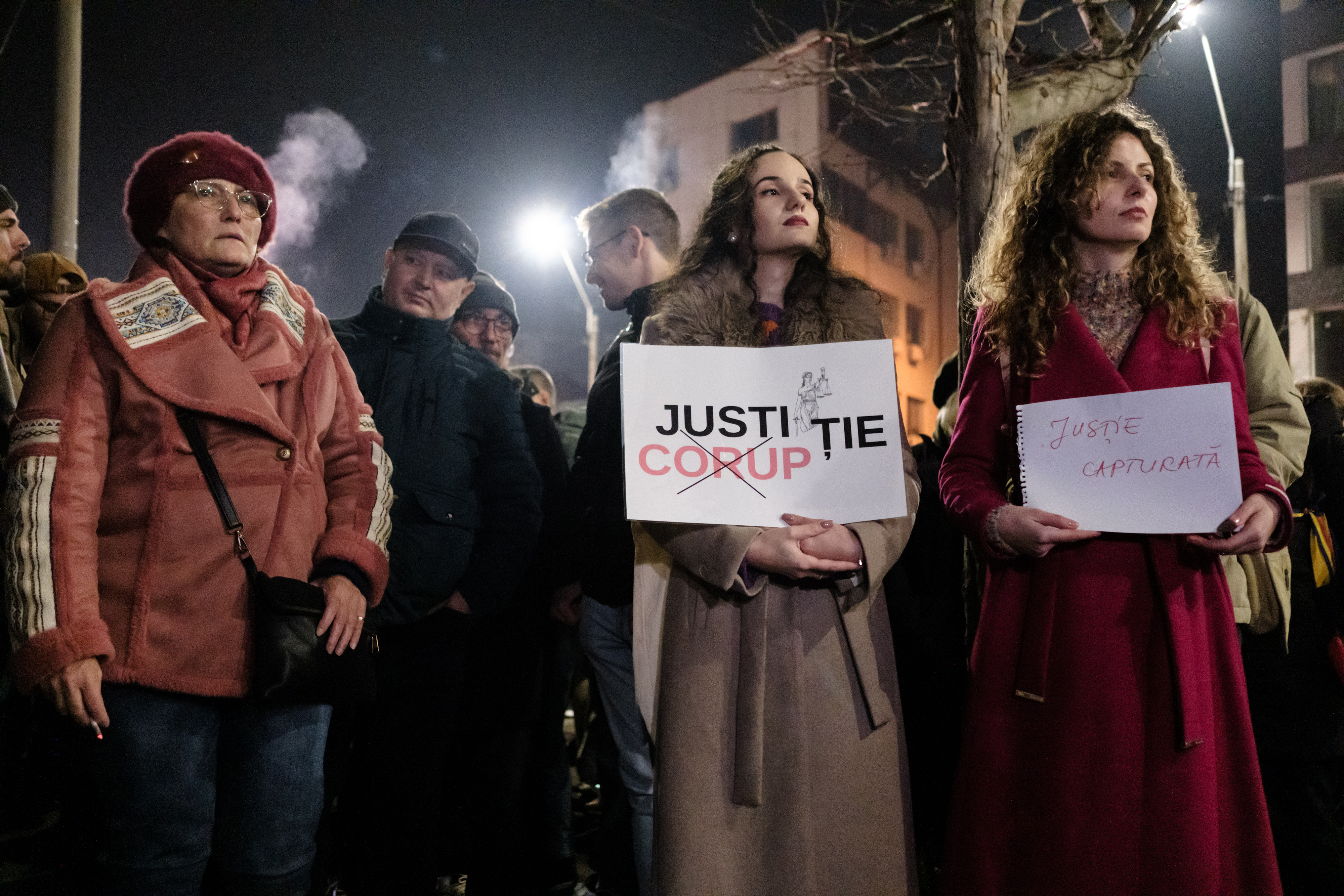
The Superior Council of the Magistracy claims that “the judiciary is currently subject to a veritable coup d'etat”, which “pursues a forceful change in the rules and the people in key positions”. In order for the coup against the judiciary to succeed, protests were also organized, says the CSM.
- Who were the authors? “The protests were organized with the support and direct involvement of some politicians, members of a party in the governing coalition, close to the prime minister,” says the CSM document.
- Politicians from PNL and USR appear as instigators, with first and last names, dozens of times in the recent CSM decision.
- PSD is mentioned twice. In another way.
- Also, the CSM publishes the division by county of the judges who have been criminally investigated by the DNA. The numbers are staggering.
In the document of 77 pages and 136 points, the Superior Council of the Magistracy claims that in Romania there is a coordinated movement “that aims at a hostile takeover of the legitimate leadership of the judiciary”. The CSM states that this movement wants “a return to an old system”.
What system?
1,900 judges out of 4,500 criminally investigated by DNA. At the ÎCCJ, 75% of the judges were criminally investigated. The division by counties
The CSM says that those who “synchronize” want justice to return to the period when judges were investigated by DNA with a frequency transformed as a “means of pressure” on them.
The council indicates the figures. They appear in a report of the Judicial Inspection. “It was an unacceptable situation in which more than 1,900 judges were the subject of criminal investigations,” says the CSM. And it details by county.
Prior to 2018, the following were investigated by DNA:
- At the High Court of Cassation and Justice – 75 judges (out of approximately 100)
- At the Bucharest Court of Appeal – 100 judges (out of approximately 218 judges)
- At the Oradea Court of Appeal – 35 judges (out of about 40 judges).
- At the Ploiesti Court of Appeal – 30 judges (out of about 50 judges).
- At the Braşov Court of Appeal – 25 judges
- At the Court of Appeal, there are 20 judges (out of about 45 judges).
- At the Constanta Court of Appeal – 15 judges (out of about 40 judges).
- At the Timişoara Court of Appeal – 15 judges (out of about 60 judges).
- At the Bucharest Court – 85 judges (out of about 200 judges).
- At the Argeş Court – 25 judges (out of about 40 judges).
- At the Bihor Court – 30 judges (out of about 40 judges).
- at the Dolj Court – 25 judges (out of over 70 judges).
The CSM says that the judges were intentionally pressured by the DNA
The figure of 1,900 judges under criminal investigation is related to the total number of judges. In Romania there are approximately 4,500 judges and approximately 2,300 prosecutors, says the Council.
The CSM mentions that anti-corruption prosecutors have reached abuses. The prosecutor's office investigated the judges not for real facts, but “for the solutions ordered in the cases”.
The council also adds that the abuses can be seen in the finality of the files. “In the overwhelming majority of situations, non-prosecution solutions were ordered.” But very late. Only “after significant periods of time have passed”. This is so that the judges can be kept under pressure. And not just the judges in the files, but the entire judiciary, says the Council.
The numbers are truly staggering.
I either had:
- The most corrupt judges in the world (more than 40% criminally investigated at the country level, but 75% at the High Court) and the weakest prosecutors, because they closed the files.
- We had honest judges, but prosecutors who targeted them to destroy or blackmail them. Both options sound bad for DNA. Especially since it was the same DNA that boasted conviction rates of over 90%. But not to the judges.
This is how, in the CSM's view, the past showed, with vulnerable judges. Who would want to revisit this past? Those who now make up a synchronized movement. who are they
NGOs, experts and Ilie Bolojan
“The campaign of denigration as a whole, which accompanied the forceful measures related to pensions and salaries, was fully participated by politicians of the governing coalition, especially from USR and PNL”, says CSM.
“In this sense, a journalistic material produced by a press entity, Recorder, whose public positions usually align with those of the political forces patronized by the prime minister and the president, was used as a pretext, which aimed to reveal alleged acts of corruption at the level of the Bucharest Court of Appeal”, the Council claims.
A working group of Prime Minister Bolojan is also part of the movement, say the judges. “This working group represents a facade, a justification, for an execution of judicial authority by the executive power, by modifying the rules of organization of the profession (laws of justice) in the direction desired by the political environment”.
The group includes “several approved NGOs, which throughout this period have been extremely active against judges (Declic, Funky Citizens), part of the smear campaigns related to pensions”.
How the “Laura Ștefan case” was built
The NGO Expert Forum is also mentioned and the presence of Laura Ștefan in the NGO is mentioned. She is one of the longest-serving and internationally recognized legal experts.
However, the CSM lets it be understood that Laura Ștefan has a problem with her presence in the working group because “she is a member of the vetting commission for prosecutors from the Republic of Moldova”.
The CSM insists, in several places in the Decision, on the person of Prime Minister Bolojan: “The campaign was based on constantly repeated lies by a part of the coalition in power today, especially by the political part under the authority and influence of the Prime Minister, by their media vectors, as well as by NGOs that are traditionally affiliated with their messages.”
The publication G4Media is also under attack, which lists the “against” articles.
However, traditionally, G4Media has positioned itself through a critical distance from the heads of justice. And after journalist Liviu Avram came from Adevărul to G4Media, the frequency of articles in the field increased. Because Avram always writes about justice.
PSD appears next to CSM in the list of those criticized
If PNL, USR and politicians from these parties are mentioned dozens of times as part of the group that wants the coup d'état from the judiciary, the name PSD appears only twice in the document.
In both situations, the Social Democratic Party is referred to as a “victim”, hit by the same people or NGOs who also criticize the CSM.
For the first time, the CSM lists PSD as a target on the Corruption Kills Facebook account. For the second time, PSD appears in the CSM's monitoring of the Funky Citizens Facebook account, where an anti Daniel Băluță – PSD post is listed.
“Anti Mr. Cătălin Predoiu”
And Cătălin Predoiu, the Minister of the Interior, is also remembered as a victim of criticism. In the right of some posts from FB Corupția Ucide and FB Declic, CSM notes: “anti Mr. Cătălin Predoiu”.
On the other side, politicians like Dominic Fritz and Cristian Ghinea are listed as part of the movement that wants, illegitimately, power in the judiciary.
Other names grouped by the CSM in the occult camp: Cătălin Teniță, Laurențiu Ștefănescu, Laurențiu Ștefănescu, Luben Latcău (vice mayor of USR Timișoara), Ana Birchall and Elena Calistru.
Oana Gheorghiu, Ionel Stoica, Diana Mardarovici, Andrei Răzvan Lupu and Oana Alexandra Cambera are also on the “black list”.
“The purpose of the proceedings is to change the legitimate leadership of the judiciary,
as well as to change the rules for organizing the profession”, says the CSM.
CSM says trust in judges has fallen in less than two years from 52% to 35%, which is “unnatural”
In 2024, 52% of citizens trusted judges, claims the CSM.
In 2025, it reached 44%.
In August 2025, “after the start of the smear campaign”, it reached 35%, the Council says.
The Council believes that the sharp downward slope is the result of the movement propagating the “judicial coup”:
“This involution is an unnatural one, being generated by organized, coordinated mechanisms, which involved instigations of the political power, the taking over of the rhetoric by the affiliated media, including through the use of informational means (social media), similar to other domestic or international situations qualified as part of a hybrid attack”.
They called the Gendarmerie
CSM lists among the methods used by the conspirators and the demonstrations that appeared after the Recorder documentary “Captured Justice”.
About the demonstrations, the CSM states: “Thus, although they were presented as an emanation of civil society, with tens of thousands of online signatures behind them, it is indisputable that they were initiated and organized with deep political support, direct or indirect, public or less public, both organizationally and through help for funding by appeal”.
The CSM says that it learned from the “competent authorities” the number of participants, which was small. In matters of public gatherings, order and safety is ensured by the Gendarmerie. The Gendarmerie also does its own numerical monitoring, in order to allocate proportional forces.
“The organized meetings did not bring more than 2,500 people to the streets (according to the data provided to the Council by the competent authorities), even if the press affiliated to the political power also featured exaggerated figures of 10,000 participants,” said the CSM.
The council claims to have identified suspicious social media accounts
CSM says it also researched social media. And that he discovered some unnatural activity.
“At the level of the Superior Council of Magistracy, countless accounts were monitored on various social networks, fake or old, but recently activated and apparently suddenly interested in the justice situation, after years of inactivity, demonstrating an atypical, unnatural, but very effective phenomenon of influencing public perception.”
“Exceptional Coordination”
And, again, PNL and USR appear.
“Besides these (no fake accounts on social media), the Council has documented public positions that come from the same side of the political spectrum (especially the Save Romania Union and the National Liberal Party), and addresses topics related to the justice system, presented distortedly, with half-truths or simply lies, with the aim of denigrating by creating strong public emotion.”
“Finally, it is obvious the press campaign by some journalists and public figures affiliated with the same political area, who emit the same type of negative message towards justice, with the same themes, at the same time, likely to create the impression of an exceptional coordination”.
“Veritable coup d'état”
In such a tangle of assumptions and “political targeting”, the valid points in the CSM document become hard to discern.
For example, the judges note the fact that the prescriptions were fully attributed, as public perception, to the courts. This, although statistically the prosecution by the prosecutors was the one that delayed and “eats” the most of the statute of limitations.
Another example: it ignores the study of the European Commission which shows that young judges in Romania are poorly paid, compared to their counterparts in Europe.
A rookie Romanian judge has a net salary of 16,863 euros per year, which is half of the salary of a Bulgarian rookie judge, who receives 35,622 euros per year.
When you talk about conspiracies, the numbers and facts are no longer noticed, that they are not as spectacular, because they do not have the attraction of a “real coup d'etat”.
The full decision of the CSM: