From Berlin, Peter Magyar has a message for Zelenski about fundamental human rights and names the condition to meet him

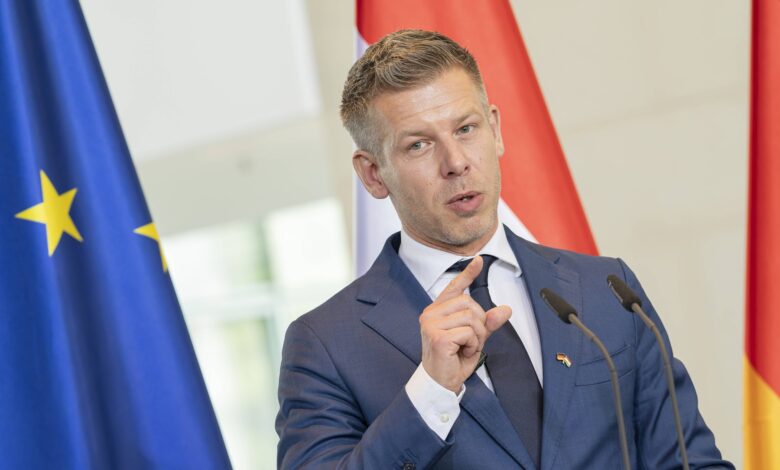
Hungarian Prime Minister Peter Magyar said on Tuesday that he is ready to meet with Ukrainian President Volodymyr Zelensky next week to open a new chapter in relations between the two countries, after ousting his predecessor Viktor Orban, known for his pro-Moscow position, in parliamentary elections.
On an official visit to Berlin, Magyar said he was ready to meet with Zelenskiy if technical negotiations on the rights of the Hungarian minority in neighboring Ukraine, in the western Transcarpathia region, were concluded this week, and that he was optimistic the issue could be resolved.
Improving relations between Hungary and Ukraine is central to the European Union's support for Kiev in its war on Russia, with Viktor Orban consistently opposed to Ukraine's billions of euros in aid and EU membership.
“So far, the negotiations are progressing in a very encouraging way and we hope that they could even be concluded on a technical level this week,” said Magyar, who was with German Chancellor Friedrich Merz, referring to the rights of the Hungarian minority in Transcarpathia.
“And here in Berlin, I can repeat that I am ready to meet with Ukrainian President Volodymyr Zelensky early next week, provided we really reach an agreement on these fundamental human rights,” the Hungarian prime minister added.
Hungary is rebuilding its ties with EU states
Magyar was in Berlin on a visit that will also take him to Paris on Wednesday as his government seeks to rebuild relations with other EU countries after a period of tension under Orban.
Since taking office following elections in April, Magyar has secured agreement to unlock 16.4 billion euros in EU recovery and cohesion funds that had been frozen under the Orban government, with Hungary pledging to continue anti-corruption reforms.
Magyar's election victory also paved the way for 90 billion euros worth of EU funds to flow into Ukraine. Orban had opposed the transfer of funds because of a conflict over energy supplies.
Although Magyar takes a less confrontational approach to Kiev, he says progress on the right of Ukraine's 150,000 ethnic Hungarians to use their mother tongue is essential for Budapest to agree to Ukraine's EU membership.
In May, Merz promoted an initiative to grant Ukraine “associate” EU membership as a first step, a proposal that Zelenskiy said was unfair because it would leave Kyiv without a voice within the EU bloc.
“We understand that Budapest wants to clarify bilateral issues first, such as the rights of the Hungarian minority in Ukraine,” Merz said. “However, this must not come at the expense of European support, nor should it deter us from our goal of formally opening accession negotiations with Ukraine now, with the first chapter,” the federal chancellor added.
Merz welcomed a new start in relations with Hungary under Magyar after Orbán's 16 years of rule, saying: “Democracy and the rule of law in Hungary are strong again. We trust that he will bring Hungary back to the heart of Europe.”
“Peter Magyar has shown that the pendulum doesn't just swing in one direction — toward illiberalism or even authoritarianism. It can swing impressively back toward the center,” the German chancellor added.
Magyar visited Poland in May, then Austria. After visits to Germany and France, he will host the Irish Prime Minister in Budapest this week.