
How TikTok turns our fear into votes. Why is Romania a special case? Interview with Justin Poncet, creator of the EU anti-fake news algorithm

In Romania, only a small part of the content circulating on social platforms can be considered authentic journalistic information, while negative emotions, mistrust and polarization are constantly amplified by algorithms and various influence operations. Justin Poncet, CEO of the French company Opsci.ai, explains why Romania is a special case in Europe, how the mechanisms that transform certain narratives into viral phenomena work and why the fight against disinformation cannot be won by the state alone.
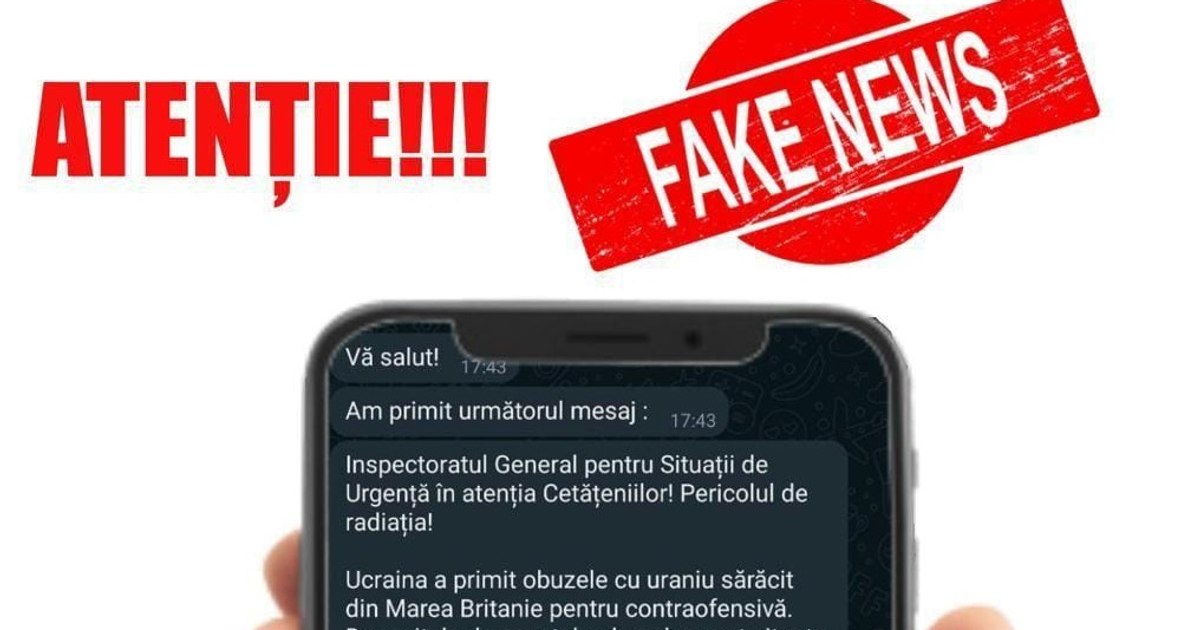
Fake news alert Photo: Facebook IGSU
In an analysis for Adevărul, Justin Poncet, the creator of the algorithm used by the European Union to combat disinformation, explained why the phenomenon of disinformation can be combated without resources comparable to those invested by the actors who feed it, mainly referring to the Russian Federation.
On the one hand, he explains that proximity to Russia influences the intensity of informational influence phenomena, Romania being, symbolically, closer to the “front line” in this type of confrontation. On the other hand, the structure of media consumption differs significantly from countries like France, where platforms have other weights in daily life, while in Romania Facebook and TikTok occupy a central role in the daily information of users.
“What we find very interesting is the fact that the Romanian digital landscape is very different from the French one. There are two main explanations. The first is a geographical one. The closer you get to Russia, the closer you are to the front line of the information confrontation. From this perspective, the phenomenon is much more amplified in Romania than in France.
The second explanation has to do with the media and digital ecosystem. In Romania, Facebook and TikTok have a much greater importance in daily information consumption than in France.”
Justin Poncet, CEO Opsci.ai Photo: The truth
Distrust of institutions fuels the consumption of algorithmic content
Asked about possible economic or social explanations for online behavior, the expert avoids a strictly economic interpretation, stressing that his team's observations point more to a crisis of institutional confidence.
“I don't think I'm in a position to comment on whether the level of income influences the behavior of users on social networks. What we observe, however, is a different relationship with institutions. In the content we analyze, there is a much more pronounced mistrust towards political institutions, but also towards the mass media.
When people no longer trust journalists and traditional sources of information, they turn to online platforms and consume content distributed by algorithms. In this process there is no longer always a clear demarcation between absurd content, legitimate political opinions, erroneous information and disinformation.
That is why we insist on the idea that the phenomenon is not black and white. There is not only truth and lies. There is a very wide range of content that starts from real facts and expresses legitimate opinions, but also content that exploits emotions to influence public perceptions.”
TikTok and the exploitation of negative emotions
The major paradigm shift in propaganda was explained in detail by project representatives. They warn that modern disinformation no longer seeks to convince ideologically, but to destabilize emotionally:
Poland is asking the European Commission to intervene after AI-generated videos on TikTok promote the country's exit from the EU
“On TikTok, we notice that most videos do not directly address political themes. Instead, they accentuate negative emotions such as resentment, anger or fear.
These emotions are used to promote content that amplifies mistrust. From our perspective, this is the main objective of influence operations associated with Russia. It is not necessarily about promoting a certain political agenda, but about strengthening distrust in institutions and democratic mechanisms. This process generates polarization, and polarization favors the rise of populist candidates.
New European populist movements are hard to define ideologically. It is difficult to determine whether they are rather economically liberal or illiberal, conservative or not. But they all have one thing in common: the exploitation of mistrust and fear.” says Justin Poncet.
Image from a report on disinformation coming from the Russian Federation
How much is Russia investing in disinformation?
The specialist says that in the war against disinformation, the amounts should not be equated with those invested by the entity that wants to propagate certain false news.
“Russia invests very large sums in propaganda and information operations. Estimates speak of about two billion dollars annually. However, it is difficult to know how much of these funds actually reach the actual operations, due to the high level of corruption existing in the system.
Moreover, the mechanism is often ineffective. Just as there are inefficiencies in other areas of the Russian state, so there are in information warfare. Thousands of operations are launched, many of them without significant results. Only a part manage to produce real effects. It is our belief that defense can be achieved with far fewer resources than those invested by actors conducting influence operations.
We don't need to monitor tens of thousands of accounts. The study shows that only a few dozen of them manage to significantly influence the digital public space.
It is important not only to identify those accounts, but to understand the mechanisms that make them effective. We need to analyze why a particular narrative has transcended fringe circles and reached elected politicians or the mainstream media. By understanding these mechanisms, we can build effective responses and develop countermeasures,” he explains Justin Poncet
Nicușor Dan, speech at the summit on combating disinformation: “We debate one thing on television, the other debates people on Tik Tok”
Part of the solution may be legislative, but it is not enough to ask for the intervention of platforms like Facebook or TikTok.
“Fighting disinformation requires a joint effort. The state is slow by its nature, and democracy involves alternation in power. For this reason, it is not healthy to transfer all responsibility to public institutions.”
A democratic coalition against evil influence
The solution found at the international level is the need to involve non-governmental organizations, companies and European institutions.
“Companies can contribute technological and methodological tools. Civic organizations can develop education and monitoring programs. And the European Union is already investing in combating disinformation and can provide additional expertise and resources.
The strength of such an approach lies in its collective and multilateral nature. It is essentially a democratic response to a challenge to the very functioning of democracy.”


