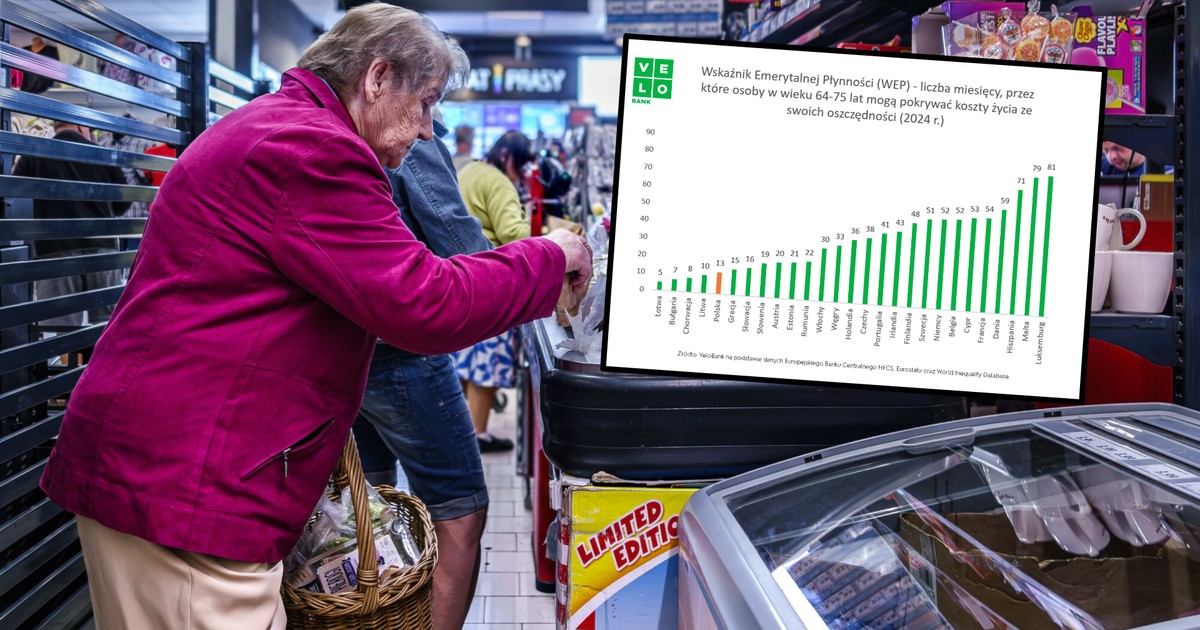
Economists point out that Despite the relatively high “wealth on paper”, many retirees have limited funds to finance current living costs. Their savings allow on average to cover approximately 12.5 months of expenses.
“Limited availability of financial resources with a high share of real estate in assets translates into a growing risk of the so-called liquidity povertyi.e. difficulties in financing everyday needs without having to sell assets. In Poland, this phenomenon is particularly pronounced, points out Piotr Arak, chief economist at VeloBank.
The financial liquidity of Polish retirees is one of the lowest in the EU
The expert points out that in the households of people aged 65-74, as many as 89.7 percent assets are real estatewhile financial assets account for only 9.6%. This is the highest share of apartments in the asset structure in the entire EU.
See also: ZUS warns seniors. Time only until June 1
In practice, this means that the average pensioner household in Poland has limited funds to cover living costs. On average, seniors' savings are sufficient for approximately 12.5 months of consumption at 50 percent. average national salary, while in Germany it is over 50 months, in France about 54 months, in the Netherlands 36 months, and in Belgium and Denmark over 50-60 months.
|
VeloBank
Piotr Arak points out that in Western European countries (including Germany, France, the Netherlands, Belgium, Denmark, Austria, Sweden) the dominant model is in which households have both high financial assets (EUR 80-220 thousand) and high liquidity reaching 55-150 months of consumption.
On the other hand Poland and other countries of Central and Eastern Europe (including Slovakia, Croatia, Romania, Bulgaria, Latvia, Lithuania) create a model in which the share of real estate in assets reaches 56-90%, but financial assets often do not exceed PLN 3,000-12,000. euro, and liquidity is limited to 2-7 months.
The third model, characteristic of Southern Europehas a mixed structure and moderate liquidity.
Pensioners' finances. Big differences in savings levels
“Poland is a particularly extreme case even compared to the CEE region. The dominance of real estate limits access to cash, and the release of funds often requires the sale of the apartment or debt. – comments Piotr Arak.
See also: Seniors are already asking about the new PLN 2,150. The senior will not receive money in his hand
He cites World Inequality Database data, which indicate that despite the increase in wealth per capita in Poland and the CEE region in 2017-2024 (approx. +28% in Poland), the structure of wealth remains unchanged. A Polish retiree still owns approximately 30 percent. the value of a German retiree's property and less than 10 percent. its financial assetswhich perpetuates differences in the level of liquidity.
The average savings of a Polish household of retirees aged 65-74 are approximately PLN 9.3 thousand. euro (approx. PLN 40,000), while in Germany it is approximately PLN 97,000. euro, and in France 88 thousand. euro, i.e. about 9-10 times more.
“The Polish model of pension wealth, shaped after the economic transformation, leads to a situation in which households are rich in assets but poor in liquidity.” – sums up the VeloBank economist.