Isărescu, on how a prime minister should be: “You need eyes not only in front. You need eyes left, right and especially behind, to see who is stabbing you. I was counting like a prisoner how many days I have until I leave”

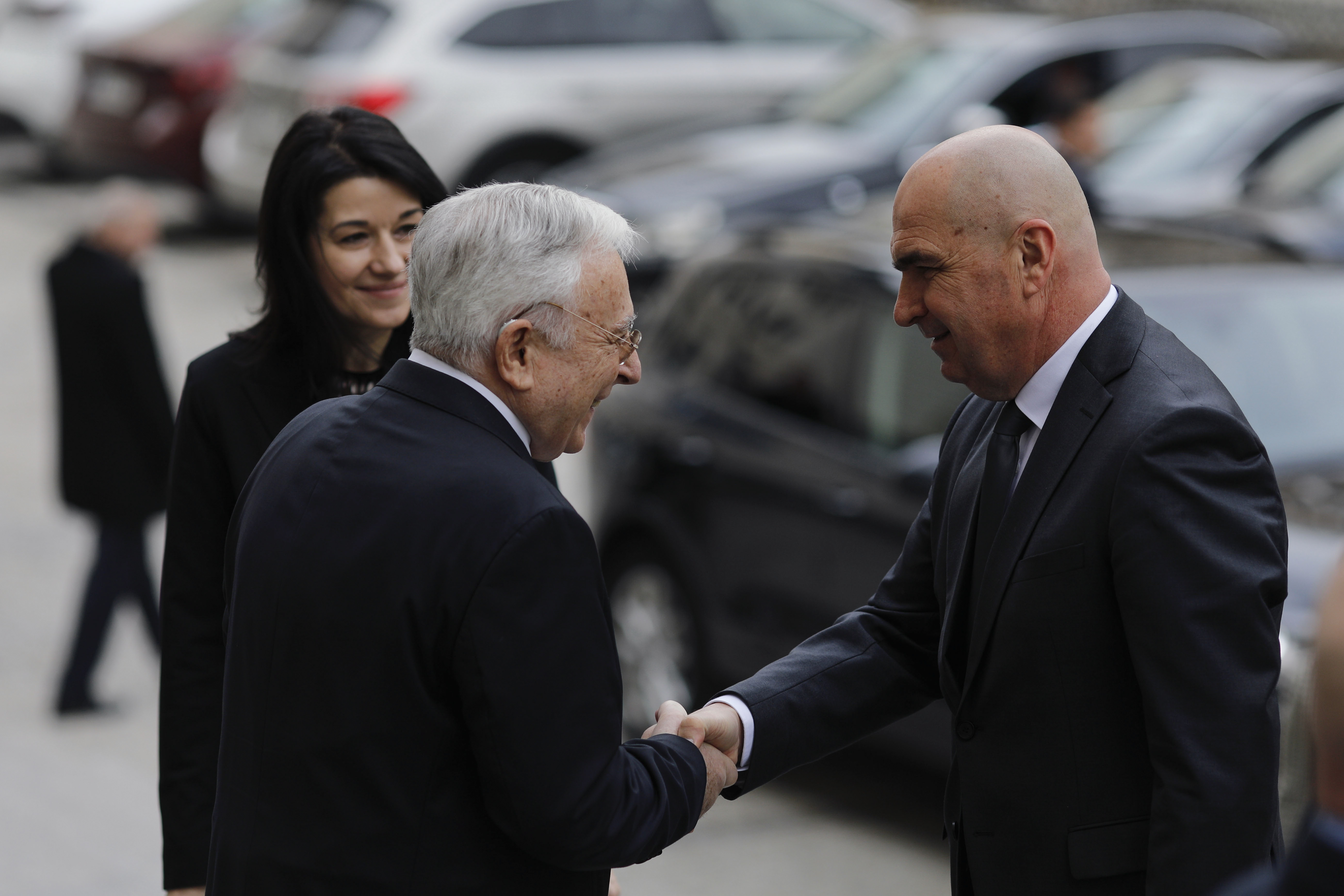
More than three decades after he headed the National Bank, Mugur Isărescu revealed what lesson he learned at the Victoria Palace: that to lead a government, you need eyes behind, to see where the knives are coming from.
Asked if a technocrat prime minister would be a solution for Romania, Isărescu replied: “I don't know how easy it would be for a technocrat, especially one from abroad, to get into trouble quickly. You have to have a certain credibility, to know those in the Government, to know you too…. Otherwise you are talking in vain, in the desert. Towards the end of my mandate, I was talking there alone”, said the Governor at the presentation of the Inflation Report.
Isărescu also added that towards the end of the term, the only person he still talked to was President Constantinescu. “I was counting like a prisoner how many days I have left until I leave the Victoria Palace. When I left, a lady asked me which is more difficult, as governor or as prime minister? What should I answer? As prime minister you need eyes not only in front. You also need eyes to the left, and to the right and especially eyes in the back, to see who is stabbing you. It is much harder to be prime minister”, said the Governor of the BNR
The governor also explained on Tuesday that there is no need for new taxes and that tax cuts are out of the question until the fiscal objectives (budget deficit target) are reached. This, added the Governor, because the logic of external credibility leaves no room for experiments now.
“The rating agencies did not downgrade Romania despite the prolonged political crisis. Capital outflows were minimal compared to the spring of last year. They are fragile victories, won through continuity and discipline, and they can be quickly lost if the signals become ambiguous,” believes number 1 of the BNR. . “The clear proof that this fiscal correction has gone well,” he said, “is that our lenders, including the rating agencies, have not downgraded us despite the political crisis.”
However, there is one variable that no monetary policy can replace and that Isărescu explicitly mentioned, several times, with an insistence that resembled concern: political stability. “Markets are very sensitive to both factors,” he said — fiscal correction and political stability. “Let's have a government as soon as possible.” The wording was sober, but the substratum was real anxiety. External financing, on which investment growth depends – the only way to offset falling consumption without fueling inflation – “needs political continuity.”
The political crisis does not help, says Isărescu
The danger of stagflation, which the European Commissioner for the Economy invoked these days for the whole of Europe, also exists in Romania. A stagnating or declining economy, with inflation refusing to come down fast enough, is the most difficult situation for a central banker: classic tools work poorly in both directions at once.
Isărescu insisted on an argument he has been repeating for years, but which acquires a new urgency in the current context: that there are two types of fiscal adjustment. One that you do, at your own pace, negotiated with the European Union, socially bearable if it is well calibrated. And one that the financial markets impose on you, suddenly, without negotiation and without mercy. “Suddenly you find you only have funding for a 1-2% budget deficit,” he said.
This is, in essence, the whole point of the fiscal reform debate: not if you tighten the belt, but who tightens it and at what pace.
And yet, Isărescu ended with something that resembled caution, optimism. The grain harvest looks good. Investments picked up in the second half of 2025 and are likely to continue. Reserves are solid. The rate seems to have found a market equilibrium. Fiscal adjustment is moving in the right direction.
The condition is simple and impossible to guarantee: there must be a government. And not to change anything that has been built in recent years.