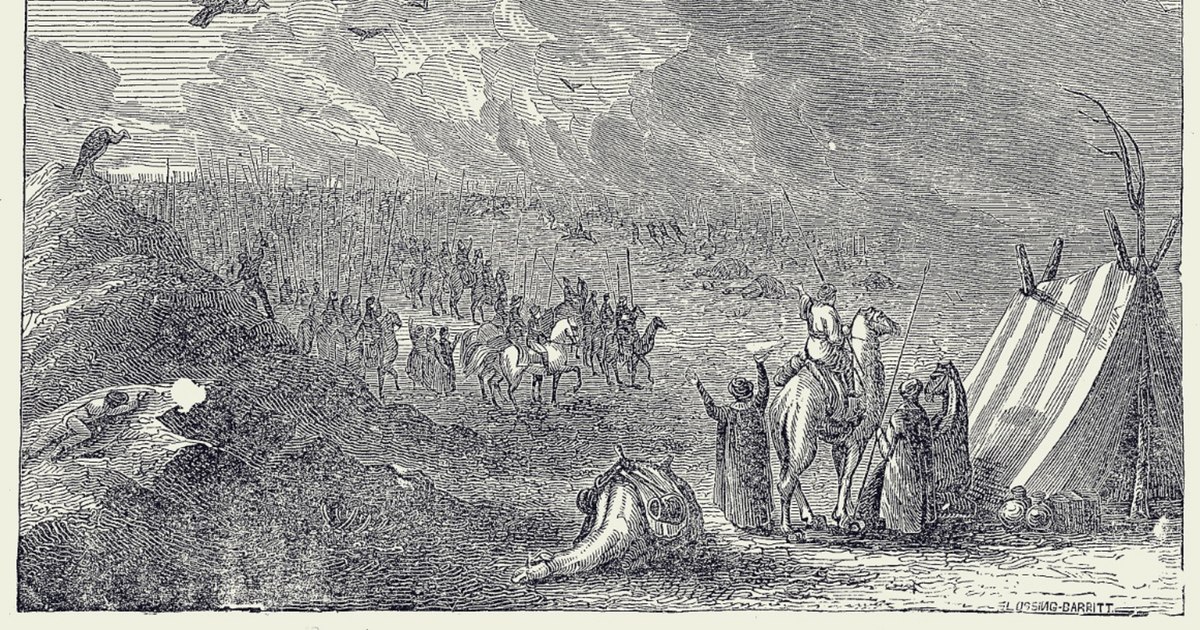
2500 years ago, in the desert of Egypt, the most enigmatic and at the same time the biggest extinction in human history took place. More than 50,000 people have disappeared without a trace. An entire Persian army was swallowed up by the desert. And no one ever saw them again.
Cambyses' army disappeared without a trace PHOTO wikipedia
In 525 BC, the mighty Egyptian Empire had fallen to the Persians. King Cambyses II, son of Cyrus the Great, had extended the boundaries of his vast empire into North Africa. However, in ancient Egypt there was one enclave that defied his authority: the famous oasis of Siwa, where the Oracle of Amun was located. It was one of the holiest sites in Pharaonic Egypt, and it is said that a resistance to the priests of Amun, led by the young pharaoh Petubastis III, coalesced there.
The “king of the world,” as the Persian sovereign was entitled, could not accept such a defiance, especially as it would have set a dangerous precedent, which would have incited other nations under Persian rule to revolt. So he sent to Siwa a huge army for those times: no less than 50,000 men, intended to destroy the Oracle of Amun and the entire Egyptian resistance. The army left for Siwa but never reached its destination. After 2,500 years, no one really knows what happened to Cambyses' army, making it one of the most mysterious disappearances in history.
When the land of the “Sun God” fell into the hands of the masters of Asia
The story begins in the middle of the first millennium BC, when Egypt was an economic and military superpower of the East. During the reign of Amasis II (also known as Ahmose II), Egypt was experiencing a period of prosperity known as the Saitic Renaissance. Although it no longer possessed the vast territorial expanses of the days of Thutmose III or Ramses II, when the empire stretched as far as the Euphrates, Egypt under Amasis was a leading economic and military power, focused on a strategy of “soft power” and maritime alliances. Territorially, the heart of the kingdom consisted of the Nile Valley and the Delta, but its control extended over the Sinai Peninsula and, most importantly, the island of Cyprus, which Amasis conquered, turning it into a strategic control point for trade in the Eastern Mediterranean.
Geopolitically, Amasis understood that Egypt could no longer be a land expansionist force, being threatened by the terrifying expansion of Persian power, the new leader of eastern geopolitics, so he chose to build an “empire of influence”. He established close ties with the Greek city-states, offering them the port of Naucratis as an exclusive trading warehouse, which brought immense prosperity to the Egyptian treasury.
Its borders were secured by a system of well-paid mercenaries, mainly Greeks and Carians, who formed the backbone of the army. In the west, his influence reached as far as Cyrenaica (today's Libya), where, after initial conflicts, he established diplomatic and matrimonial relations, thus consolidating the desert frontier.
To the south, in Nubia, although no longer exercising direct administrative control since the New Kingdom period, Amasis maintained a sphere of influence that protected trade routes to gold and ivory resources. Basically, the Egypt of Amasis II was not a mammoth geographical empire, but an extremely wealthy, cosmopolitan and fortified state. But wealth and luxury were the country's weak point: the defense relied on mercenaries of questionable loyalty, and the immeasurable resources attracted the attention of the Persians. The great kings of central Asia, who had already taken possession of a large part of the East, reaching as far as the shores of the Mediterranean, proposed the conquest of Egypt.
Cambyses II, the successor of Cyrus II the Great (the founder of the Persian Empire), took advantage of the fact that after the death of Amasis II, his son, Psamtik III—a much too young, inexperienced and impressionable leader— ascended the throne. Cambyses did not hesitate: in 525 BC, he directed his huge armies to Egypt. As expected, the betrayal came from within. Phanes of Halicarnassus, a commander of Greek mercenaries in the Egyptian army, provided Cambyses with vital information about supply routes and defensive weaknesses.
The decisive element of the campaign, however, was superior logistics. To cross the hostile desert of the Sinai Peninsula, Cambyses made a pact with the Arab tribes, who provided him with huge supplies of water carried by camels, thus facilitating the march to Pelusium, the “eastern gate” of Egypt. The ensuing battle was bloody and decisive. After the defeat, the Egyptian army retreated to Memphis. Cambyses initiated a brutal siege, and after the fall of the city walls, the resistance was finally crushed. Pharaoh Psamtik III was captured and, following a failed uprising, executed. Thus, Egypt became the sixth satrapy of the Persian Empire.
However, Cambyses was never recognized as king by the priests of Amun in the Siwa Oasis. There was the Oracle of Amun, the holiest place in Egypt; Amon was the “King of the Gods” and the ultimate symbol of power. The center was so revered in the ancient world that later Alexander the Great himself would make a perilous pilgrimage across the desert to Siwa to be proclaimed son of the god—a gesture that gave him divine legitimacy to rule over Egypt. Without the confirmation of the priests here, Cambyses remained, in the eyes of many, a usurper.
PHOTO A city founded by Alexander the Great reappears on the surface on the shore of a lake
Moreover, a strong resistance had crystallized around the priests of Amon under the leadership of the young rebel Petubastis III. The locals had begun to refuse to pay taxes to the Persians, a dangerous precedent that could inspire other conquered peoples. The defiance enraged Cambyses II, who decided to destroy the Oracle and eliminate all who opposed him in that isolated oasis.
More than 50,000 people disappeared without a trace
Cambyses ordered the formation of a formidable army of 50,000 soldiers. They were sent from Thebes to Siwa with the mission of erasing the Oracle of Amun from the face of the earth. According to Herodotus, the huge army marched for seven days through the Libyan Desert, reaching an oasis not identified with certainty even today. After this halt, the Persian army seems to have entered the land. No one ever found out the fate of the 50,000 people. Herodotus relates, based on the testimony of the locals, that while the soldiers were having lunch somewhere between the oasis and their final destination, a southerly wind of apocalyptic violence raised huge columns of sand that buried the entire army, erasing it from history for good.
“The Persians set out from the oasis over the sands, and had come about half-way between that place and the country of the Ammonians, when, while they were having lunch, a wind began to blow from the south, strong and deadly, carrying with it huge columns of whirling sand, which completely covered the troops and caused them to disappear for good. Thus it happened to this army, according to the Ammonians.”stated Herodotus. Even to this day it is not known what happened to that army.
Hypotheses of modern specialists
For millennia, the story has been viewed with a mixture of skepticism and fascination, with many modern historians considering it a mere invention of Herodotus, meant to illustrate the folly of Cambyses in sending a huge army across the desert. Or, more than that, a propaganda tool of the priests of Amon to convince everyone of the power of the great Egyptian god, who exemplarily punished the enemies sent to destroy his Oracle. And yet, what happened to Cambyses' army? There are specialists who say that it was possible that the army was swallowed by a sandstorm. The extreme nature of the Sahara desert makes the phenomenon of “khamsin,” sandstorms that can last for days and drastically alter the geography of the dunes, a plausible basis for such a natural disaster.
Egypt amazes the world: the first tomb of a pharaoh discovered after a century, since Tutankhamun
20th and early 21st century archeology has attempted to find physical evidence of this geological massacre. There are famous expeditions, such as that of Count László Almásy or the efforts of geologist Tom Brown, organized in search of fragments of armor or osteological remains, something tangible to indicate that that army perished in the desert. But the immensity of the dunes, which can reach heights of over a hundred meters, thwarted any effort. Until, in 2009, brothers Angelo and Alfredo Castiglioni, known for discovering the “golden city” of Berenike Panchrysos, came across some bronze weapons, male silver bracelets and hundreds of fragments of human skeletons near the Siwa oasis.
The discovery indicates that the Persian army was not completely destroyed by a sandstorm that buried it under the dunes. Rather, the storm caused chaos and panic among the army, scattering it, separating the various “regiments” and army groups. The storm forced the soldiers apart from each other, which made them vulnerable. Some died suffocated by the dunes, others wandered through the desert, overcome by heat, thirst and hunger, and others were killed, most likely by the Egyptians. Even so, some experts remained skeptical. To this day, it is not known exactly what happened to Cambyses' army.