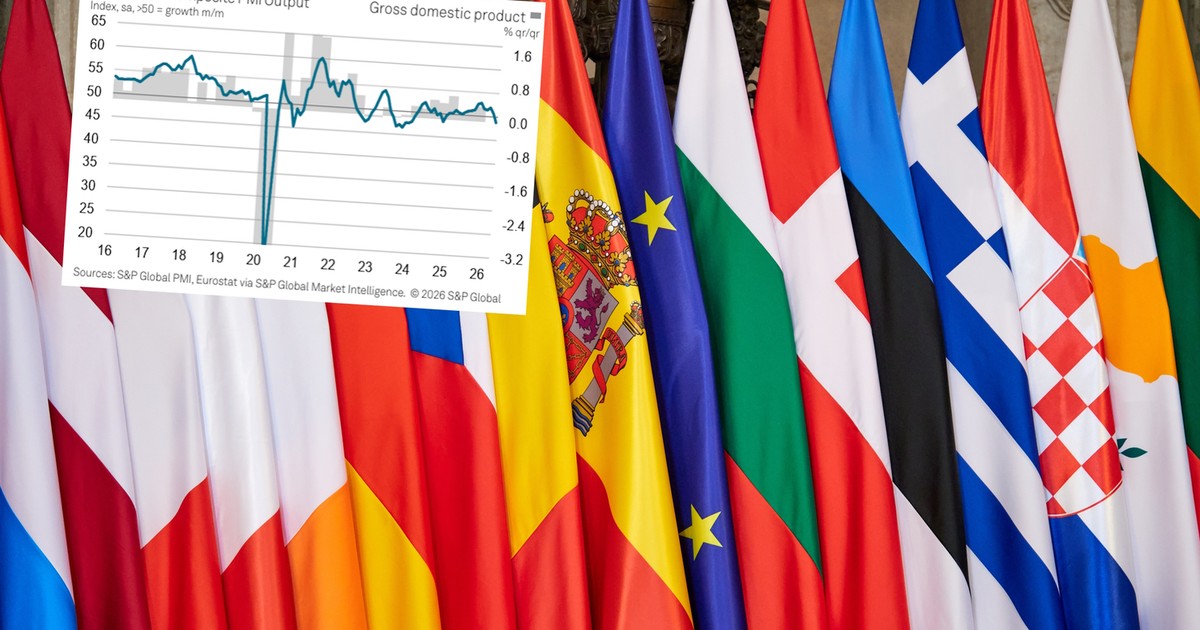
S&P Global, a large analytical company that constantly monitors global trends, issued a series of reports on Wednesday. This is the result of surveys conducted by purchasing managers in manufacturing and service companies, which in total form a picture of trends and activity in the economy. The history of these calculations has shown that they quite well reflect the GDP data published much later by statistical offices.
Read also: Poland's budget is tight. Are we facing cuts in social programs and tax increases?
And the latest calculations are not a favorable review for the European Union, or at least for its core, i.e. the euro zone. In April, although improvement was visible all over the world, although even in Great Britain there was improvement, in the euro zone the indicator fell into negative areas.
The aggregate index (industry and services) for the euro area fell to 48.8 points with the equilibrium threshold at 50 points. This means a drop of as much as 1.9 points compared to March and a 17-month minimum. In the case of the services sector, a 62-month low was reached, S&P Global reported (a drop to 47.6 points from 50.2 points in March).
Aggregate PMI and euro area GDP
|
S&P Global Market Intelligence
— The final PMI data for the euro zone confirms earlier signs of economic recession in April, as the ongoing war in the Middle East hampers the economic recovery that was building before the outbreak of the conflict, said Chris Williamson, chief business economist at S&P Global Chris Williamson, in the report.
“The recession may deepen”
— Although so far they indicate only a small, 0.1 percent. the quarterly decline in GDP and the lack of any signs of an imminent easing of the crisis suggest that the recession may soon deepen, the economist said.
— The services sector has been the hardest hit so far, with consumer-facing businesses feeling particularly squeezed as they face the double blow of rising energy prices and travel disruptions Williamson points out.
— However, while the manufacturing sector has shown resilience so far, this reflected an increase in stocksas companies fear further price increases and supply constraints. It's not only that will weaken production growth in the coming monthsas stocks start to weaken, but it will also have a knock-on effect on service sector companies that depend on industrial raw materials, especially food and, of course, refined fuels, if these further supply and price concerns materialize, the analyst says.
He also emphasizes that the euro zone economy will likely face an increase in interest rates, which will have an even greater impact on its development.
In the euro zone, only Italy can see an improvement in sentiment, as the combined PMI increased to 50.5 points in April from 49.2 points in March. In Germany, however, it dropped by as much as 3.5 points to 48.4 points, in Spain by 3.7 points to 48.7 points, and in France by 1.2 points to 47.6.
The decline in business activity in Germany has fallen at the fastest rate in three and a half years, and producer inflation is at its highest level in 26 months. S&P Gloabal economist Phil Smith estimates that the second quarter in a row of negative GDP in Europe's largest economy is likely, as a consequence of the conflict in the Middle East.
The data for the euro zone are even more worrying because outside the EU the economy seems to be thriving. Even in Great Britain, which left the EU a few years ago.
Outside the EU, there is an acceleration
The Iranian crisis does not seem to bother other economies, or perhaps it has already been noticed that it is passing and the inflow of hydrocarbons is improving? Even entrepreneurs in Great Britain They clearly noticed this, because the combined PMI not only did not fall, but increased by as much as 2.3 points to 52.6.
There was a clear improvement in the production sector – to 53.7 points and this is the 47-month maximum. — It is important to note that the increase in production is partly the result of customers accelerating purchases to mitigate expected price increases and supply disruptions. As this process concludes later in the year, as business optimism declines, sector growth may slow while inflation pressures remain high,” said Rob Dobson, director at S&P Global Market Intelligence.
Services also went up significantly to 52.7 points from the 11-month minimum (50.5 points) in March.
Aggregate PMIs also improved in India (+1.3 points to 58.3 points), China (+1.6 points to 53.1) i USA (+1.4 points to 51.7). Japan recorded a declinebut all this at increasing levels, i.e. above 50 points (-0.6 points to 52.4).
In the case of China, this is the second best data since May 2024. The S&P Global commentator emphasizes the links with new projects, market expansion and efficiency gains. “Keeping costs in check allowed companies to maintain price competitiveness,” said Yao Yu, founder of RatingDog.
Regarding the US, economist Chris Williamson, commenting on the data, pointed out that the survey data indicates GDP growth at a moderate annual rate of 1%. It highlights the decline in demand for financial services and reduced holiday and recreation spending. He warns of an increase in inflation that could lead to Fed rate increases.
|
Eurozone |
48.8 points |
-1.9 points |
|
Italy |
50.5 points |
+1.3 points |
|
Germany |
48.4 points |
-3.5 points |
|
Spain |
48.7 points |
-3.7 points |
|
France |
47.6 points |
-1.2 points |
|
Great Britain |
52.6 points |
+2.3 points |
|
India |
58.3 points |
+1.3 points |
|
China |
53.1 points |
+1.6 points |
|
USA |
51.7 points |
+1.4 points |
|
Japan |
52.4 points |
-0.6 points |