Kim Jong's nuclear arsenal could penetrate the US anti-missile shield that is designed to repel only a limited attack

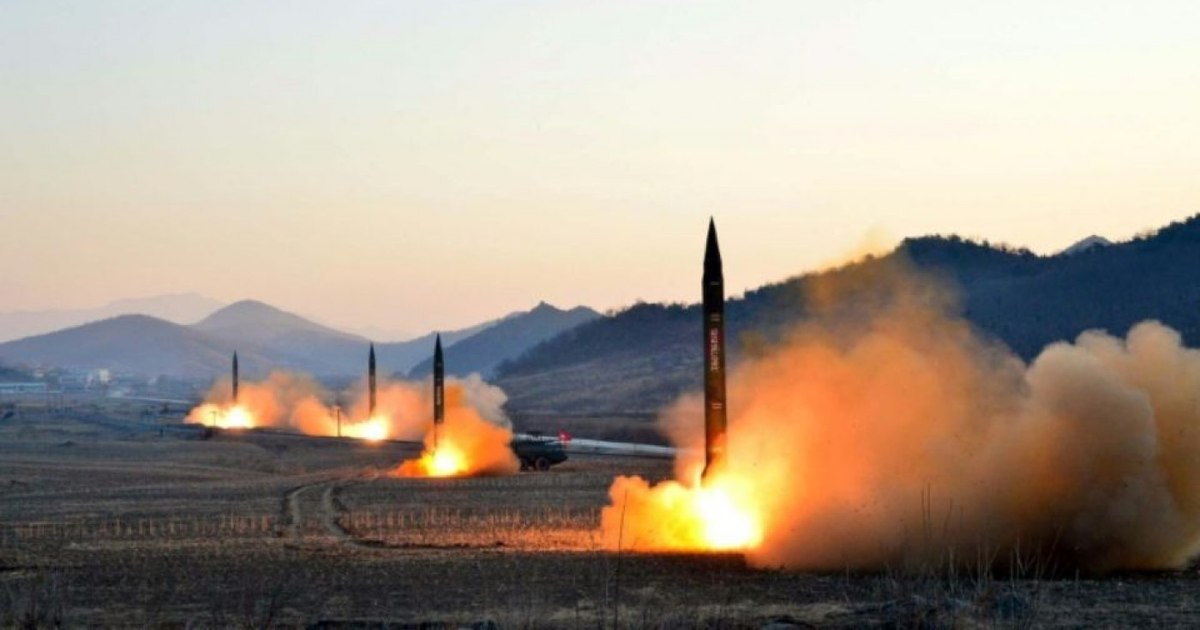
North Korea's nuclear arsenal has reached a critical point: its volume could be enough to penetrate the US missile defense system. Washington has spent about $65 billion over the past 30 years on the already inadequate system, Bloomberg reports.
North Korean missiles PHOTO: X
Kim Jong Un's Arsenal
North Korea currently has around 50 nuclear warheads. The intelligence community estimates that the country has already stockpiled enough fissile material to rival that of Israel, a state that neither confirms nor officially denies that it has nuclear weapons.
South Korean President Lee Jae-myung said in late January that Pyongyang is capable of producing material for 20 nuclear warheads a year. If this pace continues, by 2035 the DPRK's arsenal will reach 290 warheads – the level of France.
The shield problem
The ground-based Mid-Range Defense (GMD) system consists of 44 interceptor missiles located in Alaska and California, with the option to expand to 20 more. The system was designed to repel a limited attack by a “rogue state”.
Problem: Each target requires launching at least two interceptors. This means that if about 24 intercontinental ballistic missiles (ICBMs) were launched simultaneously, the US stockpile of interceptors would be depleted.
According to analyst Van van Diepen of 38 North (a specialized online publication that tracks North Korea's military developments), North Korea may have 48 ICBM launchers at its disposal. Ankit Panda of the Carnegie Endowment for International Peace estimates the actual number of ICBM launchers in service at 24 units, assuming continued production of new ones.
The US Department of Defense's Intelligence Agency (DIA) last year unveiled Project Golden Dome, the US's ambitious new missile defense program, with a much more modest figure of just 10 intercontinental ballistic missiles. Experts believe that this is a possible underestimate.
New generation rockets
Kim Jong-un is constantly modernizing the arsenal, switching to solid-fuel intercontinental ballistic missiles: the Hwasong-15, -17, -18 and -19 models. Unlike liquid-fueled missiles, solid-fueled missiles do not require lengthy refueling before launch, making them more difficult to detect and destroy with a pre-emptive strike.
This year, North Korea has already tested missiles with cluster warheads and decoys — decoy systems designed to “confuse” American and South Korean interceptors.
In addition to intercontinental ballistic missiles (ICBMs), Pyongyang has a vast arsenal of short-range missiles capable of hitting US allies in Asia and US military bases in Guam, home to the largest US military munitions stockpile in the Pacific region.
Combat experience from Ukraine
A separate factor of concern: Short-range ballistic missiles transferred to Russia for use in Ukraine have been subjected to an actual combat test. North Korea has received the most valuable data on how Western interception systems work in real war conditions and is using this knowledge to improve its advanced defense systems.
Kim Jong-un's course
Recent world events only reinforce the North Korean leader's belief that nuclear weapons are the only sure guarantee of the regime's survival.
Chung Eun-woo, South Korea's former chief nuclear negotiator who brokered a rare nuclear deal with Pyongyang nearly 20 years ago, bluntly says: “Iran and Venezuela will only reinforce Kim Jong-un's belief that his decision to build and modernize his nuclear arsenal was wise and visionary. He probably believes his regime is safe as long as it has sufficient nuclear and missile capabilities to challenge unacceptable damage to the United States and its allies.”
The military alliance with Russia, concluded in 2024, gives the DPRK new revenue to fund its nuclear program.
The nuclear program
Kim Jong-un has taken the unprecedented step of showing key nuclear infrastructure facilities to the outside world. North Korean state media has released photos of the inside of two uranium enrichment plants, complete with centrifuges and equipment, allowing experts to make informed estimates of their capabilities.
North Korean ballistic missiles were manufactured using up to 50-year-old technology, Ukrainians found
Kim Jong-un's determination
Recent world events only reinforce the North Korean leader's belief that nuclear weapons are the only sure guarantee of the regime's survival.
Chung Eun-woo, South Korea's former chief nuclear negotiator who brokered a rare nuclear deal with Pyongyang nearly 20 years ago, bluntly says: “Iran and Venezuela will only reinforce Kim Jong-un's belief that his decision to build and modernize his nuclear arsenal was wise and visionary. He probably believes his regime is safe as long as it has sufficient nuclear and missile capabilities to challenge unacceptable damage to the United States and its allies.”
The military alliance with Russia, concluded in 2024, gives the DPRK new revenue to fund its nuclear program.
The nuclear program
Kim Jong-un has taken the unprecedented step of showing key nuclear infrastructure facilities to the outside world. North Korean state media has released photos of the inside of two uranium enrichment plants, complete with centrifuges and equipment, allowing experts to make informed estimates of their capabilities.
Ellen Kim, director of academic affairs at the Korea Economic Institute of America, explains: “Nuclear weapons are the main achievement of Kim Jong-un and the entire Kim family. They are the tool with which the regime maintains and justifies its legitimacy.”
Fundamental restrictions
Despite the impressive statistics, the North Korean nuclear program has fundamental limitations:
-The missiles have never been tested with real warheads: it is not known if they will withstand overload during re-entry (return to the atmosphere) and if they will be able to accurately hit targets on American soil;
-The actual number of intercontinental ballistic missiles is disputed: estimates vary between 10 and 48;
-The United States is working on the Golden Dome, an ambitious program aimed at equipping the country with a complete anti-missile defense system. However, its implementation is estimated to cost over $1 trillion.
The nuclear club of countries that are not parties to the Nuclear Non-Proliferation Treaty:
– Israel — about 90 warheads;
-Pakistan — about 170 warheads;
-India — about 180 warheads;
-North Korea — about 50 nuclear warheads (with a growth rate of 20/year).
The main nuclear powers:
-Russia — 4,309 nuclear warheads (the largest arsenal in the world, a legacy of the Cold War);
-USA — 3,700 nuclear warheads (officially, the policy of “gradual reduction” has been switched to “modernization and accelerated development”);
– China — 600 warheads;
– France — 290 warheads;
– Great Britain — 225 warheads. The United Kingdom and France have officially frozen the production of fissile material. The total estimated stockpile of nuclear weapons in the world is approximately 9,614 nuclear warheads.
Donald Trump is raising the alarm, pointing to the next major nuclear challenge after Iran: North Korea
Perspectives
“It would be a mistake to think that the US and South Korea can simply return to negotiations with North Korea where they left off in 2019. The North Korea of today is not the same as it was then“, warns Joel Wit, a former US State Department envoy who participated in the negotiations with Pyongyang.
Pentagon chief of policy Elbridge Colby in March called the nuclear potential of North Korea and Russia the “primary existential threat” to the United States.
North Korea's growing nuclear power, combined with doubts about the reliability of the American “nuclear umbrella,” is pushing countries like Sweden and South Korea to seriously consider building their own nuclear weapons.