The mystery of the Soviet planes in which the Romanians used to party. How “airplane bars” arrived in two cities from Timiș


Two Li-2 (Lisunov) planes have been parked in the cities of Făget and Buziaș in western Romania for over half a century. Transformed into “airplane bars”, Soviet aircraft have long been points of attraction in Timișoara cities. They have a controversial history but a different destiny.
Airplanes from Buziaș. Photo: Daniel Guță. TRUTH
Located approximately 30 kilometers from the municipality of Lugoj, the towns of Buziaș and Făget each have approximately 7,000 inhabitants and are known to Romanians: the first, as an attractive resort for its hydro-mineral waters, and the second, thanks to the extensive beech forests, from which it would have received its name.
The avio-bars that made a sensation
Since the 70s, the two Timișoara cities have one more thing in common. In Făget and Buziaș, travelers find a Li-2 (Lisunov) plane manufactured in the middle of the 20th century.
The airplanes have long been points of attraction for travelers passing through the two towns in western Romania and meeting places for locals. After their scrapping, half a century ago, both aircraft were moved from Timișoara airport and transformed into “air-bars”.
In Făget, the plane remained in the yard of a house on the banks of Begăi, but the restaurant that operated here was closed almost a decade ago. In the past, the “avio-bar” in Făget was an attractive stopping place for travelers traveling on the national road DN68A Deva – Lugoj, but in recent years the road that crosses Făget has become less crowded, being doubled by the A1 Lugoj – Deva highway. Some locals remember the interest the flying machine aroused.
“I was a child when they brought it, around 1975, here, in front of my house, across the road. Until it was put into use, as a bar, we used to play in it. It was something of a sensation”, told Ernest Petrovits, for the Truth.
The local says that the initiative to bring the plane to Făget belonged to a former aviation general, Puiu Dumitru, an important figure during the Ceaușescu regime and a former member of the Grand National Assembly, representing Timișoara.
“During his mandate, then, during the communist period, there were three planes of this type in Bucharest, Lisunov-2, Li-2, Soviet, manufactured in the 1950s. They made their flight rules, scrapped them and, what do I know, they took this one and two more here, to Timiș county. One is in Buziaș, his brother, one, unfortunately, is no longer there, it burned somewhere in the Green Forest of Timisoara, I understand, there was a fire, a short circuit, something, and nothing could be done with it, only scrap metal, and this is from 1975, here.”says Ernest Petrovits.
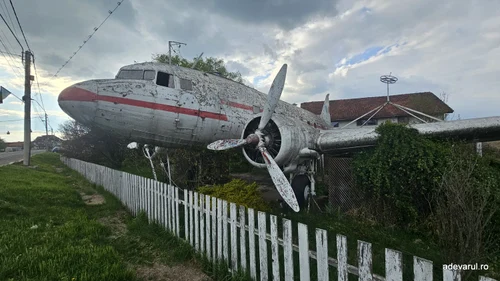
Image 1/14:
The plane from Făget Photo Daniel Guță THE TRUTH jpg
He remembers how the aircraft was transported from Traian Vuia airport in Timisoara to Făget.
“Its wings were dismantled, to be transported separately, and only the fuselage of the plane remained. With the tail forward and the muzzle in front, it was pulled by a tractor, on its wheels. The procession, accompanied by the militia, with one car in front and one behind, made about 8-9 hours to Făget”. add this one.
The local adds that the aircraft should have arrived at Valea lui Liman, the recreational area at the foot of the Poiana Ruscă Mountains and much more popular at the time, but the authorities finally decided to leave it at Făget, due to the difficult access roads and a bridge over the Bega difficult to cross with such a load.
The planes that reminded of Traian Vuia
In Buziaș, the transport from Timișoara, over a shorter distance of about 30 kilometers, was easier. Even here, however, due to the railings of a bridge, the plane had to be lifted with a crane to be able to pass on, the locals recalled. In a short time, the planes from Făget and Buziaș became attractions for the locals, many of whom had never seen anything like this before.
Exotic neighborhoods with strange stories. The City of Palaces built by Superman, Piedone, Maradona, Chaplin or Sherif VIDEO
Although they were transformed into bars, bringing them to the small towns of Timișoara was also seen as a symbolic gesture of gratitude towards Traian Vuia (1872–1950), one of the pioneers of Romanian and world aviation, who entered history through his experimental flights at the beginning of the 20th century.
“Someone had the idea that, in memory of the first real Icarus, Traian Vuia, a former student at Făget, born in a nearby village, Surduc, to install an airplane “heavier than air” at the crossroads of the main road, towards Batești and Brănești. Iosif Căliman then saw the first airplane and was not afraid. That's how he imagined it, with huge wings, a towering tail and a blunt nose. But he never went up the stairs leading to the bar in the cockpit, but passed by and, respectfully, removed his cork and bowed, saluting the strength of the mind of the man who could only be his brother, not father, not grandfather”informed Flacăra magazine, in 1979.
Thematic airport, built around the plane from Buziaș
After 1990, the plane from Făget continued to function as an “airplane-bar”. Instead, the aircraft brought to Buziaș ended up with the fate of many touristic and historical buildings in the resort, gradually falling into disrepair.
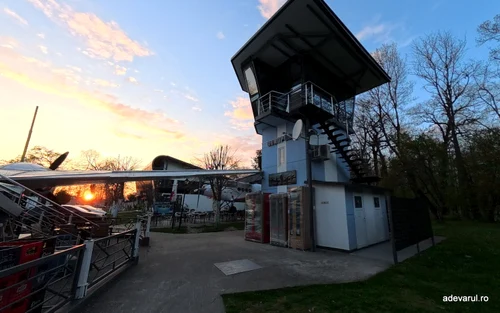
Image 1/18:
The plane from Buziaș Photo Daniel Guță THE TRUTH (16) jpg
Since the beginning of the 90s, the plane from Buziaș had been abandoned. In a short time it had become a wreck, where street people took shelter or children played, destroying the original pieces kept inside.
“At the edge of the park in Buziaș, if you have the curiosity to get there, the silver silhouette of an aircraft welcomes you, drawn long ago on a dead line. A few years ago, the owners of the resort set up a confectionery here, which was for a long time one of the attractions of Buziaș. That was, however, a long time ago. Now, the plane is rusted and abandoned by everyone, except for the children who have an ideal place to play here, it shows pathetic”informed the Renașteare publication, in 1996.
In 2005, the plane was taken over by Nelu Hudrea, a local investor who decided to refurbish it and restore its function as a bar.
“The plane was put into operation in Buziaș in 1978 and set up as an AVIABAR in the bathroom park. Its relocation in 1986, near the Silvana hotel, seemed to be its condemnation to final destruction. After 1990, the plane was abandoned and vandalized, being almost completely destroyed after a fire. In 2005, the plane was taken over by the Nedian company, ai whose associates are the Hudrea family from Buziaș, who completely restored it in the same year and set up a summer terrace under it. The Lisunov model plane has a unique restaurant with 30 seats, with upholstered banquettes in the American fast-food style.”show the representatives of the company.
In the following years, the area around the plane radically changed its appearance, being laid out according to the model of a small themed airport. Since the summer of 2017, another plane, Soviet model Antonov (AN-2), has been placed next to the Lisunov plane, and a control tower has been erected between the two planes. Since then, the place is known as “La Aeroport”. In 2018, a small plane, model Socata-TB9, manufactured in 1981, in France, joined the two older planes at the edge of the dendrological park in Buziaș.
The town with an airport and only 22,000 inhabitants. It was established at the crossroads of the first imperial roads in Dacia
In Făget, the locals hope that the city plane will someday have a better fate.
Airplanes from Romania in the 1950s
The Lisunov Li-2 was a Soviet transport aircraft used for both passengers and cargo in civilian and military versions, built under license from the American Douglas DC-3, awarded to the Soviet Union in 1936.
Its series production began in 1940 and continued until 1953, and the aircraft entered the fleets of several Eastern European airlines in the following decades. The aircraft was named after aeronautical engineer Boris Pavlovich Lisunov, who oversaw its adaptation and production in the USSR.
Almost 5,000 such aircraft were manufactured in the Soviet Union, and some were also imported to Romania. In the 50s, Gheorghe Gheorghiu-Dej used such an airplane for his internal and external trips, and in the 60s Li-2 planes were used by Tarom on internal routes, such as Bucharest – Craiova – Timișoara.
“The passengers got out in front of the Craiova airport. Everyone's eyes scanned the blue sky. From somewhere, as if out of the blue, the Li-2 plane made a noisy appearance. Then it floated a little above the horizon and, like a white, light bird, landed, metallic hissing, on the runway. A short turn on its convex wheels and here it is, imposing, in front of the airport. It is the first stopover from Timișoara and takes ten minutes. Enough time for the new passengers to take their seats. Twice a day, the comfortable Li-2 passenger planes travel on the Bucharest-Craiova-Timișoara route. Air travel is no longer a luxury.” informed the publication Before, in 1960.
In the 1970s, some of these aircraft began to be withdrawn and scrapped.