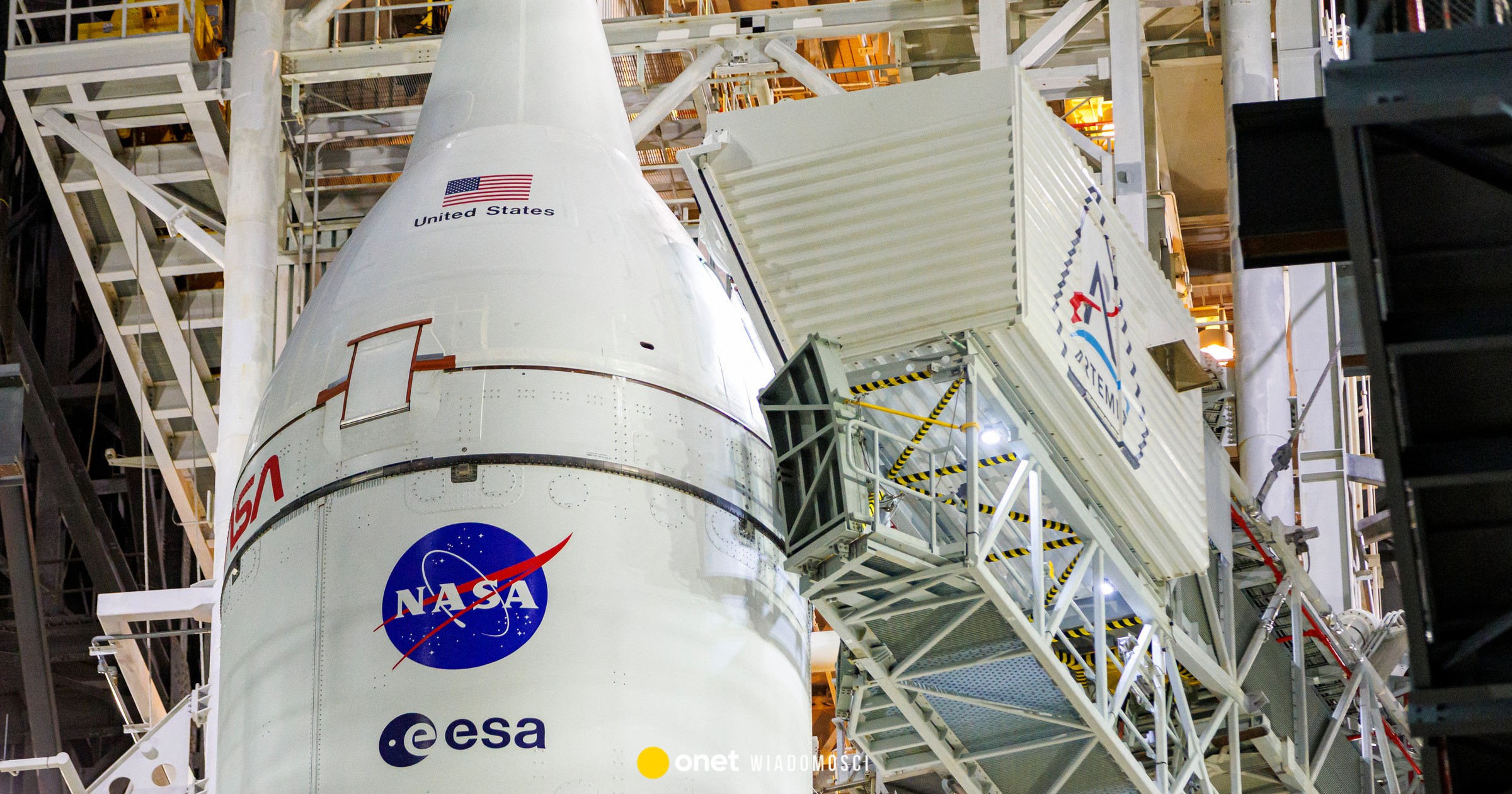
At 18.35 local time, the rocket with a height of almost 100 m and a mass of 2,610 t took off in perfect style, to the cheers of spectators gathered at the Space Center. Kennedy in Florida. There are four astronauts on board who are destined to make history with a mission called Artemis 2. The main goal is man's return to the Moon after over 50 years.
Initially, the flight went smoothly. Shortly after takeoff, Commander Reid Wiseman reported that all systems were working as planned. Later, the crew of the Orion spacecraft, just before a planned orbit correction, noticed that a malfunction light had come on. The matter was handled by the control center. Specialists analyzed all the data, located and solved the problem. As it turned out, the toilet was broken, reports the Danish public broadcaster DR.
This adventure, which is expected to last 10 days, is intended to lay the technological foundations for future landings and regular flights to the Moon.
After launch, astronauts must first conduct systems tests to check the equipment. The first critical maneuver of the mission is scheduled for approximately 25 hours. after takeoff and after two orbits around the Earth. The idea is to start the main engine of the Orion capsule, which will carry the spacecraft on an approximately four-day journey to the Moon.
This mission is a test flight for the entire Artemis program, the cost of which is approximately USD 93 billion. (PLN 345 billion). Its goal is to send Americans back to the Moon with a crew. The last time the Apollo 17 crew was on the Moon was in December 1972. No one had set foot on the surface of this satellite for 53 years.
The new race to the Moon continues — no longer between the USA and the Soviet Union, but between Washington and Beijing.
“We're going back to the moon and this time we're staying.”
This time it's not about short trips, but about permanent colonization and construction of infrastructure. According to the will of US President Donald Trump, the return of American astronauts to the Moon is planned, if possible, before the end of his term in January 2029. His slogan is: “we go back to the Moon and this time we stay.”
Decades ago, NASA was more willing to take risks in the first race to the Moon, with big rockets launching at shorter intervals. For example, during the Apollo 8 mission in 1968, the Americans dared to… orbiting the Moon multiple times during the first manned attempt. This time, Artemis 2 does not envisage a full orbit, much less a landing, but only a flight on the other side of the Moon.
The United States couldn't land anyway because it doesn't yet have a suitable vehicle. It must first be developed by billionaires Elon Musk and Jeff Bezos. During the currently planned half-circle of the Moon, radio contact with four astronauts – Commander Reid Wiseman, Pilot Victor Glover, Mission Specialist Christina Koch and Canadian Mission Specialist Jeremy Hansen – will be interrupted for a good 40 minutes.
This break in communication is not a cause for concern, but is a result of physics, because the Moon blocks radio waves directed to Earth with its rear side.
The article continues below the video
NASA caution
According to the latest changes in plans, a manned landing on the US Moon is planned only as part of the mission Artemis 4which is currently planned for 2028 at the earliest. Contrary to the original plans, Artemis 3 will not fly to the Moon yet. Instead, the Orion spacecraft in low Earth orbit is scheduled to be paired with one of two commercial lunar landing vehicles, owned by either SpaceX's Elon Musk or Blue Origin's Jeff Bezos.
NASA wants to err on the side of caution by conducting an additional test flight. The safety philosophy of the American space agency shapes the entire Artemis 2 mission, which has just started. More than three years have passed since the Artemis 1 mission, when the SLS rocket, the cost of which was estimated at $4 billion. (PLN 14 billion), launched with the Orion capsule and the European ESM service module, assembled in Bremen by Airbus, and orbited the Moon as part of an unmanned mission.
The Director General of the European Space Agency (ESA), Josef Aschbacher, constantly highlights the contribution of Europeans to the Artemis missions. The rocket bears not only the NASA logo, but also the ESA logo. As Aschbacher says, Artemis 2 is “milestone for space exploration and for Europe's role in returning humanity to the Moon.” Without European service module technology, Americans would not be able to return to the Moon.
ESA press conference for the launch of Artemis 2, Florida, April 1, 2026.Christina Horsten / AFP
The world holds its breath
NASA very cleverly designed the capsule's flight trajectory. It resembles the number eight between the Earth and the Moon. The so-called fly past the Moon without entering its orbit. The crew will orbit the Moon halfway and then be thrown by its gravity directly back to Earth.
In 1970, this maneuver saved the Apollo 13 crew as a then-emergency solution when an oxygen tank in the service module exploded. The Orion capsule as part of the Artemis mission is to depart from Earth at a distance of 402,000. km, which is the greatest distance ever traveled by man. The capsule is to approach the Moon at a distance of approximately 4,600 km.
Whether the recently launched Artemis 2 mission will be successful remains uncertain until the last moment. The delays in the implementation of the project were caused by a disturbing discovery made after the landing of the Artemis 1 mission capsule in the Pacific. Unexpected chipping of the heat shield was found in over 100 places. Although the damage was within safe limits, it was considered a threat to manned flights.
By changing the flight profile in the mission that has just started, the risk associated with the heat shield is expected to be minimized. The capsule enters the Earth's atmosphere at a speed of approximately 40,000. km per hour, which is a record value. It is expected that on April 10, the capsule will land in the Pacific Ocean approximately 80 km off the coast of San Diego, California.
I’m Ashley Davis as an editor, I’m committed to upholding the highest standards of integrity and accuracy in every piece we publish. My work is driven by curiosity, a passion for truth, and a belief that journalism plays a crucial role in shaping public discourse. I strive to tell stories that not only inform but also inspire action and conversation.