Gastronomy, courier services and IT orders. More and more Poles are looking for additional sources of income. Whether it's about supplementing your salary, pursuing your passion or financial security in uncertain times, earning extra money is becoming an everyday occurrence. We checked how many compatriots take up such activities, what are the reasons for this and where they most often find such employment.
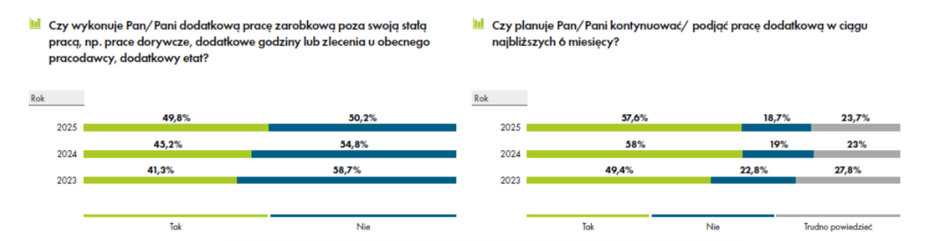
According to the latest data from Gi Group half of Poles admit that they take up additional work – this is an increase of 4.6 pp compared to 2024 and 8.5 pp compared to 2023. At the same time as much as 58 percent respondents intend to continue or undertake such activity. A year ago, a similar percentage declared such plans, while two years ago it was clearly less – less than half of the respondents.
– These data confirm the pressure that Poles feel and the growing need to ensure financial stability, a greater sense of security and the ability to plan expenses more freely. Even with an increase in nominal wages, a persistently low unemployment rate and a relatively stable labor market, they want to diversify their sources of income, protecting themselves against a possible loss of financial liquidity, and, above all, ensuring greater opportunities for saving or investing in professional development or pursuing their passions and interests – says Anna Wesołowska, managing director of Gi Group, to Bankier.pl.
Young generations are most likely to earn extra money
It turns out that men take up additional work much more often than women – 55% respectively. and 45 percent.
Most often, these are also representatives of the youngest generation – in the age group under 24 it is as much as 60.5%, and among 25-34-year-olds it is over 56%. Although the share of people earning additional income increased in each age group, the largest increase was recorded among respondents over 50 years of age (from 35.8% to 43.7%, i.e. 7.9 pp y/y) and people up to 24 years of age (+ 6.4 pp y/y).
Readiness to take up additional activities also varies depending on education. Most oftendecide more oftenąsiThis is done by educated peopleprimary education (60.4%) andhigher education (53.7%), less often with educationcrying secondary (45.8%) and basic vocational (45%).
According to Gi Group data Poles most often take up additional work for up to 9 hours. and from 10 a.m. to 7 p.m. during the week.
Why do Poles earn extra money?
Gi Group data shows that in the case of 28 percent respondents, additional work is used to finance expenses that go beyond basic needsyand another 25 percent wants to accumulate savings this way. In turn, 13.2 percent Poles undertake it to pursue their passions and interests, and every tenth respondent spends additional income on professional development. Just over 6 percent earns extra money to develop his own business.
The study shows that the main reason for taking up additional work is not the need to cover basic household costs – this was the argument given by 15 percent. respondents. Motivations for taking up additional work vary depending on the financial situation, the amount of remuneration in the main job, age, gender or time commitment in the main job.
Is working more than one job becoming the new norm?
Meanwhile, according to the latest reports of the Central Statistical Office and ZUS for 2025, only about 5-9 percent employed declare working in more than one place.
– The phenomenon of “earning money” is largely a response to the rising costs of living and inflation. The desire to improve the standard of living, build savings or invest, as well as the need to repay liabilities faster are becoming more and more important – says Grażyna Pogan, Business Development Manager at Smart Solutions HR, to Bankier.pl. Also important is easier access to remote work and the development of freelancing platforms, which have significantly lowered the threshold for taking up additional professional activities.
Also, according to Mirosław Białobrzewski, president of Golden Serwis, every year more and more Poles decide to take up additional employment.
– There is a clear, constant upward trend visible here. This is also confirmed by tax data, which show that currently approximately 2 million taxpayers settle accounts for more than one employment relationship.and this number is gradually growing – says Mirosław Białobrzewski to Bankier.pl. – The main driving force is the rising cost of living and the desire to build a financial security cushion. Moreover, thanks to digitalization, finding an additional job has become easier and faster than ever before.
A chance for career development
According to Anna Tietianiec, labor market expert at Manpower, until recently the model of one, stable employment dominated the Polish market, but today more and more people consciously diversify their income.
– The development of remote work and flexible forms of employment has made combining several professional activities easier than ever before. Additional work is increasingly becoming not only financial security, but also a way to develop competences, build independence or test new career paths. – says Anna Tietianiec to Bankier.pl. – Project work or B2B-based cooperation certainly gives candidates greater freedom and a sense of influence on their own professional path. It is also an opportunity to gain additional experience.
Casual jobs dominate
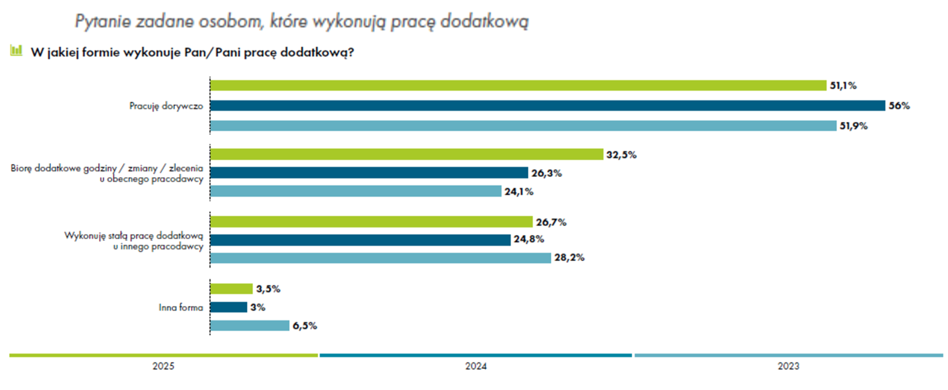
According to Grażyna Pogan, part-time jobs still dominate among the forms of earning extra money in Poland.
– These are most often works performed in the afternoons or evenings, including: in warehouses, catering or when caring for children and animals. The next places are taken by permanent additional work with another employer and freelancing, which is developing particularly dynamically in industries such as IT, marketing, media, recruitment and translations – says the Smart Solutions HR expert.
– It is worth noting that, in addition to typical occasional work, we are increasingly seeing the model of “permanent additional work”, where employees are associated with another client for a longer period of time, treating it as a stable element of the household budget – adds Mirosław Białobrzewski.
What industries do Poles earn extra money in?
According to labor market experts Sectors based on high working time flexibility remain the dominant forms of extra work. The most popular ones include:
- trade,
- gastronomy,
- transport and deliveries, among others couriers and food suppliers,
- education, among others tutoring and training,
- health care, among others care services,
- services and gastronomy,
- creative and technological industries,
- e-commerce,
- production.
What does the boss say?
According to a representative of Golden Serwis, it is also evaluating employers' approach to “multi-jobbing”.
– Currently companies are more open to additional sources of income for their employees, as long as it does not interfere with their results and does not violate the non-competition clause
– says the expert. – From the perspective of the market and entrepreneurs, this is an effective solution – it allows for better management of human resources and supports the financial results of companies. However, it is important to remember the other side of the coin – For an employee, an excessive number of working hours is associated with the risk of overload, decreased productivity and disruption of work-life balance. Therefore, the key challenge of the coming years will be to find a balance between the desire to increase income and regenerate strength.
Also, according to Grażyna Pogan, employers' approach to additional work of their employees is changing.
– There is greater openness to the fact that employees have additional sources of income, which results from, among others, due to staff shortages and the growing popularity of flexible forms of employment. At the same time, companies continue to pay attention to potential conflicts of interest and the impact of additional work on efficiency, that's why this acceptance is not unconditional – says the expert.
Companies employing employees for a “second” job also benefit from Poles' willingness to earn extra money.
– Companies operating in conditions of rising costs and economic uncertainty are increasingly avoiding permanent obligations and opting for flexible forms of employment. Design work, short-term orders and cooperation with freelancers allow you to reduce costs and respond faster to changes, says Anna Tietianiec.
An indispensable complement to your professional career?
There are many indications that In the near future, we can expect a further increase in the importance of project work, freelancing and part-time workas well as the development of digital platforms that fit into the gig economy model. It is very likely that the traditional model of one job for life will become increasingly rare, giving way to more flexible and diversified career paths.
– Additional work is no longer just a short-term response to a crisis or inflation. It has become a permanent element of the modern labor market. We expect that this market will continue to professionalize in the coming years. The flexibility of working time provided by modern technologies will mean that for many social groups, earning money in several places will become an integral, natural complement to their basic professional career – sums up the Golden Serwis expert.