Today, the ETS is being discussed not only in Poland, but throughout the European Union. The debate includes proposals for changes that will limit the cost pressure on industry and energy (as announced by the head of the European Commission, Ursula von der Leyen), but also more radical voices talk about the need to completely abolish the system, which was officially supported by President Karol Nawrocki, or to unilaterally leave Poland from the system, as suggested by PiS candidate for prime minister Przemysław Czarnek.
EU leaders will discuss the issue of the ECJ at a special summit on March 19. What really is the greenhouse gas emission allowance trading system and why does it arouse so much emotion?
The rest of the article is below the video:
Read also: High energy prices in the EU. Polish deputy minister on suspending the ECJ
How does the ETS system work?
To put it simply – ETS, i.e. Emissions Trading System, is a system operating in the European Union since 2005, in which large energy and industrial companies, as well as airlines and ship owners, must acquire allowances to emit greenhouse gases, primarily carbon dioxide. Outside the EU, it is also valid in Iceland, Norway and Liechtenstein, and from 2020 it is integrated with a similar system in Switzerland.
ETS covers approximately 40 percent. greenhouse gas emissions for which the Union is responsible; the rest falls on the so-called non-ETS sectors (such as agriculture, or – for the time being – road transport and households). It covers approximately 10,000. issuers.
The mechanism works on the “cap and trade” principle – the number of allowances is limited, and the entities obligated to do so must purchase them during auctions. Price is determined by supply and demand. One allowance corresponds to one tonne of CO2 and can be freely traded – also on the secondary market by investors who are not issuers, which is often criticized as a speculative means of increasing costs.
The number of allowances released to the market is gradually reduced, and emission prices are therefore rising, which is intended to motivate EU economies to switch to cleaner energy sources. Revenues from auction sales go to EU Member States in accordance with the quantities allocated to them (excluding trading in allowances on the secondary market). There are also some allowances granted for free in the system, which we will get to later.
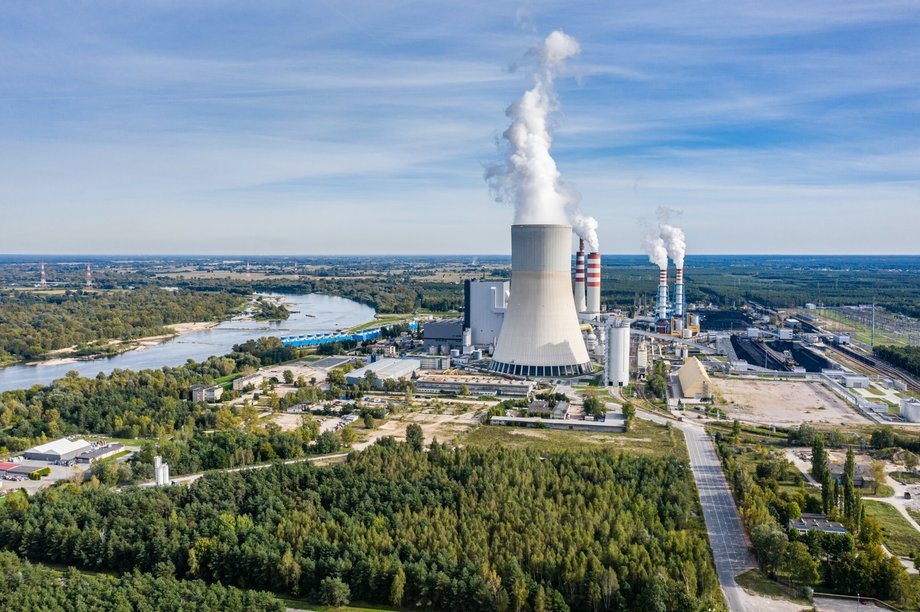
Emission allowances must be acquired, among others, by conventional power plants burning coal or gas. The photo shows the Kozienice Power Plant owned by Enea Wytwarzanie
|
Lukasz Szczepanski/REPORTER / East News
Why was the ETS introduced?
The ETS is therefore one of the emission allowance markets operating in the world, although it was introduced by a political decision and with a regulated amount of “goods” that are on it. Market pricing is supposed to distinguish the system from the tax that it is often called. The ECJ was established by an EU directive in 2003, When Poland joined the EU a year later, it was already clear that our power plants and factories would also have to acquire permits.
It is also the oldest carbon market in the world. New Zealand established its own system in 2008, South Korea in 2015, and China in 2021. Since 2013, a similar solution has also been in operation in California, USA. Countries such as Mexico, Thailand and Indonesia are planning their own systems. But where did the idea that carbon dioxide emissions – a consequence of economic activity based on burning fossil fuels such as coal, oil and gas – need to be paid – come from?
The answer is simple – from awareness of ongoing climate change, increasing warming and agreement on the need to counteract these phenomena. The ECJ is intended to implement the “polluter pays” principle, and its roots date back to the so-called the Kyoto Protocol, an international agreement of 1997 in which members of the United Nations Framework Convention on Climate Change committed to reduce greenhouse gas emissions – including by introducing mandatory emission allowances. The ETS was therefore a European way to implement the Kyoto provisions.
When it comes to this, the system actually brings results – according to data from the European Commission, in 2024 the carbon footprint of energy and industry in the EU was approximately half of what it was in 1990, and the Community is on track to reduce it by 2030 by the 62% assumed in EU law.
Read also: ETS cuts emissions, but the climate continues to warm. The record year 2024 is behind us.
ETS development phases
The EU regulations on the ETS distinguish several phases of system development. The first one, which lasted from 2005 to 2007, had a “training” character; states and business were just learning what emissions trading was, and almost all allowances were granted to issuers for free. Methods for monitoring and reporting emissions were also prepared and implemented.
In the second phase from 2008 to 2012, the system became slightly more stringent – the available allowances were approximately 6.5 percent lower. less than in the first stage, and the number of free allowances dropped to approximately 90%. The first auctions were held, and some countries also included nitrous oxide emissions into the system.
In 2013, the third phase began. Since then free allowances are granted primarily to industrial plants in order to prevent the so-called carbon leakage – the relocation of European companies outside the EU to countries where similar standards do not apply. The energy sector has, in principle, been excluded from these allocations, and the allowances must be acquired during auctions. A common EU limit on the number of allowances was also introduced instead of the previous national limits.
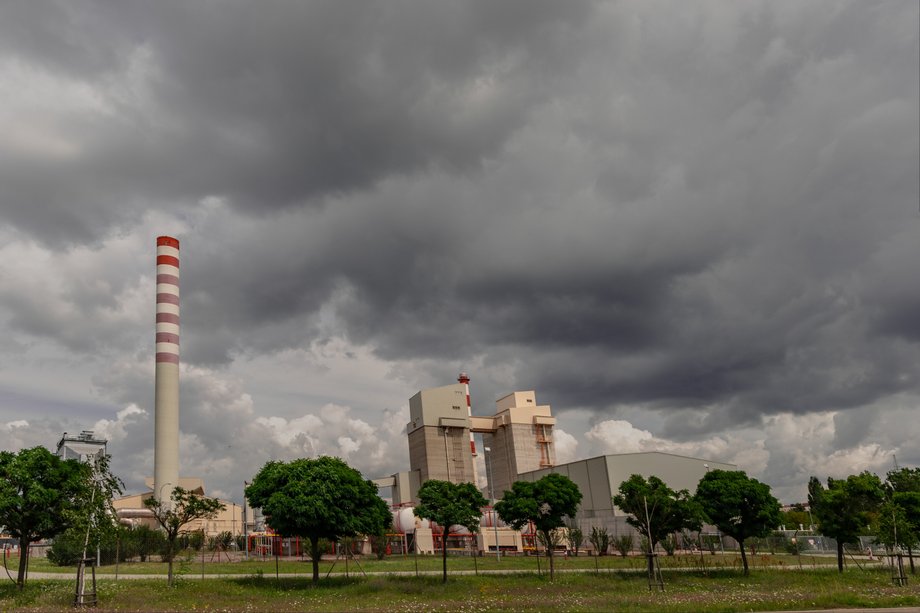
Industrial plants receive free emission allowances. The photo shows Huta Częstochowa
|
Dominik_Spalek / Shutterstock
The fourth phase is already underway from 2021 and is scheduled to end in 2030, and its essence is, among others, gradual phasing out of free allowances. Back in 2013, the entire industrial sector received 80% for free. your rights. In 2020, it was only 30 percent; the rest had to be purchased at auctions.
The phasing out of free allowances for the most demanding sectors is scheduled for 2026 – according to the regulations in force today, they are to disappear completely by 2034.
ETS system. What about authorizations for energy-intensive industries?
This is an energy-intensive industry where reducing emissions is technologically more difficult, as cleaner and cheaper alternatives to fossil fuels have not yet been implemented on a larger scale. These are plants such as steel and aluminum mills, cement plants, refineries and chemical plants. Since such industries have the theoretical possibility of “moving” their production outside the EU, they are still under special protection, receiving 100% free of charge. of their rights, although this will start to change from this year.
The change is justified by the entry into force at the beginning of 2026 of the CBAM border tax, under which the same amount will be paid for imports from outside the EU as in ETS emission allowances; the playing field was therefore theoretically equal. Despite this, the energy-intensive industry is protesting against the withdrawal of free allowances, and stopping this process is one of the key demands in the ETS reform.
Read also: In search of green steel. “We have about 14 years for full decarbonization”
Prices of allowances in the ETS. In 2023, they exceeded EUR 100
For years, emission allowances were not expensive at all. Until 2018, their prices remained low and did not exceed EUR 10 per tonne, so the energy and industry sectors did not perceive them as a particular problem. Paradoxically, however, it was an accident at work – low prices did not encourage investment in zero-emission technologies. The EU therefore used the so-called market stability mechanism, i.e. in this case, simply limiting the pool of allowances released to the market (theoretically, increasing them is also possible) in order to increase prices.
It worked and in 2019-2020 the allowance for a tonne of CO2 emissions already cost EUR 20-30. In 2023, the price exceeded EUR 100 for the first time. In 2025, the average price, according to data from the Instrat Foundation, was over EUR 73. Within a few years, issuers covered by the system have experienced a significant leap forward.
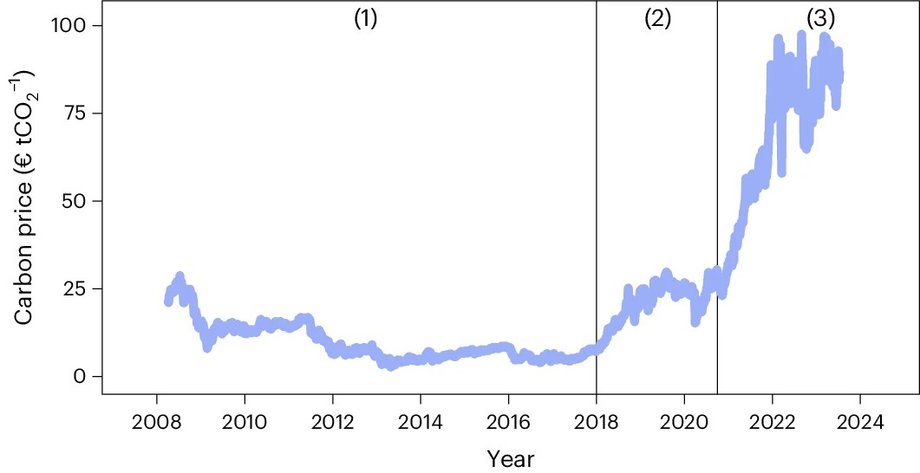
Prices of ETS allowances in 2008-2024
|
Nature Energy / Nature Energy
According to data from the Bruegel think-tank, since 2013, when auctions began in earnest as the main system for distributing allowances, by 2025, revenues from their sales amounted to over EUR 245 billion. In 2024, auction proceeds amounted to EUR 39 billion, of which over EUR 24 billion went to the Member States, while the rest went to such EU instruments supporting the green transformation as the Innovation Fund or the Modernization Fund.
What does Poland spend its ETS funds on?
As for Poland's share in this cake – the National Center for Emission Balancing and Management estimated that in the years 2013-2025 our country sold 851.366 million emission allowances at auctions, and the total revenues from these sales amounted to EUR 31.585 billion, i.e. at the current exchange rate approx. PLN 135 billion. Revenues for 2025 are estimated at approximately PLN 15-18 billion. After Germany, we are also the second country in the EU to make money from the system.
What does our state do with this money? From 2023, EU regulations stipulate that 100 percent ETS revenues should finance the energy transition. Previously, the requirement was 50%. The fact that in practice there are problems with this is proven by the report of the Supreme Audit Office from autumn 2024. The Chamber stated that in the years 2013-2023 we spent less than 1.3% of GDP directly on reducing or managing emissions. income from the sale of allowances (income in this period amounted to almost PLN 94 billion). The overwhelming majority “dissolved” in the budget and extra-budgetary funds. In its own analysis, the Instrat Foundation states that in 2023 the most money was spent on freezing energy prices.
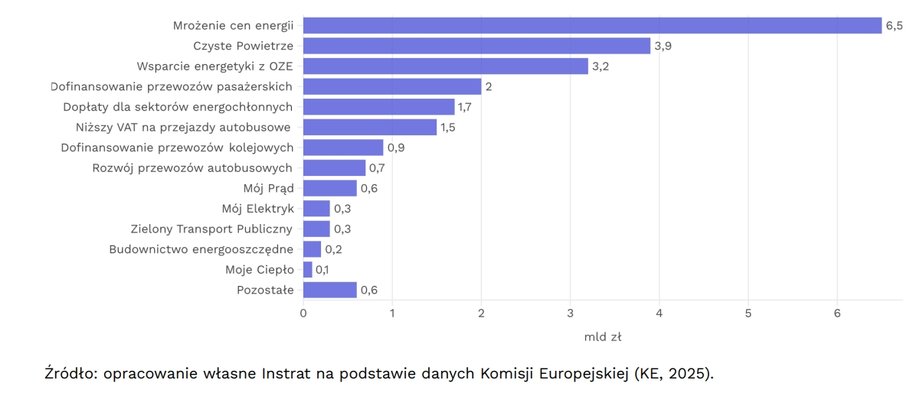
Expenditure of ETS funds in 2023
Read also: Poland will gain billions for energy transformation. Experts have an idea for this
The revision of the ETS directive in 2026 was planned earlier, but recently there have been more and more voices from various quarters – and not only from Poland, which is traditionally averse to high fees and is heavily carbon-intensive – about the need to relax the system. Europeans from various capitals and parties blame the ETS in its current form for raising energy prices and weakening competitiveness. The main demands for reform concern limiting market participation for investors who are not issuers, longer allocation of free allowances to the industry and the introduction of a price corridor (i.e. a maximum price of allowances). In the background there is also the specter of ETS2, i.e. the extension of emission allowance trading to buildings, transport and smaller industry, which will directly affect household wallets. Changes towards a looser system therefore seem inevitable – the question is how deep.