With the diploma on the wall and the steering wheel in hand: the generation that works in a different field than the one in which they studied


Romania is one of the countries where the mismatch between the job and the field in which the employees trained is still high.
Just over half of young people with secondary or higher education work in the field for which they trained. The rest – almost one in two – make compromises, conversions or choices forced by the market, according to the data published by Eurostat.
Andrei, a 26-year-old young man from the countryside, with whom HotNews spoke, perfectly illustrates the statistics presented by the research of the EU statistical office.
Coming from a family with modest incomes in Teleorman county, Andrei dropped out of high school in the 11th grade, after his father suffered an accident at work and the family faced severe financial difficulties.
“I wanted to continue, but I didn't have money for supplies or transportation to high school. I had to choose between going to school or helping my family survive,” he says.
The abandonment of formal education is a great challenge for the educational system
Andrei quickly found a job on the construction site, but after a few years he realized that without education he could not advance professionally. He now works as an unskilled laborer, feeling “trapped” – he needs steady income to support his family, but his lack of a high school diploma blocks his access to higher-paying jobs or vocational retraining programs.
In total we have tens of thousands of “Andrei”. There are more than 63,000 Romanians between the ages of 15 and 34 who declared that they abandoned at least one formal education program, according to research published by the INS. Most of them (56.5%) are men, and 65.3% come from rural areas, note the authors of the research.
Dropping out of studies does not only occur in the primary, secondary, but also in the university cycle.
The highest level of faculty dropout occurs in the first year, shows a study done on 5 cohorts of students, study carried out by 4 Romanians (Claudiu Herțeliu, Cezar Hâj, Andrei Pârvan and Daniela Alexe-Coteț) and published by the Springer publishing house.
“Students who come from other localities than the one where the university is located are more motivated and do not drop out (probably because otherwise they do not get a place in the dormitory and/or a job good enough to allow them to stay in that city afterwards). For those who live in the same city, probably the comfort of their parents' home makes them less motivated. We also found that study programs such as: medicine, military or theology had much lower dropout rates (sometimes 3-5%) compared to most other programs, where the dropout level was higher – or close – to 40%)”, says Claudiu Herțeliu, dean of the Cybernetics Faculty of the Academy of Economic Studies (ASE), in a discussion with HotNews.ro.
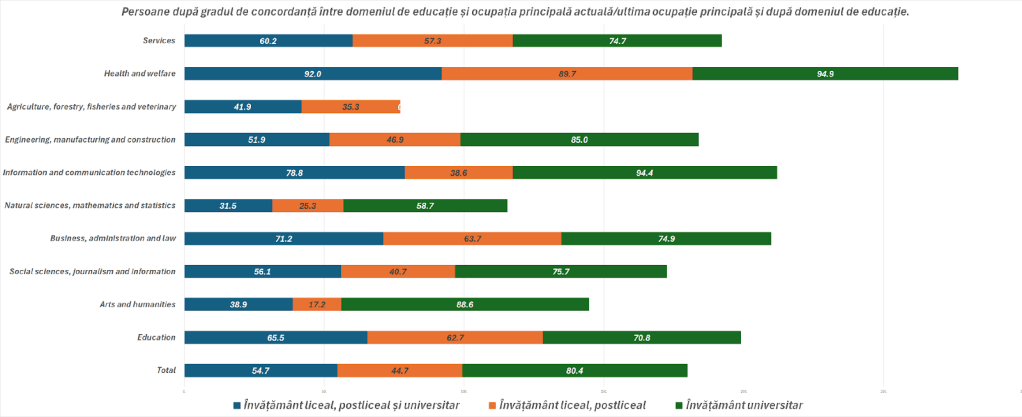
Eurostat data (set “Persons by match between field of education and current/last main job”, updated January 2026) shows that between 15–34 years, the match rate between field of study and job is 54.7% for all ISCED level 3–8 studies.
- ISCED 3–8 are the codes for upper secondary education levels in the UNESCO international classification:
- ISCED 3 – upper secondary education: classes IX–XII/XIII, all types of high school.
- ISCED 4 – post-secondary non-tertiary education: post-secondary schools, non-university tertiary.
- ISCED 5 – short higher education: colleges/short university, short tertiary programmes.
- ISCED 6 – Bachelor or equivalent level: basic university programs (3–4 years, Bologna).
- ISCED 7 – master's or equivalent level: advanced postgraduate programs.
- ISCED 8 – doctorate or equivalent level: advanced research programmes, the highest level of study.
The criterion used by Eurostat is represented by the congruence of the competences acquired through education with those regarding the competences required for the position occupied.
The mismatch of skills according to the field of education can be relevant for the analysis of the labor market, because “unsuitable” people are often frustrated because they have wasted years of their life on something that does not bring them added value, and for an employer it can mean higher costs related to the qualification of the unprepared employee for the job and a lower yield of the “unsuitable”.
Eurostat also analyzes detailed data for different fields: Education, Health, Agriculture, etc.
The Big Break: High School vs. faculty
For young people with secondary education (ISCED 3–4), only 44.7% work in the field for which they trained.
For those with higher education (ISCED 5–8), the match rises to 80.4%.
This difference of almost 36 percentage points tells a simple story: a university degree greatly increases the chance of working in the field, while secondary education produces a much more fragile integration into the labor market.
Match Champions
Health
Total: 92.0%
Secondary education: 89.7%
Higher education: 94.9%
In health, almost all young people work in the field. It is the highest matching rate in the economy. The explanation is structural: regulated system, licensed professions, clear professional path.
Information and Communication Technologies
Overall: 78.8%
Secondary education: 38.6%
Higher education: 94.4%
IT shows an interesting polarization: for college graduates, almost all work in the field. For those with secondary education, the match is below 40%.
The signal is clear: in technology, the university degree counts decisively.
Where the degree does not “catch” the market: Natural sciences, mathematics, arts and humanities
Natural sciences, mathematics
Total: 31.5%
Secondary education: 25.3%
Higher education: 58.7%
It is one of the worst matches in the economy. Many science graduates end up in other fields – frequently in business or IT.
Arts and Humanities
Total: 38.9%
Secondary education: 17.2%
Higher education: 88.6%
This is where the biggest internal fracture appears: If you only have secondary education: the chances of working in the field are very small. But if you have a university, the match goes up spectacularly, Eurostat data show.
The conclusion: in humanities fields, the level of studies changes the professional destiny.
Business and law
Total: 71.2%
Secondary education: 63.7%
Higher education: 74.9%
It is one of the most stable domains. The explanation is simple: economic and legal skills are transferable across many industries.
Engineering – better than it looks
Total: 51.9%
Secondary education: 46.9%
Higher education: 85.0%
For engineers with higher education (the others are more technical) the integration is solid. The problem arises at the middle level, where transition to other occupations is frequent.
Education and the labor market: a persistent mismatch
Only 40% of unemployed young people believe that their level of education matches the requirements of their last job. Almost half (49.8%) admit that the field followed had nothing to do with professional activity.
The mismatch does not only affect the unemployed. Overall, young people from rural areas more often feel overqualified (12.7%) or underqualified (7%) for the available places. Conversely, in cities, 79% say that their level of education is adequate for the job, according to an INS survey.
The most vulnerable: rural youth and agricultural workers
In agriculture – where more than 10% of active young people work – the discrepancies are even more evident. Almost a quarter of young agricultural workers do not know if their education matches the job requirements, and 16.7% consider themselves overqualified. The same sectors also register the highest percentage of those who believe they have inferior skills for the job (15.7%).
“Romania has a generation of young people who enter the labor market with a fragmented educational background and with a low level of professional orientation”, warn labor market specialists.