Students wearing keffiyehs appeared at a lecture by a Jewish guest. “God, I just realized: they're just kids”

Our tendency, all of us, is to speak in areas where we feel uncontradicted. Next: we end up chatting in the bubble. Jewish journalist Haviv Retting Gur was invited to a college in Pennsylvania to discuss the history of Israel. About 10 masked people entered the classroom. Gur let them attend the conference, continued to give his lecture and at the same time talk to the protesters. At the end he said to them: “Thank you for staying. You have earned my respect.” What would a debate like this look like in our schools?
The keffiyeh is the traditional scarf, in colorful spots, worn on the head and sometimes on the face by men in the Middle East. The scarf has become a symbol with global stakes for many decades. She was constantly dressed by Yasser Arafat, the influential chairman of the Palestine Liberation Organization.
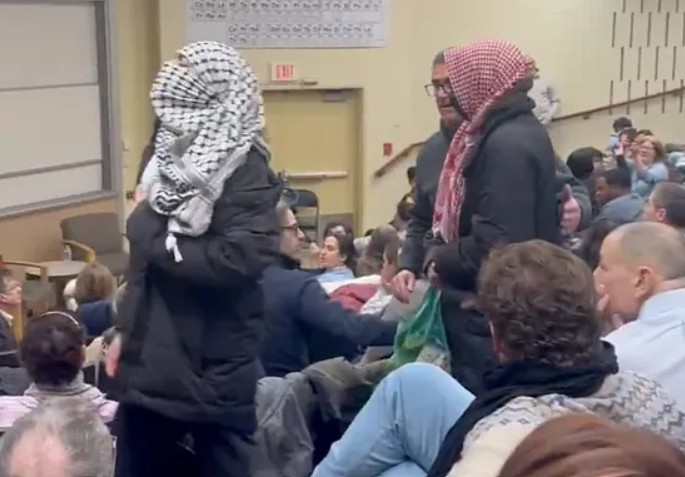
More than 10 students appeared in keffiyehs at Haverford College, right at the beginning of the lecture that journalist Haviv Rettig Gur was going to give.
Gur, 44, specializes in lecturing on the relationship between Jews and Arabs. “Why I let anti-Israel protesters interrupt my speech,” Gur told The Free Press of what happened.
On “displacement and death”
“I wanted to talk about Jewish history, a story of displacement and mass death, a story that largely explains the difference in worldview and politics between Israeli and American Jews,” he said.
“At the start of the event at Haverford College, more than a dozen masked people wearing keffiyeh entered the lecture hall. It was a scene that has become sad and familiar on American campuses. At any moment, the chanting and intimidation, the masked pretext for doing something dangerous and brave, was about to begin.”
“One person asked me to distance myself from The Free Presswhich she believed was on the wrong side of some internal culture wars. When I told her that it was a childish request, that I deal with the Middle East and don't know much about these issues, and that purity tests are a bad way to navigate a complicated world, she started to cry.”
He felt there was a chance for a dialogue
But something caught his eye, he says. It seemed to him that there was something almost scenographic about the ceremony of hostility. That there is a chance for dialogue.
The Jewish guest thought that perhaps it was a lot of theater, which does not preclude sincerity, but allows dialogue to make its way beyond the curtain of apparent hatred.
“The keffiyehs, the fake paramilitary march — these protesters were acting out a kind of learned rebellion that they'd picked up from social media and Hollywood influencers. They were fantasizing. They were playing. God, I realized: They're just kids,” said the speaker.
The Jewish students were, in turn, tense
The speaker on stage recalled the moment his own child told him “Dad, I hate you”. Then the child ran to his room. But didn't that mean, “Dad, I need you and I love you and I'm hurting without you and I need you to see me”?
And by this model, what did these young people on the US campus want to be heard?
The Jewish students in the room were also tense. Supporters of the Palestinian cause, too. “But I was satisfied,” claims the speaker.
“I decided I wanted them to stay. So of course I asked them to leave. You can't learn while trying to intimidate others wearing a mask, I told them. So they had to take off their masks or leave the classroom.”
“Free Palestine”
“Then I sat in the lectern's chair and counted to 30. They remained in their seats, berating me with their revolutionary stares and accessories. So, defeated, I stood up to begin my speech on the death of European Jewry.”
The journalist reports that they managed to talk for about 25 minutes before violent disturbances began, with another protester shouting “free Palestine”, “death to the IDF” and “one more soldier in the ground”.
The protesters did not take off their masks. But almost all of them stayed until the end.
“I didn't meet violent and intolerant radicals; I met children playing with violent and intolerant radicalism”
“It was the strangest thing: the more we treated them like neglected children, hungry for knowledge, the more willing they were to respond in healthy and productive ways. I didn't meet violent and intolerant radicals that night; I met children playing violent and intolerant radicalism.”
“I met young men hungry for wisdom and authority who had been told that every one of their whims and emotional outbursts were valid and indisputable truths.”
The difference was that the journalist also told them, bluntly, what he was thinking.
How was the dialogue
A university staff member confided to him that if they had told the kids, “like I did, that they were being childish and ignorant,” the faculty would have been fired on the spot.
But hearing things openly stated, while they in turn sprinkled theirs, just as openly, the young men listened. “They had never heard this history of the core of the refugees, told from the Zionist experience.”
It is only possible if the teachers believe in the students
At the end, the Jewish guest thanked the keffiyeh-clad ones for staying. “One of them laughed mockingly. It earned my respect even more.”
“Last week at Haverford, I didn't meet a big, powerful political movement. I met children neglected intellectually and emotionally, surrounded by adults paid enormous sums not to challenge them, not to teach them, not to instill in them the great gifts of substance and courage and nuance,” added Haviv Rettig Gur.
This can only be done if the teachers believe in the students.
The possibility from Romania
What would such a sequence look like in Romanian schools? Because we really need dialogue. Society is not only divided at the level of adults. It can be seen, for example, in the “irreconcilable” votes of young people.
In the most recent major elections, those in Bucharest in December 2025, the candidates AUR and SENS, two parties in complete opposition, gathered, together, 28% of the votes. They probably wouldn't even enter the same room.
In a recent article in Contributors, high school teacher Dan Alexandru Chiță says that this happens in the context where “One out of three students is “lost” along the way by the public education system”.
The most efficient targeted propaganda machine in the history of the world: Russia
More precisely: “One out of 3 students meets the Romanian school only a little in the process of individual development or receives the final qualification to be rejected, as a future adult who did not manage to get the passing grade for compliance with the minimum requirements of formal education, imposed both by the reformed Romanian state and by the European Union”. This does not make students more tolerant, nor could it make them.
Added to this is the fact that we are in the vicinity of the most efficient targeted propaganda machine in the history of the world: Russia. And young people's brains are also a target.
A dialogue in our school classes, about the EU, Romania, work, merit and success in life, would probably disturb us. How much do young generations still believe in democracy and what does democracy do for them? But that's exactly why the conversation is worth having.