Road transporters in Romania continue to pay the highest price in the Central and Eastern Europe region for diesel fuel, despite the fact that they benefit from a diesel excise duty compensation mechanism of 65 bani/liter for the period January 1 – March 31, 2026, a market analysis shows.
Romanians fuel their cars in Hungary because of the high prices in the country
“Diesel price differences in the region and the fact that the excise duty recovery mechanism applies only to Romanian transporters
generates a direct effect on the state budget.
Romanian carriers operating on international routes choose to fuel in countries such as Hungary, where costs are more competitive, and foreign operators transiting or carrying out activities in Romania avoid local fueling because they cannot recover their excise duty.
Practically, important volumes of fuel move outside the country, which means lower receipts from taxes and excises for the Romanian state and a loss of competitiveness for the local transport market“, said George Dobre, sales manager Romania at TFC for “Adevărul”.
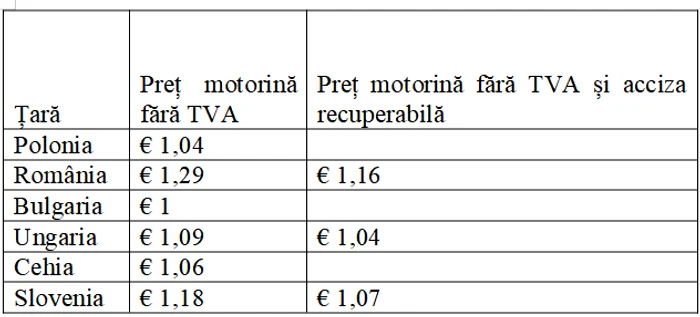
According to him, the price of a liter of diesel in Romania, without VAT and without excise duty, is 16% higher than that in Bulgaria, 12% higher than Hungary and Poland, 9% higher than the Czech Republic and 8% higher than Slovenia.
At EU level, 7 other states refund the excise duty for road hauliers, Belgium (0.1913 euro), France (0.1575 euro), Italy (0.2141 euro), Croatia (0.0761 euro), Slovenia (0.1038 euro), Spain (0.0490 euro) and Hungary (HUF 20, about 0.053 euro). It should be noted that, in these countries, both local and foreign road carriers can recover the diesel excise tax, unlike in Romania where the scheme applies only to Romanian carriers.
Regarding the diesel price situation at the European level, Spain, Bulgaria and Belgium remain the countries where road carriers can find the best price for fuel, claims the representative of TFC, a company specialized in the international supply of fuel cards.
Road charges have increased in Europe
With fuel costs accounting for up to 35% of total costs for fleets operating internationally, the share of road taxes lags far behind.
The year 2026 brought road toll increases, expansion of toll networks and a shift to new toll collection models for road hauliers. In Hungary and Austria, the rate of road tolls per kilometer exceeded diesel costs.
In Poland, the tariffs have already been indexed from January 2026 by 5%, and since February the taxes in the e-TOLL system have increased by 40% for trucks and buses.
In Austria, the new truck tariffs have risen by 7.7% from 1 January 2026, taking into account the number of axles, CO₂ emissions and noise level.
From 1 July 2026, the Netherlands will replace the Eurovignette with a mileage tax, calculated according to vehicle weight and CO₂ emissions, applicable on most main roads. In the same period, Romania will introduce the TollRo electronic system for vehicles over 3.5 tons, on the principle of “you pay as you go“.
Excise duties on fuels were increased on January 1
From January 1, 2026, carriers in Romania feel the effects of the increase in fuel excises, which put pressure on operating budgets, given that fuel represents an important share of the total cost of a journey.
Carriers estimate an increase of at least 10% in transport rates as a result of the accumulation of factors that make the operation of fleets more expensive in Romania and in the rest of Europe.
“Government Decision No. 1094/2025 regarding compensation for the increase in diesel excise duty expires on 30.03.2026. If the diesel excise duty refund scheme is not extended until the end of 2026, transport prices will certainly increase (around at least 10%).
As for the increase in the road tax (the introduction of the ToolRo tolling system from 01.07.2026 for trucks over 3.5 t, the rate is below the one in Bulgaria. OGnr. 23/2025 increased the rates for eggplants already, I think that the transporters also increased transport prices by 5-8% last year due to the increase in the rates for eggplants. All these increases will be seen in the prices on the shelf, but also in the price of tickets for road passenger transport“, stated for “truth“, Beniamin Lucescu, president of the Federation of Romanian Transport Operators (FORT).
Charging per kilometer will make transport rates even more expensive
Mihai Teodorescu, director of Eltra Logis, one of the main players in the niche logistics, transport and storage market, stated that Romania is preparing to introduce a new road toll system pay as you gowhich will replace the wreckage for vehicles over 3.5 tons.
According to him, charging per kilometer, differentiated according to vehicle mass and emission class, will lead to higher costs for domestic and transit transport.
“We are in a moment of structural recalibration of road transport at European level. Increasing infrastructure charges, increasing fuel excises and introducing traffic restrictions in key transit states are fundamentally changing the way transport fleets are planned and operated. These developments have a direct impact on fuel costs, tolls, delivery times and efficient use of resourcesexerting constant pressure on operating margins. In this context, the adjustment of transport tariffs becomes a strategic decision necessary to ensure the sustainability of operations in the medium and long term, the continuity of services and the maintenance of standards of quality, safety and predictability“, declared Mihai Teodorescu.