This was not the inflation economists expected. The jump in these prices disturbed the forecasts


Annual inflation fell for the seventh time in a row and amounted to 2.2% in January. – the Central Statistical Office reported on Friday. “Only” 2.2%, because the last better result was in March 2024, i.e. 22 months ago. This is a good forecast for rate cuts in March, although analysts expected a drop to as much as 1.9%. You could say they are disappointed.
The text continues below the video
ING Bank Śląski economists expected a 1.9% price increase per year. “Energy and food prices are slightly higher than our expectations, so the transition to COICOP 2018 has increased the estimates, but these are technicalities. Disinflation mechanisms are firmly entrenched, the price pressure has been decreasing for many months, which is why the Monetary Policy Council will reduce rates by 25bps in March. We are waiting for the NBP projection and the update of the CPI basket,” comments Rafał Benecki, the bank's chief economist.
The inflation reading was prepared in accordance with the new COICOP 2018 methodology, which modifies the classification of consumer spending, but using last year's weights.
mBank Research analysts estimated that core inflation amounted to 2.5-2.6 percent.
“The New Year's jump in food prices has thwarted market forecasts” of inflation
“The surprise was mainly the food. As usual, there was a slight relief (+1.3%). [mdm]). We cannot escape the fact that prices in this category jump at the beginning of the year,” mBank economists comment.
— The New Year's jump in food prices has thwarted market forecastswhich assumed a drop in inflation to the lowest level in seven years – says Bartosz Sawicki, an Exante analyst.
Sawicki notes that, in addition to the effects of the statistical base, further inhibition of price pressure was again caused by trends in fuel prices, which this time fell by 2.4%. m/m.
— In turn, food prices broke the favorable trend, starting the year with a jump of 1.3%. mdm. Energy prices had a similar effect, growing by 1.9% in January. mdm – lists.
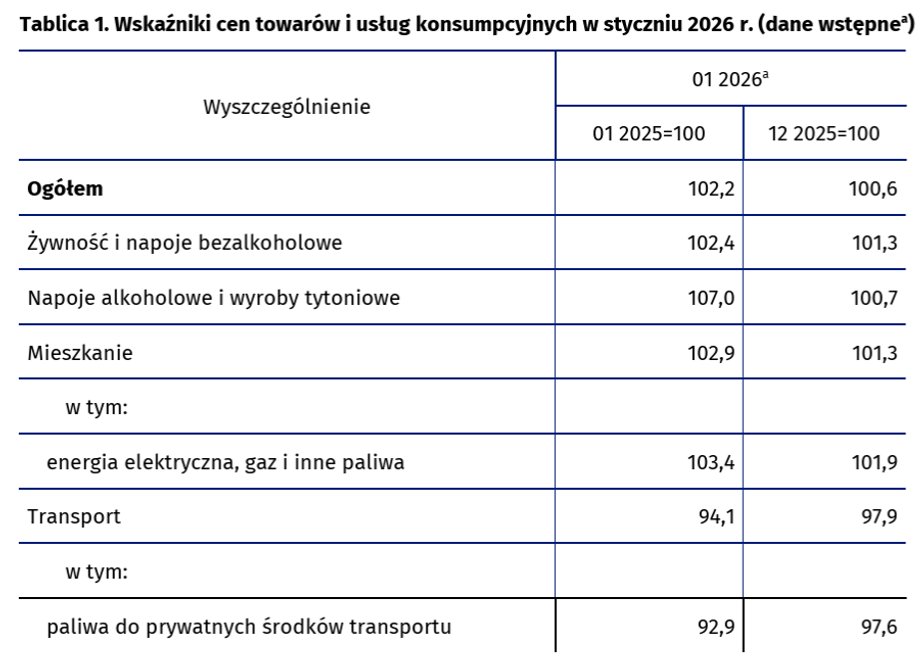
Inflation on January 26
|
Central Statistical Office, own study
What about interest rate cuts?
— Today's reading does not rule out the March interest rate cut, but marginalizes the chances of a move larger than 25 bp – says Sawicki.
Some forecasts actually pointed to a cut in March of as much as 3.5%. This is what analysts from Bank Pekao and Credit Agricole thought. According to the former, we would then see a reduction of a total of 0.75 percentage points at the end of the year. in the year, and according to the latter, it would be the first and last reduction move of the Monetary Policy Council in 2026.
According to the Exante analyst, the reading does not constitute an argument for the Monetary Policy Council to postpone interest rate cuts for the third month in a row. Jan Karczewski, director of strategic clients at Michael / Ström Dom Maklerski, also has similar thoughts.
— Although the January reading turned out to be slightly higher than the consensus, it is worth emphasizing that since November, inflation has remained within the inflation target of the National Bank of Poland, and even below its level of 2.5%. on an annual basis. In such an environment, another reduction in interest rates at the next meeting of the Monetary Policy Council in March seems to be a foregone conclusion, he believes.
— March will also bring significant statistical events. As every year, the Central Statistical Office will revise the inflation basket, which will involve adjusting the inflation readings for January and February. Additionally, a new NBP inflation projection covering the next two years will be published, Karczewski points out.
— Current market valuations indicate the scenario permanent anchoring of inflation close to the NBP target in the medium term. This picture favors further easing of monetary policy, he adds.