In February, Krasnoyarsk residents will be able to observe the active movement of the Moon and the parade of planets in the sky

1 February 10:17
The observatory of Krasnoyarsk Reshetnev University told what astronomical phenomena can be seen in the sky in the last month of winter.
Yes, all February The moon will actively move among bright objects, witha traveler of the Earth will make a series of encounters with planets and stars:
- February 1 – full moon (Snow Moon) and the Moon's approach to the Manger star cluster.
- On February 3, the Moon will pass very close to the star Regulus.
- On February 7, the Moon will be next to the star Spica.
- February 11 – The Moon is near the star Antares.
- February 18 – Moon next to Mercury.
- February 19 – The Moon is next to Saturn and Neptune.
- February 23 – Moon next to Uranus.
- February 24 – The Moon is near the Pleiades star cluster.
- February 27 – Moon next to Jupiter and Pollux.
- February 28 – The Moon will once again be close to the Manger star cluster.
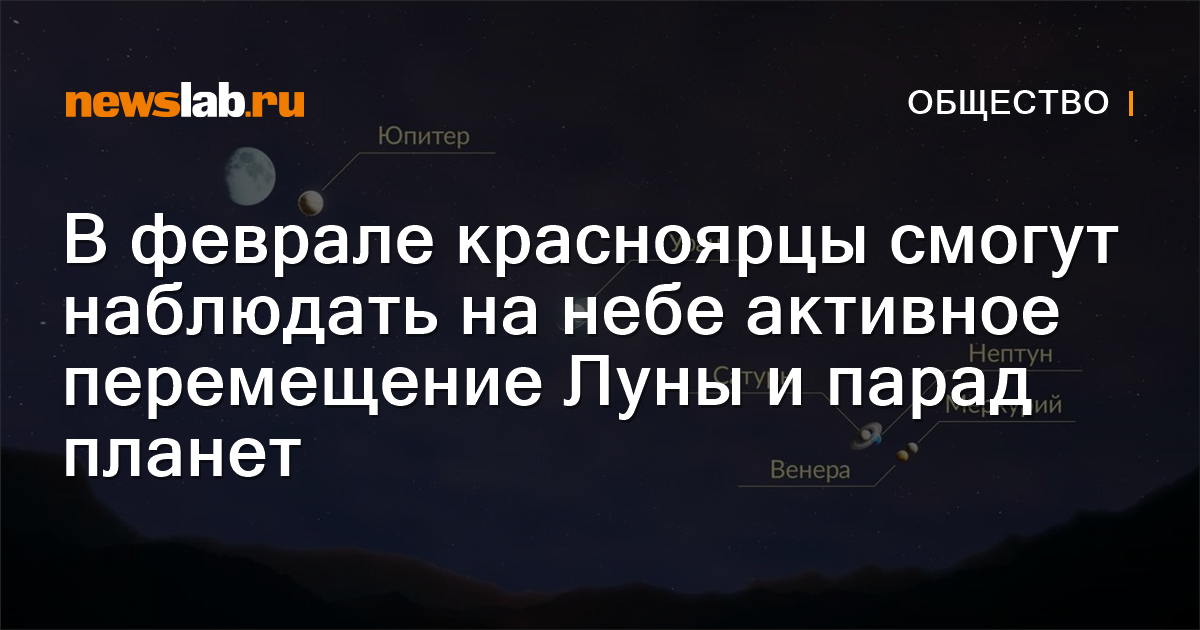
But the main event of the month will be parade of planets. On February 28, in the evening sky after sunset, six planets will line up in the sky: Mercury, Venus, Neptune, Uranus, Saturn and Jupiter, of which the minor parade will be four.
“Four planets (Venus, Mercury, Saturn, Jupiter) will be visible to the naked eye, while viewing Uranus and Neptune will require binoculars or a telescope. The Moon, illuminated at approximately 89%, will join the parade,” said Sergei Veselkov, head of the Reshetnev University Observatory.

To observe these events, it is recommended to choose places with minimal illumination and an open horizon. It is also important to take into account weather conditions – clear skies increase the chances of success.
Newslab is now at MAX. News is also published in OK | VK | Zen | Telegram
Related links:
- Krasnoyarsk residents share pictures of the Wolf Moon
- The number of days with magnetic storms over the past 10 years has reached its maximum