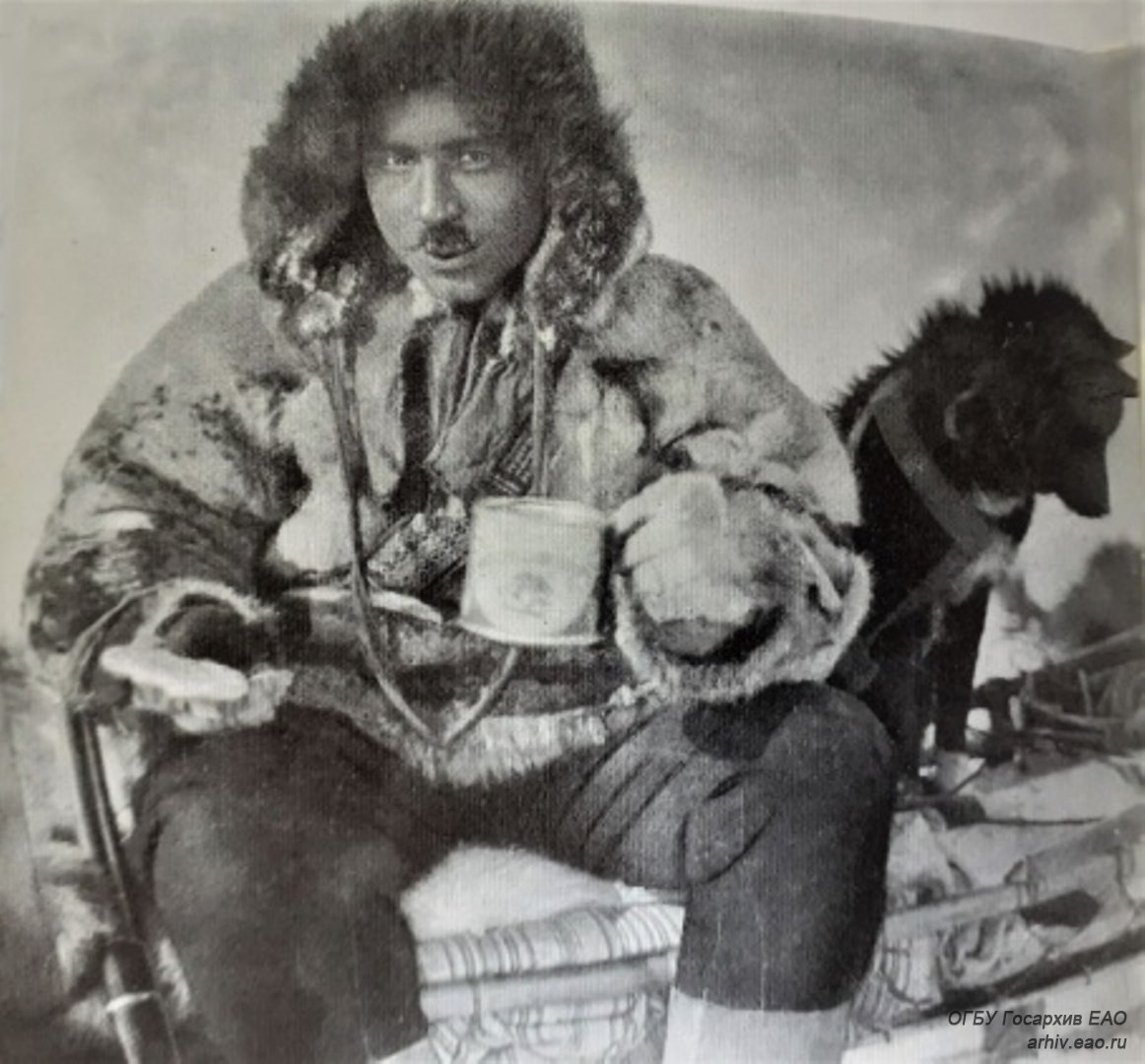
Ushakov G. A. Blizzard Island. On untrodden land. – Leningrad, 1990.
Photo: State Archive of the Jewish Autonomous Region
January 30, 1901
On this day, Ushakov Georgy Alekseevich, an outstanding Soviet explorer of the Arctic, Doctor of Geographical Sciences, Honorary Polar Explorer of the USSR, Honorary Citizen of the Jewish Autonomous Region, was born.

Georgy Alekseevich was born into a large Cossack family of the Amur Cossack Army, in the settlement of Lazarevsky – now the village of Lazarevo, Leninsky district.
Georgy Ushakov received his primary education in the village of Babstovo, having studied at a local Cossack school. G. Ushakov received further education at the Khabarovsk Higher Primary City School, which he graduated in 1916.
During the summer season of 1916, Georgy Alekseevich worked on the expedition of V.K. Arsenyev in the Ussuri taiga.
In 1917, after the October events, he sided with the revolution. In 1918, he volunteered to join the Red Guard, participating in the suppression of the uprising of Ataman Gamov in Blagoveshchensk. Until 1920 he fought in the partisan detachments of the Amur and Primorye regions. In between hostilities, he continued his studies at the teachers' seminary, then at the Far Eastern University. Served in the Red Army.
After demobilization, he worked in Primorye, holding various positions, from the head of a hut-reading room to the chairman of the board of a Credit Society.
On May 8, 1926, the chairman of the Far Eastern Regional Executive Committee appointed G. Ushakov as commissioner for the management of Wrangel and Herald Islands.
Ushakov managed to firmly establish a settlement on Wrangel; for three years he headed the settlement on the island.
The project of Ushakov's expedition to Severnaya Zemlya, which had remained unexplored since its discovery in 1913, was unanimously approved by the government Arctic Commission of the USSR Academy of Sciences.
G. Ushakov’s expedition spent two difficult years on Severnaya Zemlya. A huge “white spot” was explored and 37 thousand square kilometers of land among the polar seas were mapped.
In 1935, Georgy Alekseevich led the first Soviet high-latitude expedition on the icebreaker Sadko. The expedition deciphered the vast unexplored space on the map between Franz Josef Land and Severnaya Zemlya. An island was discovered in the Kara Sea. The scientific significance of G. A. Ushakov’s expedition surpassed the results of other expeditions previously working in the Arctic.
Deteriorating health deprived Georgy Alekseevich of the opportunity to continue expeditionary work in the Arctic.
From 1938-1940 Georgy Ushakov is the head of the newly created Main Directorate of the Hydrometeorological Service. Georgy Alekseevich laid the foundations for the activities of the hydrometeorological service, which are still alive today. In subsequent years of his life, G. A. Ushakov held senior positions in the USSR Academy of Sciences.
Since 1958, Georgy Ushakov has been a federal pensioner.
For services to the Fatherland, G. A. Ushakov was awarded the Order of Lenin, the Red Banner of Labor, the Red Star and medals.
Georgy Alekseevich Ushakov died on December 3, 1963.
But his memory lives on. In the center of Moscow on Nikitsky Boulevard, a memorial plaque was installed on the facade of house No. 9 (Polar Explorers House). An island in the Kara Sea, the village of Ushakovsky on Wrangel Island, a spit and cape on the same island, a river on the Severnaya Zemlya archipelago, and mountains on Enderby Land in Antarctica are named in honor of our fellow countryman. The oceans are plied by the weather research vessel “Georgy Ushakov” and the transport refrigerator “Ushakov Island”. Two commemorative envelopes with his portrait and a commemorative medal were issued.
In his honor in the village. A memorial plaque was unveiled in Lazarevo, Leninsky district of the Jewish Autonomous Region. One of the districts of the city of Birobidzhan is named after Georgy Alekseevich Ushakov.
January 30, 1952
The Council of Ministers of the USSR adopted resolution No. 562 “On measures to assist the agriculture of the Jewish Autonomous Region of the Khabarovsk Territory.” It set tasks for the regional leadership. Overdue payments on bank loans in the amount of up to 5 million rubles, as well as interest on them, and primarily the debt on loans issued back in 1939-1940 for the construction of houses for displaced people, were written off from collective farms. The Central Union was instructed to deliver to the Jewish Autonomous Region in the first half of 1952 36 tons of roofing iron, 30 thousand pieces of slate, two thousand rolls of roofing felt, 100 tons of cement, 54 tons of construction and roofing nails, 2 thousand pieces of cross-cut saws, 6 thousand axes, 10 thousand triangular files and 20 tons of cart rope.
January 30, 1971
The XXVI Birobidzhan City Party Conference summed up the work of the city’s communists to implement the decisions of the XXIII Congress of the CPSU and the tasks of the Eighth Five-Year Plan.
The five-year plan for the volume of industrial production was fulfilled ahead of schedule, on October 18, 1970, production output increased by 77%, 22.3 million rubles were produced in excess of the five-year plan, labor productivity increased by 46%. Over five years, the volume of capital investments in the development of the city’s national economy has increased 1.5 times compared to the seventh five-year plan. 130 thousand square meters of comfortable housing were put into operation, more than 4.4 million rubles were implemented, and 4.2 million rubles were received from the implementation of rationalization proposals.
The conference delegates identified specific measures to increase the efficiency of social production, fulfill the state plan and socialist obligations for 1971, and improve the style and methods of party work. A new composition of the city committee of the CPSU and the audit commission was elected.
January 30, 1995
The Federation of Trade Unions of the Jewish Autonomous Region is registered.
The main goals of the Federation of Trade Unions are to consolidate and coordinate the actions of member organizations to represent, implement and protect the labor, socio-economic rights and interests of trade union members, provide legal guarantees for their activities, and strengthen trade union solidarity.
Since December 2020, the chairman of the federation is Olga Alekseevna Stepina.