Saudi Arabia and the United Arab Emirates have announced that they will not allow the use of their airspace for a possible US military operation against Iran, a decision that complicates the Trump administration's plans at a time of rising tensions with Tehran, writes The Wall Street Journal.
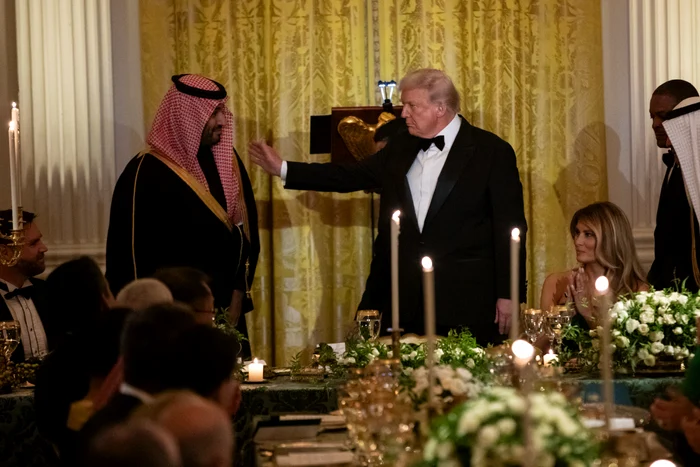
Prince Mohammed bin Salman and Donald Trump/PHOTO: EPA/EFE
On Tuesday, Saudi Arabia explicitly ruled out the use of its territory and airspace for any US attack on Iran. The statement comes a day after the UAE Foreign Ministry issued a similar message.
The positions of the two Gulf states represent a diplomatic obstacle for Washington, which is trying to step up pressure on Iran, accused of continuing to enrich uranium and violently suppressing domestic protests.
Saudi Crown Prince Mohammed bin Salman, the kingdom's de facto leader, reiterated Riyadh's position in a phone call with Iranian President Masoud Pezeshkian. According to an official statement, he stressed that Saudi Arabia “will not allow its airspace or territory to be used for military action against Iran.”
The decision reflects Saudi Arabia's concern that it could be drawn into a direct conflict with Tehran. Iran has previously been blamed for an attack on Saudi oil facilities in 2019 during Donald Trump's first term.
“Both Saudi Arabia and the United Arab Emirates have been targets of attacks by Iran and its allies. A weaker Iran is in principle in their interest, but they fear retaliation and destabilization of the region and do not want to spearhead an American intervention“, explained Karim Sadjadpour, analyst at the Carnegie Endowment for International Peace.
The White House said President Trump is “monitoring the situation in Iran very closely” and that “all options remain on the table” if the regime in Tehran continues to execute protesters.
On Wednesday, Trump drew attention to the large number of US warships deployed in the Middle East and called on Iran to return to negotiations.
“I hope that Iran will quickly come to the negotiating table for a fair and just deal – no nuclear weapons – a good deal for all parties“, he wrote on social media. “Time is running out.”
Military impact and remaining options
Former US military officials say the position of Saudi Arabia and the United Arab Emirates complicates the planning of a military operation, but does not make it impossible.
“Militarily, it increases the complexity and costs of possible action against Iran, but it does not stop it”said David Deptula, a retired US general who played a key role in the 1991 Gulf War air campaign.
He added that the refusal of the Gulf states also reduces the “political cost for Tehran” of resisting external pressure.
The Trump administration has already sent the USS Abraham Lincoln aircraft carrier and escort ships, some equipped with cruise missiles, to the region. Several squadrons of F-15E fighter jets are also stationed in Jordan.
The United States could launch strikes using these forces, as well as B-2 strategic bombers or other long-range aircraft, either from American soil or from the Diego Garcia base in the Indian Ocean.
“This situation could force us to rely more on carrier-based aviation or long-range assets from the US or Diego Garcia”said Gen. Joseph Votel, former commander of US Central Command.
He pointed out that the decision of Saudi Arabia and the Emirates also puts pressure on other states in the region that could consider supporting an American operation and makes a possible intervention look more like an exclusively American one, not one supported by a regional coalition.
Fears regarding the destabilization of the region
Donald Trump has cultivated close relations with the Saudi crown prince, whom he welcomed to the White House in November. At the time, the US president promised to sell F-35 jets to Riyadh and defended Mohammed bin Salman over the murder of journalist Jamal Khashoggi. Saudi Arabia later confirmed in a cooperation agreement that the US remains its “main strategic partner”.
Analysts in the Gulf states, however, warn that an American military intervention could lead to chaos in Iran rather than regime change, with destabilizing effects throughout the region, WSJ notes.
“Iran has been weakened and so have its allies, but they have not disappeared,” said Bader Al-Saif, a professor at Kuwait University. “The region is trying to present itself as a stable space for investment. No one will invest if this becomes the new normal.”
Experts warn that removing the Iranian regime or even exerting enough military pressure to stop domestic repression would require a protracted campaign, possibly weeks or months – a much more difficult scenario without the support of the Gulf states.
“The regime is determined to stay in power and is willing to kill whatever it takes to do so”said Kenneth Pollack, former CIA analyst and vice president of the Middle East Institute. “Overcoming this reality was already extremely difficult with air power alone, and without regional support it becomes even more complicated.”