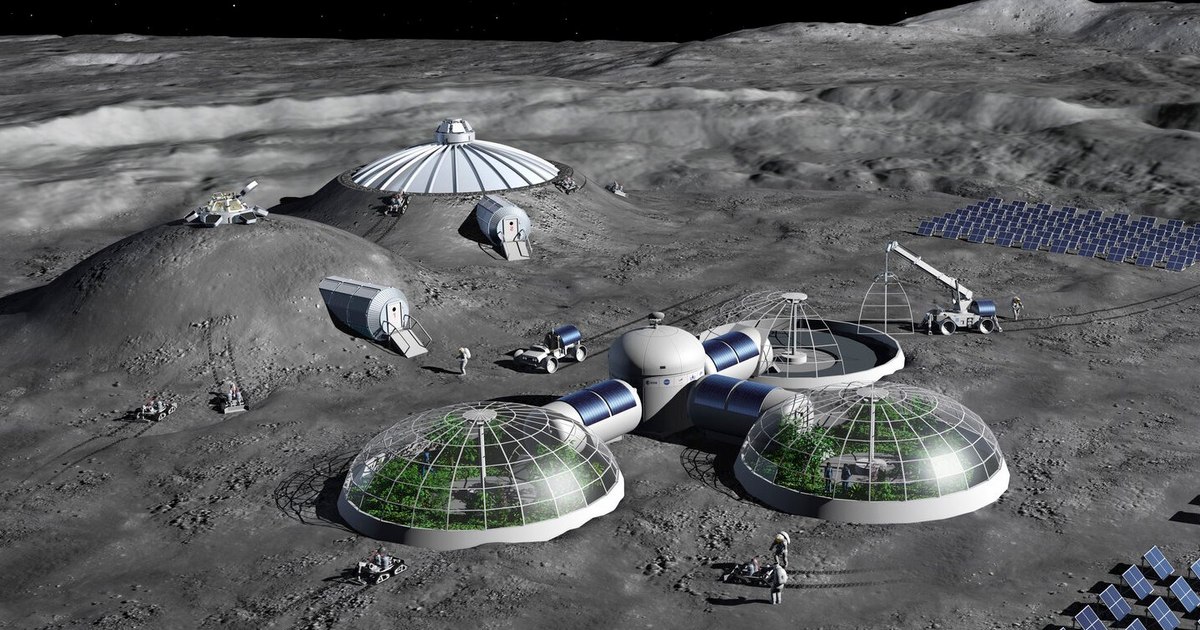
People who will one day live on Mars or the Moon could live in 3D-printed structures built almost entirely by robots using local materials. A series of concepts developed as part of a competition organized by NASA offer clues as to what these first alien settlements might look like.
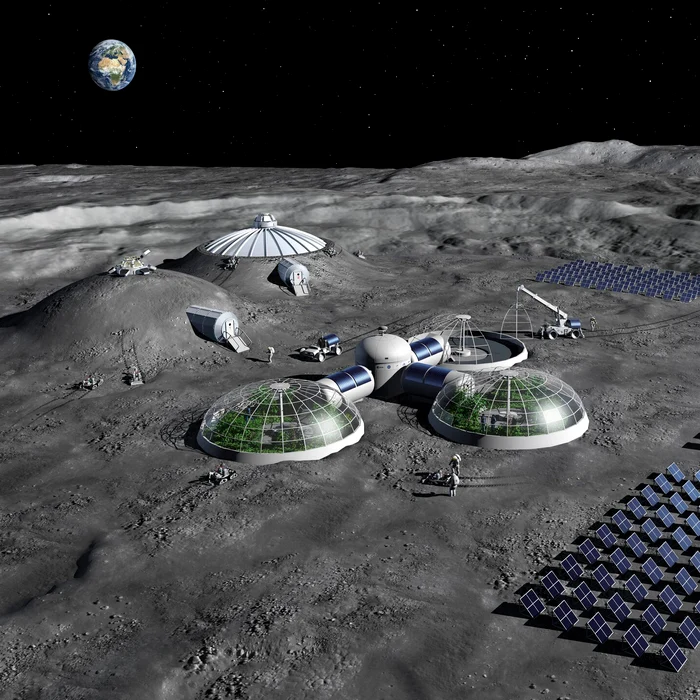
For future settlers, robot-printed homes could be a practical solution/PHOTO:X
The NASA Centennial Challenge, a four-year program, invited teams of architects, engineers and researchers to design habitats for “deep space exploration.” Key condition: buildings can be constructed with minimal human intervention and, as far as possible, from resources directly available on the Moon or Mars.
“Shelter is an obvious necessity as we prepare to explore worlds beyond our planet,” explained Steve Jurczyk, former NASA official, during the competition. “But space and weight aboard spacecraft are extremely limited. So we're looking for technologies that combine the materials we're carrying with what's available at the destination—in this case, soil.”
Robot builders and cities below the surface
Many of the concepts are based on the use of swarms of mining robots. They would excavate regolith—the layer of dust and rock from the planets' surface—which is then processed and used as building material.
A project by Hassell and EOC studios proposes the use of wheeled robots that collect local material and turn it into “ink” for 3D printing. The resulting structures would have colors similar to the Martian landscape and would visually blend into the surrounding environment.
Other concepts explore the idea of modular cities, connected by tunnels, that would provide protection from radiation and extreme temperature variations on the planet's surface.
Inflatable towers, domes and modules
The AI team. SpaceFactory in New York imagined a cylindrical tower made of bioplastic reinforced with basalt fiber. The shape is chosen to maximize interior space and reduce structural stress. The construction has a double-wall system that allows it to expand and contract according to the wide temperature variations on Mars.
Another project, developed by researchers at Northwestern University, combines 3D printing with inflatable structures. The robots would first create a solid foundation, then deploy an inflatable dome, which is then covered with a printed protective layer. The modules would include living spaces, laboratories and common areas, linked together by a network of tunnels.
SEArch+/Apis Cor projects focus on protection against cosmic radiation — one of the biggest threats to colonists' health. These habitats use thick layers of regolith and high-density polyethylene, combined to allow natural light in without compromising safety.
Mobile printers and autonomous constructions
Another idea involves the use of mobile 3D printers, transported to the surface of the planet by a lander. It would mine local materials — such as calcium oxide or Martian rock — process them and turn them into habitable structures. After completing one building, the module would move to begin construction of the next.
The X-Arc concept goes even further, proposing the manufacture on Mars of materials such as polyethylene, which would then be mixed with local basalt to create three-level printed structures, later completed with prefabricated elements assembled by robots.
How far are we from Mars?
For now, all these projects remain at the concept stage. There is no guarantee that they will be implemented, but they provide a realistic view of where space exploration is headed.
Mars is the fourth planet from the Sun and is considered the most promising candidate for colonization after Earth. A Martian day is similar to an Earth day, but a year lasts 687 Earth days. Temperatures can range from about 20 degrees Celsius to minus 150 degrees.
The distance between Earth and Mars is constantly changing, but on average it is about 225 million kilometers. With current technology, a trip to Mars takes between four and eleven months.
For future colonists, robot-printed housing could be not only a practical solution, but an essential condition for survival—a first step toward turning a hostile planet into a habitable space.