In 2025, cryptocurrencies have become the financial mainstream, supported by US President Donald Trump. It was a year of regulation and increasing entry of traditional financial institutions into this market. The year when the bitcoin price exceeded $125,000. And the year in which Poland failed to adopt the act on the crypto-assets market.
While 2024 was the year of Bitcoin ETFs, which allowed institutions to enter this market, 2025 was marked by regulations and pro-cryptocurrency policy of Donald Trump. On January 20, on the day of the inauguration of the 47th US president, the price of bitcoin exceeded $109,000. Shortly before his inauguration, Donald Trump and his wife announced the launch of their own speculative tokens $TRUMP and $MELANIA, the price of which skyrocketed by hundreds of percent within a few days.
At the end of the year, on December 29, 2025, however, bitcoin was trading nearly 7% lower than on January 1 and 30% below the latest all-time high of $126,080 set on October 6. The $MELANIA and $TRUMP tokens were trading 99.1% and 93%, respectively, below the highs reached around Donald Trump's inauguration.
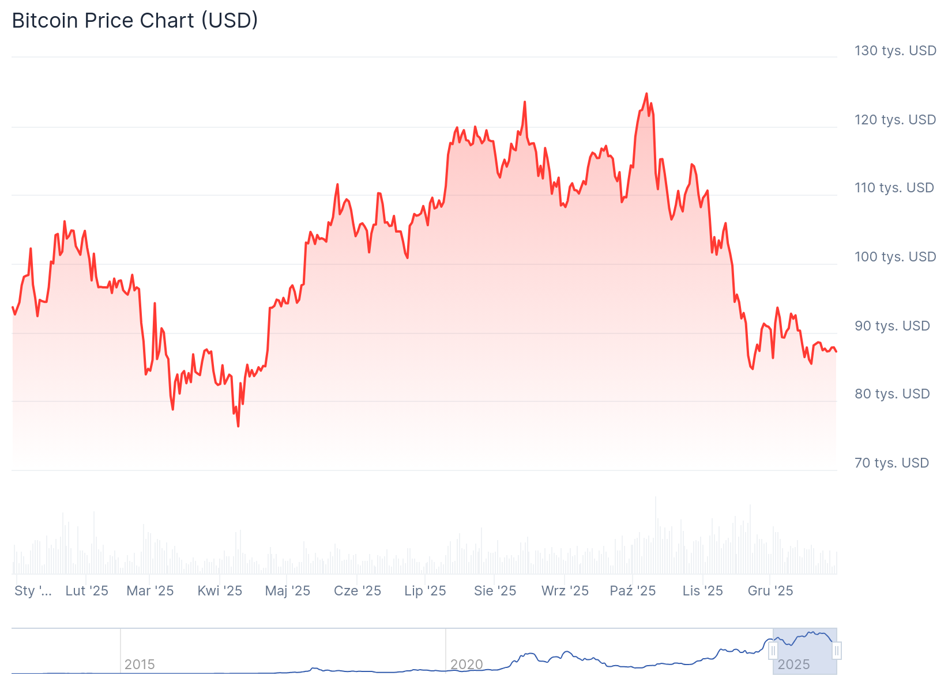
So it wasn't an easy year for cryptocurrency investors. Despite support from the US president himself, risky assets did not respond well to the turmoil in global trade, announced tariffs and mixed signals sent by the US economy, where strong GDP readings are accompanied by inflation remaining above the Fed's target and weak employment data.
Cryptocurrencies in the corridors of power
My NEW Official Trump Meme is HERE! It's time to celebrate everything we stand for: WINNING! Join my very special Trump Community. GET YOURS $TRUMP NEW Go to https://t.co/GX3ZxT5xyq — Have Fun! pic.twitter.com/flIKYyfBrC
— Donald J. Trump (@realDonaldTrump) January 18, 2025
If we were to choose the cryptocurrency market man of the year, in 2025 this title would be awarded to Donald Trump. The new president of the United States fulfilled his promises made during the election campaign to representatives of the crypto industry who supported him. He did not limit himself to setting up his own family businesses in this area. At the beginning of his term, he replaced the management of the most important regulatory agencies with people who were supporters of cryptocurrencies.
Paul Atkins took over the reins of the Securities and Exchange Commission, replacing Garry Gensler and ending the policy of regulating through enforcement and lawsuits. The SEC vs. Ripple case has ended, as have other numerous disputes between the agency and industry companies. The US administration has fundamentally changed its approach to the cryptocurrency market towards a policy supporting innovation and the competitiveness of the sector.
In addition, on the first day of his term, Trump pardoned Ross Ulbricht, the creator of the Silk Road black market, who was serving a life sentence. The platform enabled drug trafficking on the dark web between 2011 and 2013 and is considered one of the first cases of large-scale use of bitcoin in the real world, which is why it was labeled as the currency of criminals for many years.
Changpeng Zhao, the founder of Binance, the world's largest cryptocurrency exchange, was also pardoned in October, sentenced to 4 months after pleading guilty to charges of assisting in money laundering. Do Kwon, known for the Terra LUNA cryptocurrency, the collapse of which led to investors losing $40 billion, was sentenced to 15 years in an American prison.
Perhaps the most important change for the industry, however, was the GENIUS Act signed by President Trump in July 2025, establishing the first comprehensive federal framework for stablecoins, requiring them to be fully covered by reserves. In addition, at the legislative level, the CLARITY Act, an act aimed at clearly dividing regulatory powers between the SEC and the CFTC, passed the House of Representatives.
However, the hopes placed in it by cryptocurrency investors were not met by the Bitcoin Strategic Reserve in the USA. President Trump announced plans to create it and announced that it would initially include bitcoin, ethereum, ripple, solana and cardano. Shortly later, however, it turned out that instead of buying bitcoins, the American administration would simply not sell the cryptocurrencies it already owned and confiscated as part of the proceedings.
Wall Street is having an affair with bitcoin. Crypto in Spanish banks
Following the change in the approach of the US authorities to the cryptocurrency market and a number of facilitations for financial institutions (from consent to custody services after the withdrawal of statements that effectively limited banks' ability to cooperate with companies from the crypto sector), they began to enter the new asset class more and more boldly.
Changes have not only occurred in the United States. In the European Union, this was the first year of the Markets in Crypto-Assets (MiCA) regulation on crypto-asset service providers (CASPs). MiCA introduced uniform requirements in terms of licensing, market conduct, consumer protection and prudential standards for all companies operating in the industry in the EU. However, they cannot register in Poland, which we discuss in more detail in the next chapter.
“Elliptic” indicated in its recent report on global regulations for the crypto industry that countries such as France, Germany and the Netherlands have become licensing hubs. Obtaining a license in one of them allows companies to passport their services to all other European Union member states. Therefore, cryptocurrency service providers operate legally in Poland, but none of them is registered in Poland.
Meanwhile, cryptocurrencies appeared in Spanish banks, including: the second largest in the country and one of the largest in the euro zone, i.e. BBVA. Digital assets can also be purchased at Santander's Openbank. Crypto is becoming the next product on the shelves of European brokerage houses, next to stocks and bonds. Global cryptocurrency exchanges are receiving permission to provide services in the European Union and are experimenting with tokenized shares.
Even the Czech central bank has taken steps to test crypto technology. After an unsuccessful attempt to create bitcoin reserves by the president of the institution at the beginning of the year, the Czech National Bank bought cryptocurrencies in November. The digital wallet, made up mostly of bitcoin and stablecoins, is worth $1 million and is intended to help the institution test the new asset class.
The first anniversary of the failure to adopt the Polish act on the crypto-assets market
We will end 2025 in Poland just as we started – without the act on the crypto-assets market, which would enable Polish companies in this industry to obtain a license in Poland under MiCA. “Polish blasphemy in the EU. We missed the bill on the crypto-assets market in time, and here are the consequences” – we wrote on December 23, 2024. Even then, Poland belonged to a very small group of latecomers. Now it has become the last country that has not adopted the appropriate law that the EU requires of us.
The time to adopt the act was not December 30, 2025, but December 30, 2024, which seems to be forgotten by many commentators who became interested in the regulations for the cryptocurrency market after President Karol Nawrocki's veto. Once bitcoin and stablecoins entered the party's messaging of the day, facts ceased to matter. Many politicians speaking on this subject from the position of experts, could not correctly read the names of the most famous cryptocurrencies from a piece of paper.
According to experts such as prof. Krzysztof Piech, as well as many lawyers specializing in serving the industry, the Polish act on the crypto-assets market was an example of over-regulation, going further than what the European Union requires from our country. However, there were companies that asked for its adoption, bearing in mind that the transition period set by MiCA ends on July 1, 2026.
After this date, the Polish crypto industry will de facto cease to exist if companies are not given the opportunity to register their businesses. And they cannot do it due to the lack of a law that would designate the body responsible for issuing licenses, i.e. in the KNF project rejected by the president.
At the moment, the prospects for solving the impasse and passing the law are not promising. The bill, vetoed by the president, returned to the Sejm and was voted on again in almost unchanged form on December 18. Most of the amendments proposed by Polska2050 were rejected by the votes of the Civic Coalition, PSL and the Left. The only change introduced was a reduction in the maximum fee for supervising the issuance of tokens.
Bitcoin at $200,000?
These types of summaries are a good opportunity to look at how analyst forecasts for 2025 have aged. In most cases, they turned out to be far too optimistic. Bernstein, Standard Chartered and Bitwise have signed up to the “Bitcoin $200,000 by the end of the year” club. Therefore, $75,000 was needed for their predictions to come true.
VanEck analysts predicted bitcoin at $180,000, ethereum at $6,000 and solana at $500. However, this year's records for ETF and SOL were $4,890 and $295, respectively. Commenting on its failure this year on the X platform, the investment company wrote: “there are no forecasts for 2026. Good luck!”
The closest to the truth among the forecasts we described turned out to be James Butterfill, head of the research department at CoinShares, who predicted that the probable levels for bitcoin in 2025 are both $150,000 and $80,000. The upper border was not penetrated, but the lower border broke only twice. We will look at the forecasts for next year 2026 in a separate article.