
Italy is returning to plans for the world's longest suspension bridge after two millennia of waiting


Italy is once again trying to make an ambitious project, discussed for more than 2,000 years, a reality: the construction of a suspension bridge to connect Sicily with the mainland. The bridge across the Strait of Messina was set to become the longest in the world, but the plans are again facing legal and environmental hurdles.
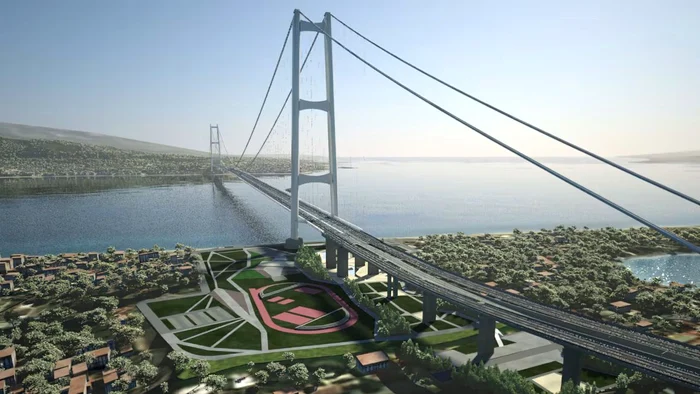
The bridge will be 3.6 kilometers long/PHOTO:X
The project, recently approved by the Italian authorities, is estimated to cost up to 12 billion pounds (about 13.5 billion euros). The European Union has agreed to cover half of the design costs for the railway infrastructure, an amount of around 20 million euros.
If completed, the bridge will be 3.6 kilometers long, surpassing the current world record held by a bridge in Turkey. The structure would be supported by two steel towers, each about 400 meters high, and would include both a highway and a rail line. Designers say the bridge could withstand winds of nearly 300 kilometers per hour.
The Italian authorities claim that the new infrastructure would significantly reduce the crossing time between Sicily and the mainland, from over 30 minutes by ferry to around ten minutes, which would be a major advantage for both residents and tourists.
The project represents “an investment in the present and future of Italy”
Italian Prime Minister Giorgia Meloni said the project was “an investment in Italy's present and future”, while acknowledging the complexity of the work. Transport Minister Matteo Salvini said the goal was for the bridge to be completed between 2032 and 2033 and estimated it could create up to 120,000 jobs, boosting the economy of the poorer regions of Sicily and Calabria.
The idea of building a bridge over the Strait of Messina dates back to the Roman period. Historians mention that in 252 BC the consul Metellus would have improvised a temporary link of barrels and boats to transport war elephants. Over the centuries, numerous other plans have been proposed, including in 2009, but were abandoned for financial and political reasons.
The project was constantly controversial. Critics cited the risk of embezzlement of public funds, the impact on the environment and safety in an area known for intense seismic activity. In 1908, a magnitude 7.1 earthquake devastated the region, killing more than 100,000 people.
Architects say the new bridge would be designed to withstand major earthquakes, and authorities say it would help reduce carbon dioxide emissions by reducing maritime traffic. “It will be one of the greenest bridges in the world,” Salvini said.
However, the project recently received another blow after Italy's Court of Auditors ruled that the plan violates European rules on the environment and public procurement procedures. The court concluded that the public interest justifications are not sufficiently supported by technical documentation.
In addition, approximately 4,000 residents in areas on both sides of the strait are at risk of displacement, which could lead to further litigation and delays.
Despite these difficulties, the Italian government says it will look carefully at the court's decision and continue efforts to move the project forward, seeing the bridge as a symbol of ambition and long-term development.


