Forecast for 2026. Companies focus on the quality of offices. Limited offer and higher requirements


The Warsaw and regional office markets end 2025 in a state of clear stabilization. The total volume of new supply in the capital amounted to approx. 90,000. m, and the area under construction did not exceed 200,000. m, which confirms developers' caution.
Read also: KSeF and invoice security. Experts from the Ministry of Finance dispel doubts
— The decline in supply is not a sign of weakness, but a natural stage of market maturation – says Emilia Trofimiuk, Research Manager at Axi Immo.
JLL data shows that the demand situation was almost a mirror image of 2024. The total volume of office transactions in Poland in 2025 amounted to approx. 1.5 million sq m, and in Warsaw alone approx. 740 thousand. square meters
A similar assessment is presented by Agnieszka Ciupak, Managing Director of GTC in Poland, who points out that limited new supply coincided with a more conscious approach by companies to leasing decisions. — Companies are striving to improve the quality, functionality and flexibility of workspace, but decisions are still made carefully, he emphasizes.
Roger Andersson, Managing Director of Vastint in Poland, states that 2025 brought greater stabilization on the office market, although decision-making processes remain long. — Demand is focused on modern, energy-efficient buildings, the supply of which is limited. Warsaw and regional cities continue to generate stable demand from international and domestic companies, he estimates.
Renegotiations dominate, but relocations are back
The demand structure remains unchanged – renegotiations account for approximately half of all transactionswhich is confirmed by both Axi Immo and JLL data. The share of new contracts remains below 45%.which shows that companies are still testing work models and optimizing costs.
At the same time – as JLL analysts point out – relocation recovery is focused on the largest and most mature marketsprimarily in Warsaw and Kraków. This is where companies try to simultaneously raise the standard of offices and reduce the space occupied.
— It's no longer enough to be in a good neighborhood. It matters micro-location and convenient access – emphasizes Bartosz Oleksak, Associate Director at Axi Immo.
From the perspective of office portfolio owners, this means this the need for more active asset management. – From landlords, this requires excellent knowledge of local markets and tenants' needs, as well as proactive building management – emphasizes Agnieszka Ciupak.
Flex, consolidation and returning to the office
One clear trend is the growing role of flexible offices. According to CBRE flex spaces are today approximately 90 percent filled. and are increasingly a transitional stage before signing a classic lease agreement.
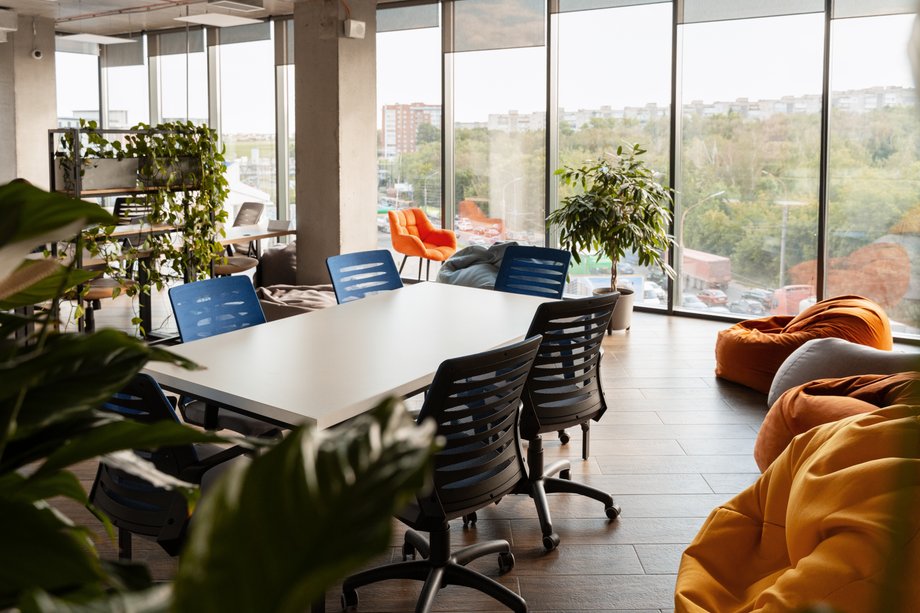
According to JLL, a slight increase in demand can be expected in 2026, mainly due to the increasingly frequent model of presence in the office approximately three days a week
|
AYO Production / Shutterstock
See also: The first zero-emission office building in Poland. Poznań is starting a breakthrough on the market
— Companies prefer to start with flexes and then sign longer contracts in exchange for a higher contribution for fit-out, notes Paweł Dobrowolski from CBRE.
JLL also draws attention to: a gradual return to a more office-centric work model. – In 2026, we expect a slight increase in demand, mainly due to the increasingly frequent model of presence in the office for approximately three days a week – predicts Mateusz Polkowski, Director of the Market Research Department, JLL.
However, as he emphasizes, limited availability of modern space in key locations may become a real barrier to relocation.
Rents are rising in the best projects
Asking rents remain stable, but upward pressure is visible in the premium segment. In Warsaw, prime rates reach EUR 27.5/sq m/monthand increases are also recorded in the best regional projects.
JLL experts point to the ongoing market segmentation:
- rents are rising in the best quality buildings,
- stabilize in “medium” objects,
- and the weakest assets lose competitiveness.
— Tenants are ready to pay a premium for qualitywhich, given the low availability of prime space, will further drive rent growth in the premium segment, JLL analysts point out.
The retirement of older office buildings is accelerating
The market is increasingly rapidly eliminating facilities that do not meet modern standards – both technological and ESG. – This is the next stage of market optimization – says Emilia Trofimiuk from Axi Immo.
JLL adds that this process, currently most visible in Warsaw, will also cover regional markets such as Kraków and Wrocław in the coming years. For some owners, the only rational path may be changing the function of the building or its thorough reconstruction.
Read more: Private dormitories are conquering Warsaw. Office buildings are gaining a second life
2026: space deficit and increasing selectivity
Experts agree: in the next 2-3 years, the market will struggle with a deficit of modern office space. Development activity will remain limited – mainly due to the profitability of new projects.
— With rents below EUR 19-21 per square meter, launching new office investments is unprofitable in many locations – points out Piotr Kamiński, director of the Office Space Lease Department, JLL, adding that further increases in rates in Warsaw and Krakow may gradually change these calculations.
At the same time – as summed up by Ida Stankiewicz, director of the Tenant Representation Department, JLL – the market is moving from the phase of “flight to quality” to “flight to functionality”. — Tenants must prepare for earlier planning, faster decisions and talks with developers at the pre-leasing stage. Extending the contract is no longer a formality, he emphasizes.
Application? The office market in Poland is entering a phase in which the best located, flexible and functional buildings win. Compromises – on the part of both tenants and landlords – are increasingly breaking down.