Putin's Russia is less stable than the USSR, a Russian historian believes. What does it say about a possible collapse of the regime


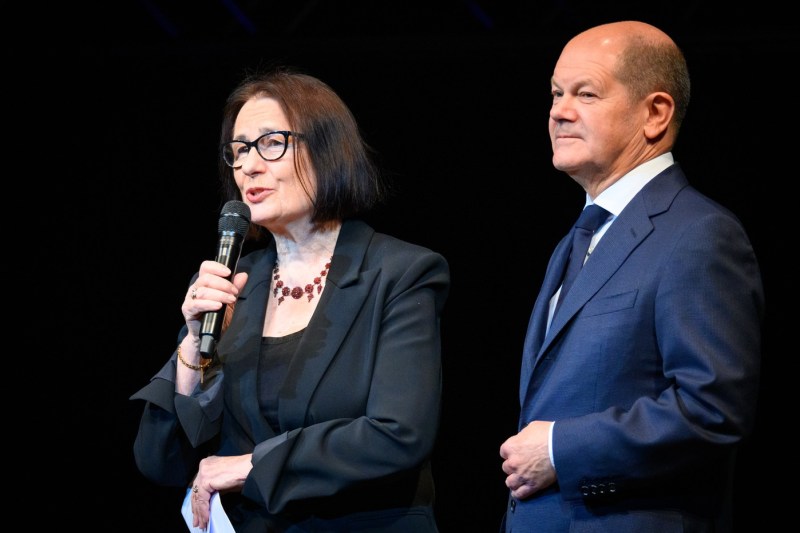
Irina Şerbakova, with former German Chancellor Olaf Scholz Photo: Jonas Walzberg / DPA / Profimedia
Russia under President Vladimir Putin is less stable than the Soviet Union, Russian historian Irina Sherbakova, co-founder of the human rights organization Memorial, said on Thursday for DPA, taken over by Agerpres.
An expert on the crimes committed during the Stalinist era, Sherbakova explained that although the Soviet system was rotten and lacked credibility, there were clear rules for those in its leadership, for the Communist Party and for the administration. She compared this to what she described as Putin's system “organized on mafia principles and based on personal trust”.
Sherbakova mentions that, at present, everything depends on the 73-year-old Russian president. “And that could lead to the collapse of everything, if something happened to this person,” she told DPA.
The history of modern Russia does not foresee a rapid collapse even after almost four years of war in Ukraine. “The crisis is getting worse; however, the country still has capacity, and the power structure has capacity. The security apparatus is very strong,” she declared.
Sherbakova pointed out that Putin's propaganda was based on the rewriting of Russian history and highlighting a supposedly heroic Russian past. In response, the Memorial, which received the 2022 Nobel Peace Prize, continued to “process the history of political repression and resistance” despite a 2021 ban.
The work of the Memorial organization has changed in exile, said Sherbakova, who had to leave Moscow shortly after the invasion of Ukraine in February 2022 and who now heads the Future Memorial Association in Germany.
She says the civil rights organization holds the largest non-state archive detailing political repression in the Soviet Union, the gulag, criminals and the wars in Chechnya and Georgia.
“And we would like people to have access to our documents and materials,” she adds. The goal is for the Russian archive, with millions of names and hundreds of thousands of documents, to be digitized and accessible, along with a multimedia platform in German, Russian and English, known as the Lantern project.
The Lantern Project aims to relate the experiences of state terrorism in the Soviet Union and Russia to a young audience. It also aims to expand its activity to the dictatorships of Germany, Argentina, South Africa and other countries.