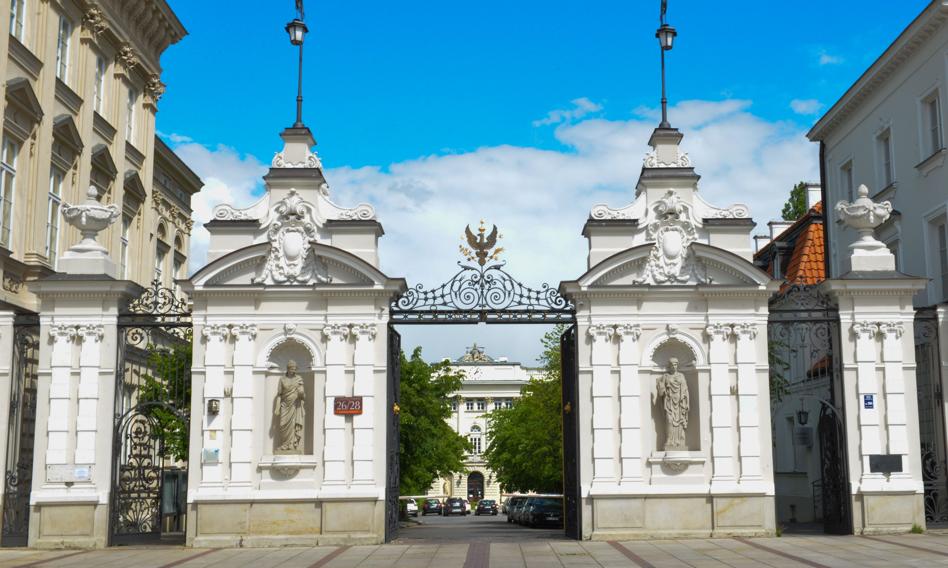
Four scientists from Poland received ERC Consolidator Grants 2025 – announced the European Research Council. Three researchers work at the University of Warsaw, one at the Wrocław University of Science and Technology. In this year's edition, a total of 349 grants were awarded for a total amount of EUR 728 million.
Scientists from the University of Warsaw who received funding for research projects include: prof. student Ph.D. Maria Nowak from the Faculty of Law and Administration and prof. student Ph.D. Wojciech Czerwiński and prof. student Ph.D. Michał Pilipczuk from the Faculty of Mathematics, Computer Science and Mechanics. The ERC grant was also awarded to Dr. hab. engineer Sławomir Porada from the Faculty of Chemistry of the Wrocław University of Science and Technology.
Each Polish scientist received funding of approximately EUR 2 million.
Consolidator Grants, awarded by the European Research Council (ERC), is one of the most prestigious international grant programs. Scientists with 7-12 years of experience since completing their doctoral studies can apply for funding. Grants are intended to conduct groundbreaking projects and research that will significantly impact the development of science.
The condition for receiving a grant is to demonstrate exceptional scientific achievementsamong others publications in significant peer-reviewed and international journals or presentations at international conferences. The research must be conducted in a public or private research organization in one of the EU Member States or associated countries (including Albania, Bosnia and Herzegovina, Iceland, Moldova or Ukraine).
According to the University of Warsaw, project of prof. Wojciech Czerwiński from the Faculty of Mathematics, Computer Science and Mechanics “will lead him closer to solving one of the key dilemmas in computer science, which are the limits of reachability in systems with an infinite number of states.”
As part of the “Reachability in Infinite Systems at High Resolution” project, the researcher asks questions about reachability in infinite systems, i.e. in program models that have an infinite number of possible states.
– I am focused on finding techniques that allow us to solve the accessibility problem as quickly and simply as possible. And it is a key factor contributing to a better understanding of how programs work, said Prof. Czerwiński, quoted in the UW press release.
The scientist received funding of almost EUR 2 million, and the project will start in 2026 and will last five years.
Prof. Maria Nowak received an ERC Consolidator Grant worth EUR 1.9 million for the project “A provincial capital policy at the end of the Roman era. Periphery or a center of power?” (“Capital of the province at the end of the Roman era. Periphery or center of power?” acronym PeriPolis). The University of Warsaw announced that the work is intended to show the late Roman Empire as a state struggling with problems surprisingly similar to those affecting modern societies.
– The aim of the project is to check whether crisis is an inherent element of the collapse of empires. I also want to better understand everyday life in the end times – both ordinary citizens and political elites. I am interested in whether the elites were aware of the coming collapse and tried to counteract it, or whether the end came as an inevitable shock, explained Prof. Maria Nowak, quoted in the UW press release.
According to the university, the study of graphs, i.e. a set of connected elements, will be conducted by Prof. Michał Pilipczuk from the Faculty of Mathematics, Computer Science and Mechanics, University of Warsaw, who received an ERC grant for the project “Towards a unified structure theory for dense graphs”, acronym WYDRA.
– Graphs are basic mathematical objects modeling all kinds of networks. Graphs found in applications often have a specific structure. For example, road networks are “flat”, and social networks consist of dense clusters and less frequent connections between them – described Prof. Pilipczuk, also quoted in the release.
This is the second ERC grant for this researcher – after the ERC Starting Grant awarded in 2020. In the “Decomposition methods for discrete problems” (BOBR) project, the scientist investigated the structural and decompositional properties of networks.
Implementation of the project for which prof. Pilipczuk has now received funding of EUR 2 million, it will start in 2026 and last five years.
Dr. hab. engineer Sławomir Porada from the Wrocław University of Science and Technology received an ERC grant for the project “Small Differences, Big Impact: Achieving Effective Selective Separations from Water by Tuning Ion Transport Processes” (“Small differences, huge impact: Efficient selective separation of ions from water by regulating ion transport processes”, acronym ION-TRACE). As the University of Wrocław said in a press release, the work concerns understanding and controlling ion transport processes, especially how ions are adsorbed and desorbed in electrode materials.
– I want to find a way to control the kinetics of these processes even when the ions have very similar properties – said the scientist quoted in the release.
As described by PWr, the idea of Dr. hab. Advice will help, among others: develop new techniques for removing and recovering ions from water. This will enable the use of brine from desalination and used battery waste as new sources of ions, primarily magnesium, sodium and lithium. The project, for which the scientist received almost EUR 2 million from the ERC, will last five years.
The European Research Council (ERC) is an organization established in 2007 supporting innovative, groundbreaking scientific research in Europe. Every year, the Agency announces competitions for young scientists (Starting Grants and Consolidator Grants) and for experienced researchers (Advanced Grants). Synergy Grants (for teams of 2-4 leaders) and Proof of Concept Grants (for commercialization) are also awarded. The ERC budget for 2021-2027 is EUR 16 billion.
As reported on the council's website, from 2007 to date, the ERC has awarded over 17,000 funding across all programs. projects and over 10 thousand scientists from 85 countries. ERC grants worth EUR 180 million were awarded to 100 Polish projects (including 17 from the ERC Consolidator Grants program worth EUR 33 million). (PAP)
abu/ bar/