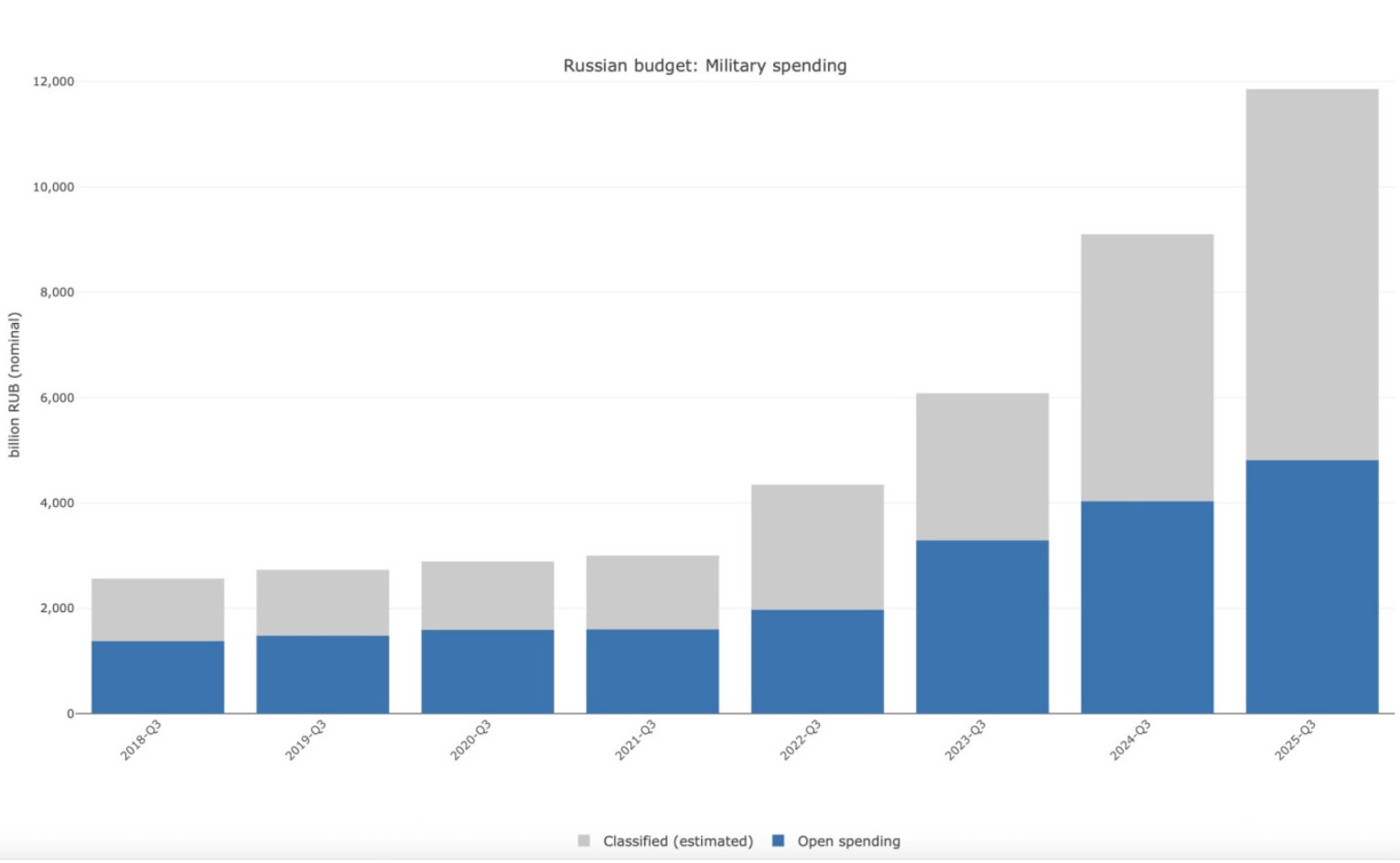
Expenditures of the Russian federal budget for military purposes in January-September 2025 reached a new record — 11 trillion 854 trillion rubles [ok. 545 mld zł]. These are calculations based on data from the Ministry of Finance, carried out by a researcher at the German Institute for International Security Problems, Janis Kluge.
Compared to the same period last year, spending on the army and weapons production increased by another 30%. that is, by 2 trillion 763 trillion rubles [ok. 127 mld zł].
Compared to 2023 levels, the military budget of the Russian Federation has increased by 95%. , and compared to 2022 – by 173%. Compared to the times before the war, in 2021 this increase is as much as 295%. , that is, almost four times.
Russia is turning its finances upside down – all for the sake of war.
Below we present the analysis of expert Janis Kluge, specializing in economic development and trade in Eastern Europe and Eurasia, the Russian state budget, sanctions and the internal policy of the Russian Federation.
On average, the Kremlin's “military machine” consumed over 1 trillion rubles per month [ok. 60 mld zł]and approximately 40 billion rubles per day [ok. 2 mld zł]which amounts to approximately 2 billion rubles per hour [ok. 87 mln zł].
More than half (59%) of Russia's military budget is blacked out and secret. Kluge's data shows that over 4 trillion rubles were spent in three quarters through overt defensive positions [ok. 222 mld zł]and through closed positions – approximately 7 trillion rubles [ok. 325 mld zł].
Compared to last year, the “thin” military budget increased by 39 percent, and compared to the pre-war period, it is five times larger.
The Kremlin is already directing 44% of its votes to the war itself. of all federal taxes collected and 39 percent. total state expenditure. These are proportions unheard of in modern Russian history – both indicators break previous records and show how much of public money is consumed by the war effort today. In practice, this means that almost every second ruble of taxes goes to the front or to maintain the military apparatus.
For comparison: a year earlier it was 39%. and 36 percent, and in 2021 — only 18.4 percent. and 19 percent
Russia's military spending in 2018–2025. Chart prepared by journalists from The Moscow TimesJournalists of The Moscow Times / The Moscow Times
According to Kluge's calculations, since the beginning of 2022, the war with Ukraine has cost Russian taxpayers over 42 trillion rubles (approx. PLN 2 billion), i.e. the equivalent of:
24 annual budgets of the entire higher education system in Russia,
22 years of federal health care spending
and almost 80 annual budgets of rich regions such as Sverdlovsk Oblast or Krasnodar Krai.
A state for the army, not for the citizens
In the draft budget for 2026, the government has planned almost 13trillions of rubles [ok. 600 mld zł] for “national defense” and another almost 4 trillion rubles [ok. 180 mld zł] on “national security” – including spending on the Ministry of Internal Affairs, the National Guard, secret services and the Russian Federal Penitentiary Service system.
In total, gymnasiums will receive approximately 17 trillion rubles (approx. PLN 776 billion), or 38%. the entire budget. This is a gigantic leap compared to pre-war times: in 2021, the share of expenditure on the army and services was 24%, so now it is growing by as much as 1.6 times. In other words, Russia is allocating a larger part of its budget to the force apparatus than at any time in recent decades, clearly putting the country on the track of permanent mobilization.
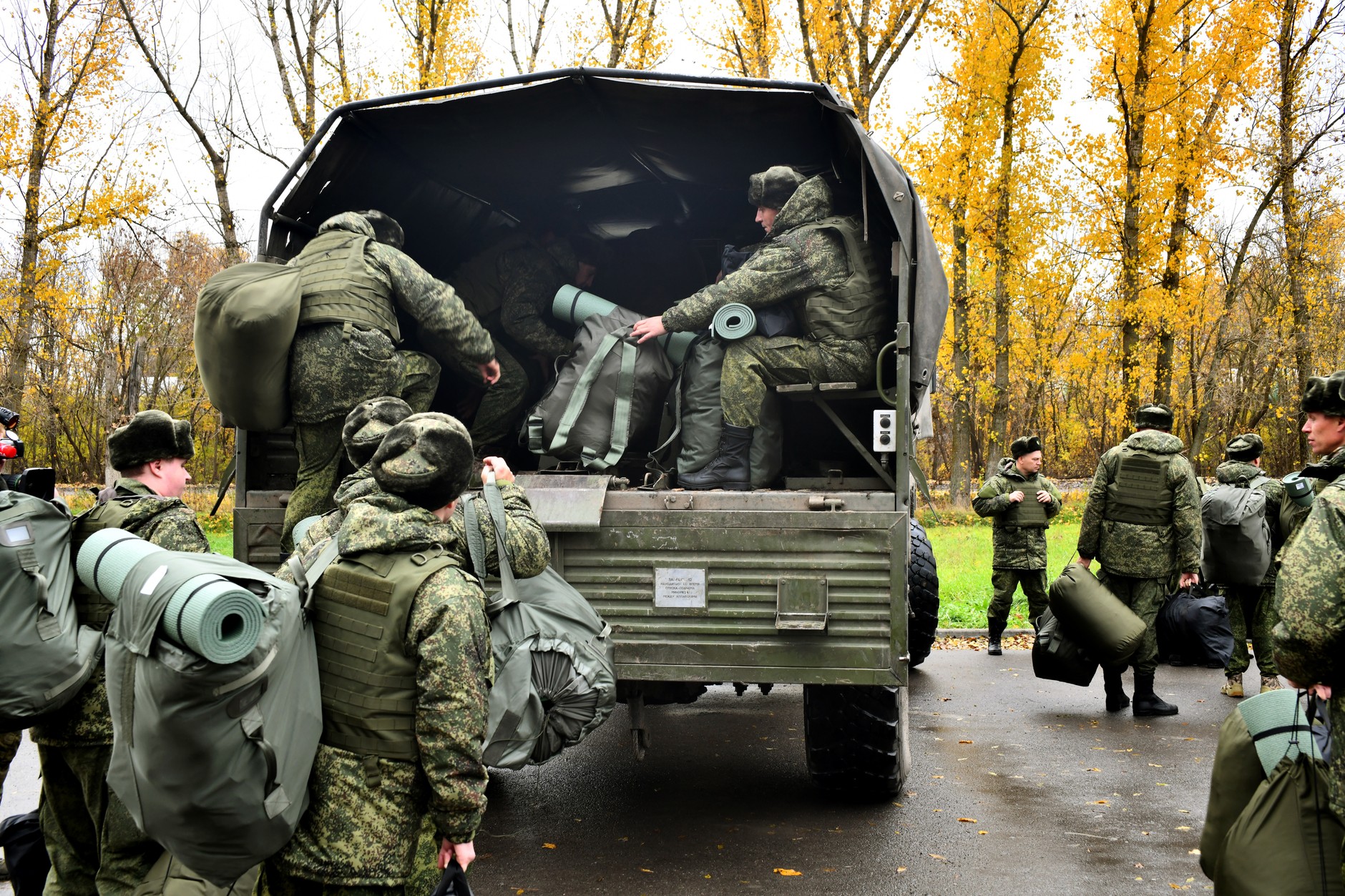
Conscripted soldiers boarding a military vehicle, October 31, 2022 (illustrative photo)Anadolu / Contributor / Getty Images
The share of social spending will shrink to 25.1%. budget (from 38.1% before the war), and expenses to support the national economy – to 10.9%. (from 17.6 percent before the war).
Both indicators will reach their lowest levels in 20 years available statistics of the Ministry of Finance.
The war continues even when the guns fall silent
Even if peace talks regarding the war in Ukraine are successful, the Kremlin does not intend to significantly reduce military spending.
Signals coming from those around the government indicate that Russian force structures will remain a priority, and the level of army financing – despite the possible cessation of military operations – will continue to be maintained at an exceptionally high level.
— Cartridges and drones will have to be produced anyway, even on a smaller scale.
The confrontation will continue, the army and military spending will remain high, because the West is also increasing them
A source close to the government told Reuters.
If the active phase of fighting ends, the military budget may start to decrease from 2027, but – as Reuters' interlocutor emphasized – a return to pre-2022 levels is not expected.
I’m Ashley Davis as an editor, I’m committed to upholding the highest standards of integrity and accuracy in every piece we publish. My work is driven by curiosity, a passion for truth, and a belief that journalism plays a crucial role in shaping public discourse. I strive to tell stories that not only inform but also inspire action and conversation.