What does Alexander Stubb see and Europe refuses to see? Romania risks being on the map again, not at the table


In Europe today, you rarely meet a leader who talks about the international order without being a prisoner of institutional nostalgia or strategic panic. Alexander Stubb breaks out of this pattern not through radicalism, but through lucidity.
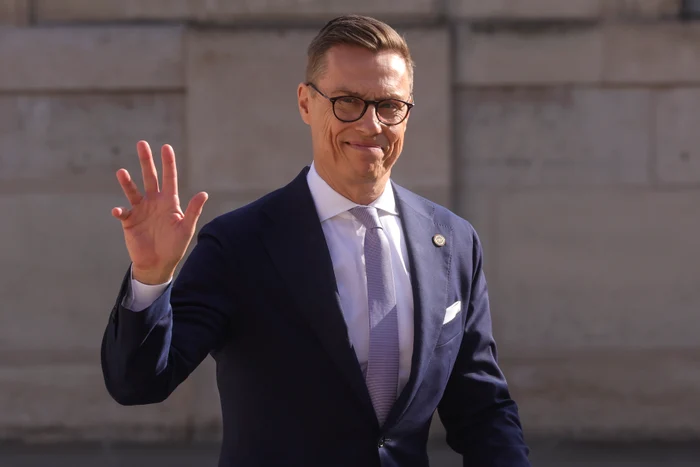
PHOTO EPA EFE
His essay from Foreign Affairs“The West's Last Chance,” has the tone of a man who has lived on the edge of empires and learned that geopolitical tranquility is only a temporary form of balance. Stubb writes not as a theorist, nor as a diplomat, but as a leader who understands that international order is not an academic abstraction but the vital environment in which states live or perish. Finland, his country, knows this better than anyone.
In his analysis, the world has changed more profoundly in the past four years than in the past three decades. It's not hyperbole. The post-1945 liberal order, built on the expectation of cooperation and the belief in the universality of rules, seems to be eroding from all directions. Russia defies the system by invading Ukraine, China challenges Western normative supremacy, and the Global South, once the periphery of history, becomes the moral, demographic, and economic center of the world. Stubb captures this transformation with a realism that many Western leaders avoid. The world is not moving towards a new liberal order, but towards an undefined space, where multipolarity, transactionalism and technological competition redraw the contours of power.
Much of his analysis starts from Europe's ability to recognize its own delusions. After 1989, Europe believed that history had entered a linear path towards democratization, economic integration and collective security. Francis Fukuyama spoke of the “end of history” and European leaders believed him. Germany plunged into an energy partnership with Russia believing that dependence creates peace. The US exported democracy by force, convinced that the liberal order could be imposed militarily. And the EU has lived with the belief that globalization and interdependence will dissolve old rivalries. Stubb takes a blunt look at these three decades of self-sufficient idealism and concludes that the West has confused wishful thinking with reality.
His text has the rare merit of analyzing, without self-justification, the strategic errors of the West. The failed interventions in Iraq and Afghanistan are not, in Stubb's logic, mere military excesses, but severe blows to the legitimacy of the liberal order. The financial crisis of 2008, tolerated and then externalized, delegitimized the economic model of the West in the eyes of the global South. The inequalities resulting from globalization, the lack of economic predictability, the inability of multilateral institutions to respond to new crises, all these show not only the limit of the system, but also the limit of the Western imagination. Either the West has become anything but imaginative.
Stubb's most important observation, however, is another – the world is reconfiguring itself not only around a competition between the US and China, but through the emergence of a West-East-South triangle. In this architecture, the global South is no longer an object of history, but an autonomous actor with its own interests, with unresolved colonial memories, an expanding demographic and aspirations to power. Stubb implicitly cites ideas from Jaishankar, Mahbubani and other voices of the Global South. These states are not neutral, nor undecided, but claim their own, non-aligned and yet influential space.
This is where one of the text's strong intellectual ideas comes in – the recognition that the global South will decide the direction of the next world order. If the West continues to be paternalistic, moralizing and inconsistent, it will lose. If the East thinks its massive investments can buy loyalties, it will be fooling itself. Stubb observes what many Western capitals avoid. The global south no longer wants to be “co-opted”, but part of the power architecture. And the future order will depend on how much the West is willing to concede.
The text becomes even more interesting when Stubb introduces his favorite concept, values-based realisma notion that, at first glance, seems contradictory. But for Finland, it is not. Finland survived the Cold War through a combination of pragmatism, territorial compromise, diplomatic self-restraint and a domestic project of quiet resistance. After 1990, it plunged into the idealism of Western values, but made the strategic mistake of not joining NATO in time. It paid for this hesitation with years of structural vulnerability, which Russia's invasion of Ukraine brutally reactivated. Thus, Finland's entry into NATO in 2023 was not an ideological act, but an act of lucidity. “Values-based realism” becomes, in Stubb's reading, a formula for the survival of small states in a world where the great powers are regaining their seats at the table.
However, this theory, while elegant, has its own limits. Stubb suggests that the multilateral order can be saved through reform. Expansion of the Security Council, elimination of the veto, suspension of aggressor members. It is a normative, almost moral, but structurally impossible vision. Great powers don't cede power, they just redistribute it when they have no choice. China and Russia will block any real reform. The US will avoid any restructuring that would diminish its influence. Europe, divided, has neither the political weight nor the strategic will to force change. For this reason, Stubb's text seems, in certain passages, closer to the spirit of OSCE 1975 than to the geopolitics of 2025. It is a nostalgia for a time when rules seemed possible, in a world where rules are increasingly difficult to negotiate.
Another weakness, which Stubb touches on only marginally, is the absence of technology from his analysis of global power. Today's world is no longer ordered by states alone, but by technological conglomerates, digital networks and global supply chains. Artificial intelligence, quantum computing, semiconductors, the cloud, fiber optics and data control are the new tools of geopolitics. NVIDIA, OpenAI, Huawei, SpaceX or Amazon Web Services influence the global order in ways that even the UN can no longer do. Power has migrated outside the states, and Stubb's text, true to the Westphalian paradigm, does not capture this fundamental mutation.
However, it is precisely this structural limitation that gives the text its political value. Stubb writes for the political audience of the West, not the technological community or techno-capitalist geopolitical analysts. He is trying to save what can be saved, namely the idea that international order can be governed, not merely endured. That institutions can be repaired, that rules can be adapted, that dialogue can prevent collapse.
This kind of rational optimism is rare in Europe, where leaders either take refuge in technocracy or become prisoners of fear.
PHOTO Profimedia
But Stubb knows time is short. Towards the end, he introduces the metaphor of the two models that governed reality until yesterday – Yalta or Helsinki. Two historical moments, two lessons, two possible futures. Yalta, the great powers dividing the world, the small states being mere negotiable variables. Helsinki – common rules, broad participation, mutual respect, even between ideological opponents. Stubb warns that the world is approaching a similar crossroads. If the great powers will rewrite the order in the logic of spheres of influence, small states will become currency and conflicts will proliferate. If, instead, the world succeeds in building a new global Helsinki, order can be saved.
This conclusion, however, hides a truth that Stubb leaves unsaid – today's world no longer has the institutional, moral or strategic capacity to reproduce Helsinki 1975. The paradox is that that moment of multilateralism was possible precisely in a bipolar world, where the rules were imposed by two rival hegemons, but disciplined by the symmetry of power. Today, multipolarity is fluid, asymmetric, undisciplined and dominated by non-state actors. That's why Stubb's call sounds like a warning. If multilateralism cannot be saved, multipolarity will swallow us up.
There is, throughout the text, an important subtext – the role of small states. Finland is presented as an example of resilience, strategic autonomy and moral clarity. In front of Russia, he did not hesitate. In the face of a changing world, he did not seek refuge in ambiguity. And maybe this is the most relevant part for Romania.
Romania, like Finland, is a border state, caught between orders, vulnerable to geopolitical changes and dependent on alliances. But unlike Finland, Romania does not yet have a coherent strategic culture. It relies on the NATO umbrella, but does not invest enough in its military and technological autonomy. He wants Western recognition, but avoids firm positions in the big global debates. It is in the EU but has no strategy of its own for the Global South. It is a member of NATO, but it does not have a security doctrine adapted to the coming world.
Seen through the lens of Stubb's analysis, Romania seems to be in the position of a state that knows where it needs to be, but does not know how to be. He entered NATO with hope, not strategy. He entered the EU with enthusiasm, not with a project. While Finland, faced with Russia, understood that neutrality is not the solution, Romania still lives in a form of passive dependence on external guarantees. If the world is heading for a new Yalta, Romania risks being on the map again, not at the table. If the world succeeds in a new Helsinki, Romania must be prepared to participate, not assist.
The conclusion that emerges from Stubb's text is that Europe today has perhaps only one leader with a coherent vision of the global order – and he comes from a small state. The lesson of Finland is the lesson of all small states. Survival is not guaranteed by allies, but by the internal ability to understand the coming world. Romania can learn from this text that, in an age of global uncertainty, small states cannot remain neutral, confused or reactive. They either define their direction or are defined by others.
If Stubb is right – and there are few European leaders who think with the same clarity – then the world order faces its last window of opportunity. And the small states are faced with a decisive choice, either to act as victims of history or as actors of it. Finland has already chosen. Romania still hesitates. But the world will not wait.