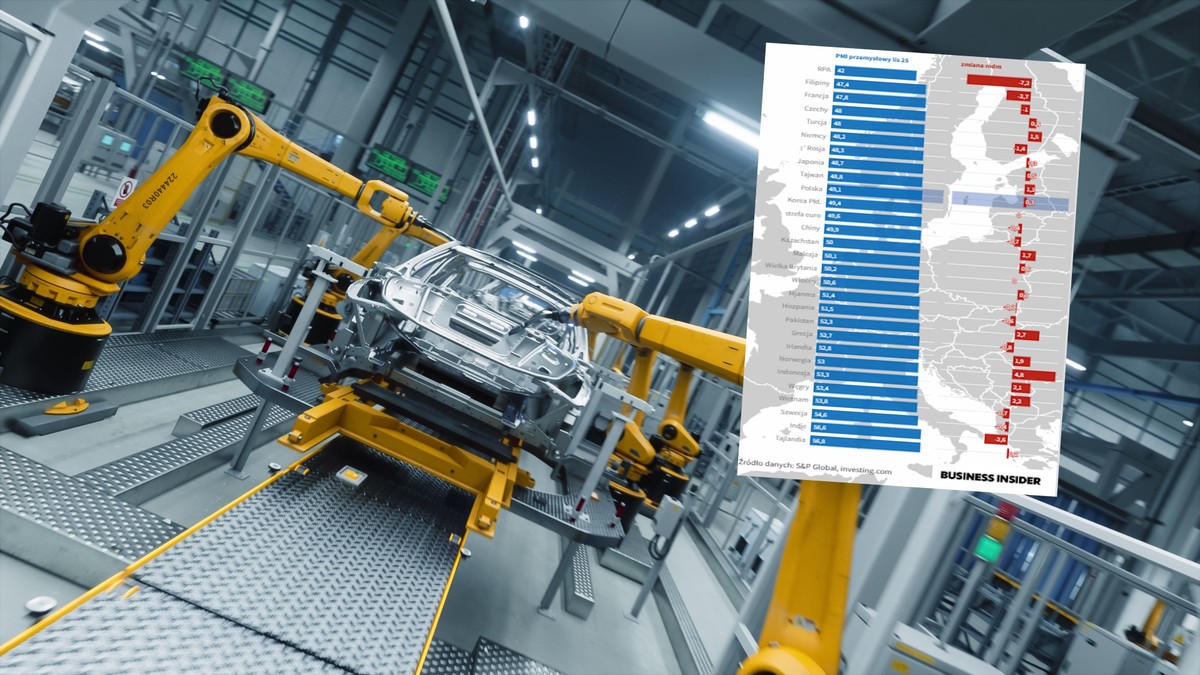
President Trump's administration has imposed one of the highest tariffs on South Africa since August, as much as 30 percent, and the effects can be seen in the country's economy. PMI (purchasing managers index) measuring industry activity through surveys conducted among purchasing managers in South Africa in November it was only 42 points and this is the lowest level since October 2019. Everything below 50 points is an area of decline in activity, so in this case we can already talk about the specter of recession.
The text continues below the video
This is a drop from 49.2 points, so significant and the largest this year. And as recently as September, the manufacturing sector was at growth levels in South Africa. In November, however, everything collapsed. Measuring this metric, Absa has seen declines in demand and production, mainly due to reduced export sales. It's hard not to associate this with US customs duties.
Read also: There are new data on Polish GDP. Economists surprised
The second biggest problems are experienced Philippines (47.4 points), which received 19% tariffs from the USA, and the third one has France (47.8 points), which, like other EU countries, has to face 15% customs duties. On continuing political uncertainty in the latter country additionally points out Dr. Cyrus de la Rubia, chief economist at Hamburg Commercial Bank. According to him, the weakness of President Emmanuel Macron's government causes many companies to refrain from making investment decisions. “Companies are limiting purchases of inputs while reducing inventories, signaling lower demand for production,” comments Jonas Feldhusen, junior economist at Hamburg Commercial Bank, in the S&P Global report.
Poor data also concerns the industry of Germany and the Czech Republic, although the trends in both countries are opposite, because in Germany there was a deterioration by as much as 1.4 points compared to October, and in the Czech Republic to increase by 0.8 points.
The declining industrial activity in Germany has been ongoing since July 2022. “Even though companies have been increasing production for nine months in a row, other indicators such as the number of orders, employment and inventories clearly show that the situation in the industry remains poor,” comments Dr. Cyrus de la Rubia in the S&P Global report.
— Foreign orders had been weak since August but fell sharply in November. One explanation may be that the largest buyers of German products so far, American companies, have accumulated import stocks, especially in the first half of the year, and now have correspondingly lower demand for goods from Germany, he says, pointing out that German companies have been cutting employment for two and a half years.
It's bad, but not hopeless. — Most companies in the euro zone are confident that they will be able to increase production in the next twelve months. In this respect, the mood in Germany has improved somewhat, and in France there has even been a shift from pessimism to optimism. If you believe the saying that “half of economics is psychology“, this increase in confidence is a sign of improvement in the situation in the coming year,” said the economist.
Poland is in trouble, but it is getting out of it bravely
Germany, the Czech Republic and France are Poland's three largest trade partners this yearto which we sent in the first three quarters as much as 39.4 percent our exports. Their problems are, indirectly, our problems.
However, in the countries mentioned above, the most important industry is this one car, in Poland it constitutes only about 10 percent. sold production of industryand over 18 percent gives the food industry.
Therefore, the Polish PMI for industry looks clearly better than that from Germany, the Czech Republic and France, where the automotive industry dominates. It is still declining, but in November it amounted to 49.1 points, which means an increase of 0.3 points compared to October and, what's more, the measurement clearly exceeded analysts' expectations (48.8 points).
—Noted positive growth in new export orders, only the second such increase in almost four years. Companies remained optimistic about production growth over the next 12 months and increased their purchases of inputs for the second month in a row, commented economist Trevor Balchin in an S&P Global report.