Article by Andrei Crăciun – Published Saturday, November 29, 2025, 1:04 p.m. / Updated Saturday, November 29, 2025, 1:24 p.m.
Cosmin Ciotloș, 41 years old, literary critic, writer and teacher, spoke to Gazeta Sporturilor about his passion for football, especially for Rapid Bucharest.
Why didn't Cosmin go to the stadium since March 2024? How did he get to see Rapidul at work twice – once at the Casa Scriitorilor in Neptun and the second time right in Giulesti – with the poet Nora Iuga, born in January 1931, when Rapiduleț was only eight years old?
And why Wolf, and not Sabau? Cosmin Ciotloș tells everything and something more: if you read on, you will also find out how Tudor Arghezi used to pull animals and where you can still see his dumbbells.
– Cosmin Ciotloș, teacher, university, man of letters, writer (who can forget the wonderful romanticized biography of Anton Pann, published in the Polirom series of romanticized biographies?). All these beautiful achievements, however, pale in front of the basic reality with which we operate: you are a speedster (like the poet Nora Iuga, ninety-four years old). So the easiest and hardest of questions: Why Rapid?
– Let me say first that I had the privilege of seeing a Rapid match twice with Nora: first at Neptun, at the Writers' House there, on the terrace, where only us and the late Traian T. Coșovei were playing with whomever we needed (we were playing against Stella, severe illness); that very special solidarity, because full of humor, made us repeat the experiment in Bucharest. This time properly, that is, in the stadium, not on TV, and it was as exciting as you can imagine humming together all the choruses possible, more caustic or more innocent. That's why the Rapid: it carries with it a human story. Full of love and candor, in its essence. This is not about cups and laurels, but about a way of taking life in the chest, honestly, from equal to equal, without despair and without contempt. I think I understood it through adolescence, and if I have since forgotten the chemical formula of formaldehyde or the capital of which African state, this lesson in applied ethics has remained imprinted on my mind.
– When was the last time you visited Giulești and how was it? Can you tell the younger ones what was the charm of the old Giulesti?
– Coincidentally, I also know the date, it was March 15, 2024 when I decided to “go to sleep” and avoid the stadium until not times but at least better emotional temperatures come. For a long time I felt an unpleasant air emanating from the management offices (I don't remember if Mr. Șucu himself or his wife announced one day that they want to change the DNA of this club, which is at best an imprudent statement), but the little skit with Liviu Ungurean and Daniel Niculae picked up by the police for possession of pyrotechnic materials put the lid on it. I may be overly idealistic, but Rapidul is what it is precisely because it does not stop being what it has always been: a team with soul, not a company, which you join if you feel like it, not if you have a magnetic badge. Hence the charm of the old Giulești: from the time I started my studies until last year, I didn't miss his stands, except about ten or fifteen times.
– You are a good connoisseur of Romanian literature, of its history. Share with us some lesser-known tidbits from our top writers' sporting passions. What sports did they play, did they go to the arenas, dance? Who, what, where, when, how and why?
– My regret is that I couldn't find any information about Caragiale as a sports fan anywhere. For the rest, the list is long and should start with Eminescu, who we know that, as a teenager, was hitting the ball. Or with the forgotten N. Nicoleanu, also a Junimist, cherished by Maiorescu, creator among other things of the first institution with a sports profile from us: a strength gym located in Pasajul Român, where he used to shoot beasts, as they say today. Gantere also had Arghezi on hand — visit his house in Mărțișor and you will find them in a corner of the balcony. Călinescu and Camil, this is generally known, kept profile columns, the latter even founding a publication with this title, Football. It is perhaps more unexpected to learn that Ștefana Velisar-Teodoreanu, the wife of the author of Medelenilor and a not bad writer herself, played football as a child, preferring the position of goalkeeper above all. Or that the delicate poet Radu Stanca could be found at Cluj University matches. Shall I say more? Tudor George (better known as Ahoe) had been a performance rugby player at “Locomotiva”, while Ion D. Sîrbu had started playing, as a high school student, at Jiului Petroșani juniors. Among the eighties, Cristian Teodorescu and Eugen Suciu are the first that come to mind – at Medgidia and at UTA Arad, respectively.
– Will Rapid take the title this year? Risk a prognosis and in the summer we'll see if you had a golden mouth.
– I risk it, but I don't seem to want to have it. I like how Gâlcă's Rapid plays, I really like the swordsmanship of Alex Dobre, but it would make me sad if we win in the very year when a long-running heart like Săpunaru was removed from the club in a way that he would not have deserved.
– From the great Giulești team from the late 90s, who was your favorite? Saber or Wolf?
– Wolf, definitely. Sabău inspires, as now, respect and safety, but we like negative heroes, we know from literature. Curtea-Veche Crai would be boring without Gore Pirgu, we admit it. Now, Dănuț Lupu, like Giussi Baratky before him, like Daniel Pancu, a little after him, had something of a Matein character – who makes all the fuss in the world, without letting you down.
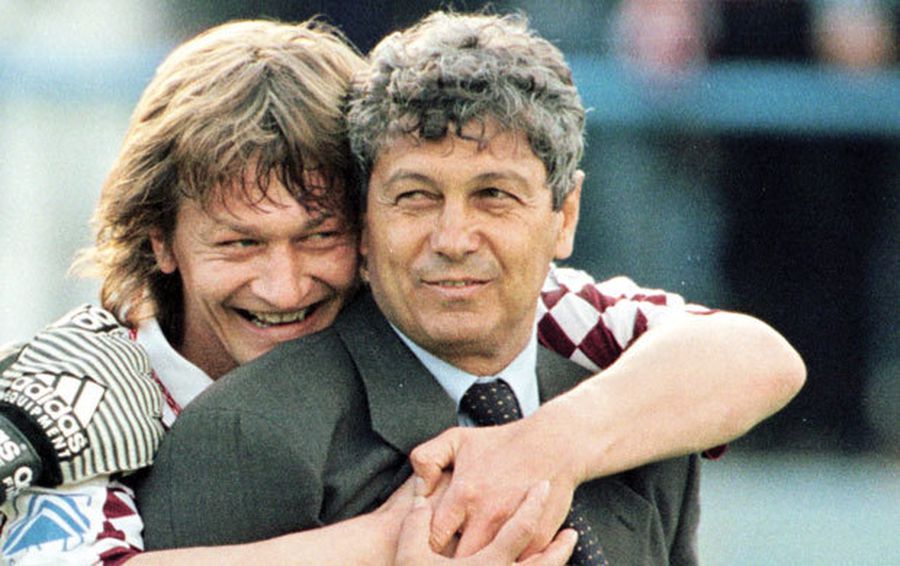
Collection image from the Rapid period with Dănuț Lupu and Mircea Lucescu
– Do we qualify for the World Championship in 2026? Can Mircea Lucescu still be a great coach at the age of eighty?
– I like to give people credit, so if he says he can, he means he can.
– Which Romanian and foreign athletes have you admired over time? And why?
– All the problematic ones: from Maradona to Zlatan Ibrahimovic and Mutu, who left their sins and failures on the surface, without trying to pose as saints. Plus Roberto Baggio, for the distinction, but especially for that missed penalty in the '94 World Cup final.
– How can we bring sport and literature closer? In the old days, many writers and literary critics (from Fănuș Neagu and Adrian Păunescu to Eugen Barbu and from Radu Cosașu to Nicolae Manolescu) also wrote sports chronicles. Can we revitalize this tradition?
– I know many writers of our age (you yourself, dear Andrei, are an example) who comment with aplomb, in private discussions, on the phenomenon and who could become columnists in a sports publication tomorrow.
Yesterday, my friend Dan Popescu, a man from the arts, but with deep roots in philosophical speculation, gave me a spectacular x-ray in play of the reasons why football remains an unrivaled sport. From sociological arguments to biomechanical situations, it was all there in his plea. Remaining bouche bée, I only said to him: “Write these things, please!”. I repeat, here, now, in full view of the world.
– What position did you perform at the neighborhood girls? And why didn't you make a career as a player, what did you miss? Were you sloppy and miserable like Anelka or what was the matter?
– From a moment on, I preferred school. And I let myself be seduced by literature. Otherwise, I was an attacking midfielder with good dribbling, speed and an inexplicable to this day pleasure in providing the decisive pass. I am proud, however, that, seeing me play, in the spare moments of a colloquium, in Alba Iulia, Mihai Vieru included me in one of his poems. I didn't make it as a footballer, but as a muse I did my duty…
– And instead of closing, my favorite question: How do you play chess?
– I don't really play, to be honest, but I don't mind giving others the impression that I'm a master.